
Badminton Betting Tips — How Value Bets Actually Work
 Available in US
Betting on badminton looks simple from the outside — pick a name, pick a price, click. The mechanics behind that click are the same as on football or tennis: a margin the bookmaker builds into every price, a market structure that turns three or more outcomes into a single balance sheet, and a set of offer conditions that look generous until the small print is read. This page works through those mechanics, in the language British punters already use, so a wager on a Thomas Cup tie, a BWF World Championships match, or an Olympic final can be sized against what it actually returns and what it costs to clear. The aim is not to predict winners. It is to make the price the reader sees do what a price should do — show the bet’s edge, the bet’s risk, and the gap between the two.

*Verified against the UK Gambling Commission’s public register as of 30 October 2026.*
How Badminton Betting Offers Are Built
The marketing word and what sits behind it
Every bookmaker offer is built from the same kit of parts — a headline number, a stake condition, a turnover rule, a deadline and a list of markets that do and do not qualify. The headline number is the part that gets shown; the rest is what the offer actually is. A “100% bonus” sounds like a doubling of the deposit, but the deposit itself is still yours and the bonus has to be turned into withdrawable cash by working through a wagering requirement. A “free bet” sounds like a free entry to a market, but the stake is usually not returned with a winning free bet — only the profit lands. A “boosted odds” offer sounds like a higher discount on the same selection, but the boost is paid as a free bet or capped at a low stake, and the underlying price has already been shaved by the margin. The bookmaker’s job is to put a friendly word on a working product; the bettor’s job is to read the product beneath the word.
The first offer to read carefully is the welcome package. UK bookmakers running on a remote general betting licence will offer some form of deposit match or bet-and-get, but every one of them sits inside the same Commission framework. Wagering requirements on bonuses are capped at 10x — a £10 bonus cannot ask for more than £100 of qualifying bets before it releases. Mixed-product promotions (offers that require the customer to bet on more than one product type, for example “bet on badminton to claim free casino spins”) have been banned since 19 January 2026. Beyond those two rules, the shape of the offer is up to the operator.
What the conditions cost
Three conditions do most of the damage to the headline number: the wagering multiple, the minimum price, and the deadline.
The wagering multiple tells the reader how much they need to bet before the bonus becomes withdrawable. At 10x on a £10 bonus, that is £100 of qualifying stakes. Each stake has to be at or above the minimum price the offer names — usually 1.50 (1/2) in decimal, sometimes 1.80, sometimes a specific market. A stake on a 1.30 shot counts toward the turnover figure but does not clear the bonus if the offer specifies 1.50 or higher, and the bettor learns that only by reading the small print or by losing the bonus to a technicality.
The minimum price affects the value of every qualifying bet. A bookmaker’s margin on a 1X2 badminton match sits around 5-7% in the main markets (more on the calculation further down); at decimal odds of 1.50 the implied probability is 66.7% and the margin eats roughly a tenth of that. A punter working through £100 of turnover at 1.50 prices is paying the margin on each bet, and the average loss to the margin is the simplest way to read the bonus’s true cost.
The deadline is the cheapest clause to read and the easiest to breach. A seven-day free bet that expires before the weekend’s BWF Super Series event has been played is a free bet the reader never used. A 30-day bonus window that closes during a holiday is a bonus the reader pays for without clearing. Time pressure is part of the design.
How to read a free bet the right way
A free bet whose stake is not returned pays only the profit when it wins. A £10 free bet at decimal odds of 3.00 wins £20 of profit and pockets nothing back of the £10 stake itself; a £10 stake bet at the same price would have returned £30. The free bet is worth £10 multiplied by (3.00 minus 1) divided by 3.00, which is £6.67 of expected value at a perfectly fair market. The bookmaker pays for that gap by setting the minimum price slightly above where the customer would naturally bet, or by capping the stake, or both. Free bets are useful. They are not the same as cash.

A free bet whose stake IS returned — sometimes advertised as a “refund” or “cash” free bet — pays the full return on a win. These are rarer on GB-licensed sites than the standard free bet, because the operator is funding a real liability. Where one is offered, it usually carries a much smaller stake cap and a tighter market list.
Boosted odds and best-odds-guaranteed
A price boost is a temporary uplift on a single selection: Viktor Axelsen at 2.50 instead of 2.20 for the All England final, for example. The boost is usually paid as a free bet or capped at a low stake (£5 to £20) so the bookmaker’s exposure on any single uplift stays bounded. A boost on a market the operator has also shaved with a higher margin is doing two things at once — making one price look generous while quietly making the surrounding prices less generous.
Best Odds Guaranteed (BOG) is the racing-side cousin and does not apply to badminton. Where it does apply (UK and Irish horse racing), the rule is simple: take a price early, and if the starting price is bigger, the bookmaker pays the bigger price. BOG appears in several of the operator write-ups below because the brands behind them run horse racing alongside badminton and the term travels with them.
Live Betting and Cash Out on Badminton
What live betting changes
A badminton match is short. Men’s singles at the top of the BWF Super Series typically finish in forty to sixty minutes; women’s singles are quicker; doubles can be over inside half an hour. Live betting fits the rhythm — markets update after every rally, after every service break, after every medical timeout. The volatility is what makes live badminton interesting and what makes it expensive. Prices swing faster than in tennis or football because the sample is smaller; a three-point burst by the underdog moves the match-implied probability meaningfully.
A bettor working live markets needs the same margin awareness as on the prematch board. Live margins are typically wider than prematch margins because the bookmaker is pricing into uncertainty — the next rally is unknown, so the safe response is to widen the overround. A bettor who is willing to back the underdog mid-game because momentum has shifted is paying the live margin on top of the price correction, and the price they see already reflects both.
Cash out as a closing tool
Cash out lets the bookmaker buy the bet back mid-event at a price it sets, rather than letting the bet run to settlement. The cash-out price is built from the current live odds and a margin on top, so the bookmaker takes a slice whether the punter cashes out or holds. On a badminton match the cash-out window is short — the bet is open only between rallies in practice, and the price is recalculated frequently.
Used as a stop-loss, cash out is a way of locking in a smaller win (or a smaller loss) when the match has turned against the original read. Used as a profit-taker, it lets a punter bank the green rather than wait for a final rally that may not go their way. The cost is the margin baked into the cash-out price; the benefit is certainty.
The mechanics of in-play
Most GB-licensed bookmakers stream badminton through the same feed partners and display the same in-play markets: match winner, next game winner, total points in the next game, handicap lines set on the current score. Some carry a point-by-point feed during major tournaments; most show only game-level updates. The in-play product on a Super Series event at a major operator is richer than the same product on a BWF International Challenge tie — the bigger the event, the more markets the bookmaker staffs.
Predictions, Tips, and Why the Word Is Misleading
What a tip is
A tip — a “prediction”, a “pick”, a “forecaster’s selection” — is one person’s view on the outcome of a match. It is built from form (recent results, head-to-head, the run of tournaments the player has played), from conditions (the venue, the altitude, the shuttle batch, the surface), from line-up news (injuries, withdrawals, last-minute switches), and from the bookmaker’s own prices (a price that moves tells its own story about where the money is going). A tip that names a winner and a price is one opinion dressed in numbers.
This page does not carry tips, and no tip is a guarantee. A tipster who hits 55% at average odds of 1.90 is breaking even before the margin; a tipster at 60% is making a small profit; a tipster at 70% is fictional. The honest framing is that a tip is one input to a betting decision, and the betting decision is the bettor’s own.
What a value bet is
A value bet is a bet whose price is higher than the true probability of the outcome implies. If Kento Momota has a 60% chance of beating his first-round opponent and the bookmaker is offering 1.80 (implied probability 55.6%), the bet has positive expected value: the reader is paying less than the true probability. If the same match is priced at 1.50 (implied 66.7%), the bet has negative expected value: the reader is paying more.
The skill is in computing the true probability. It comes from the form, the conditions and the line-ups mentioned above, and it comes with error. A bettor who thinks Momota is at 65% when the true probability is 55% has mispriced the bet, and the bet loses over the long run even though it “felt right”. The discipline is to back only the prices where the reader’s probability estimate sits above the market’s implied probability by a margin large enough to absorb the reader’s error.
Bankroll and staking
Bankroll discipline is the dull side of betting and the side that decides who survives a bad run. The simplest rule is to stake a fixed percentage of bankroll (1% to 5%) on each bet, so a losing streak of ten bets at 2% erodes 20% of bankroll rather than 50%. The next simplest is to stake a fixed unit (£5, £10, £20) and reset the unit when bankroll moves meaningfully up or down.
The bookmaker cares about staking because it limits winners. A punter who has been beating badminton markets for six months will find maximum stakes trimmed, prices nudged, and in some cases the account closed. The Commission framework sets rules around treatment of customers, and the operator’s terms say how and when a stake limit may change, but the practice is real and the bettor should expect it.
Why no tip is certain
The closing line is the last price the bookmaker offers before the match starts. The closing line is, on average, the most accurate probability estimate available — it has absorbed the most information, the most money, and the longest settling of opinion. A bettor who consistently beats the closing line is making a profit in expectation; a bettor who loses to the closing line is paying the margin for the privilege of betting. No tip beats the closing line forever, because if a tipster’s edge were permanent, the bookmaker would stop pricing in that tipster’s direction and the edge would vanish. Edges decay; books adapt.
Bet Types and How Odds Settle
Decimal odds and fractional odds
British bookmakers quote fractional odds by default — 5/1, 11/4, evens — and switch to decimal form on request. The two systems carry the same information. Fractional odds of 5/1 mean a £1 stake returns £5 of profit plus the £1 stake, for a total return of £6. Decimal odds of 6.00 carry the same return: a £1 stake returns £6 total. The conversion is a divided by b plus 1, so 5/1 becomes 5 divided by 1 plus 1, which is 6.00.
Decimal odds are easier to read because the return includes the stake. A £10 stake at decimal odds of 3.75 returns £37.50. Profit is £27.50. A £10 stake at fractional odds of 11/4 returns £37.50 on the same bet. The two number systems agree; the question is which one the reader prefers to read at speed.
Singles, doubles, trebles, accumulators
A single bet is one selection. A double is two selections, both of which must win for the bet to pay. A treble is three; an accumulator (“acca”) is four or more. The odds of a combination bet multiply: a double at 2.00 and 3.00 pays 6.00. A fourfold at 2.00, 3.00, 4.00 and 1.50 pays 36.00. The payout is large because the probability is small — four independent 50% chances compound to 6.25%.
Combination bets on badminton are best treated as a small-stake lottery. The 10x bonus wagering cap applies to bonuses, not to accas, but the same maths cuts the other way: an acca on badminton is paying margin four times, once per leg, and the compound margin can reach 20% or more on a heavily priced bet. A punter who fancies an acca should know the compound margin before they click.
Each-way bets
Each-way bets are two bets of equal stake: one on the win, one on the place. The place terms are set by the bookmaker and depend on the number of runners in a tournament — most BWF events have sixteen or thirty-two in the main draw, so each-way terms of 1/2 odds on the semi-finals are common. An each-way bet on Kento Momota at 5/1 in a sixteen-player field at 1/2 terms pays 5/1 if he wins and pays 2.5/1 (5/1 × 1/2, with rounding) if he reaches the semi-final.
Each-way on badminton is unusual but not unknown. The deeper the draw and the more even the field, the more sense each-way makes; the shallower the draw, the more it is just doubling the stake on the favourite.
Match winner, handicap, total points
The most common badminton markets are match winner, game winner, handicap (set with a plus or minus game handicap to balance a mismatched tie), and total points (over/under on the total points scored in a match or a single game). A BWF Super Series match between a top-eight seed and a qualifier might be priced at 1.15 / 5.50 on the moneyline, with a -1.5 game handicap on the favourite at around 1.80.
Handicap and total-points markets tend to carry a tighter margin than the match winner market because the lines are easier to balance. A bettor who wants the cheapest price per unit of probability should look at the handicap board before the match-winner board.
Bet builders and same-game multis
A bet builder is the bookmaker’s own combination bet on a single match: match winner, total games, handicap and a points line from the same event, all priced into one ticket. The bet builder is convenient and usually overpriced; the bookmaker is charging a margin on the combined legs rather than offering the legs separately, and the compound margin is the bettor’s cost. Where the legs are available as singles, singles are cheaper.
Badminton as a Sport and as a Betting Market
The governing body and the season
The Badminton World Federation (BWF) governs international badminton. It was founded in 1934 as the International Badminton Federation and renamed itself in 1978. The BWF runs the BWF World Tour (the top tier of the international circuit), the BWF World Championships (held since 1977, every year except an Olympic year), the Thomas Cup (men’s team, every two years since 1949) and the Uber Cup (women’s team, every two years since 1957), and the Sudirman Cup (mixed team, every two years since 1989). The All England Open, first held in 1900, is the oldest and one of the most prestigious tournaments in the sport.
Badminton has been an official Olympic sport since 1992 at Barcelona, with mixed doubles added at Atlanta in 1996. The five Olympic disciplines are men’s singles, women’s singles, men’s doubles, women’s doubles and mixed doubles. The BWF World Tour runs through the year, with the All England, the Indonesia Open, the Malaysia Open, the Denmark Open and the China Open as the headline events outside the majors.
Scoring and structure
A badminton game is played to 21 points with rally point scoring — every rally produces a point, no separate service points. At 20–20 play continues until one side leads by two clear; at 29–29 the next point wins. A men’s singles match is the best of three games; a women’s singles match is the same; doubles follows the same format. A typical men’s singles match at the top of the BWF World Tour runs forty-five to seventy minutes, with longer matches at Grand Slam and World Championship level.
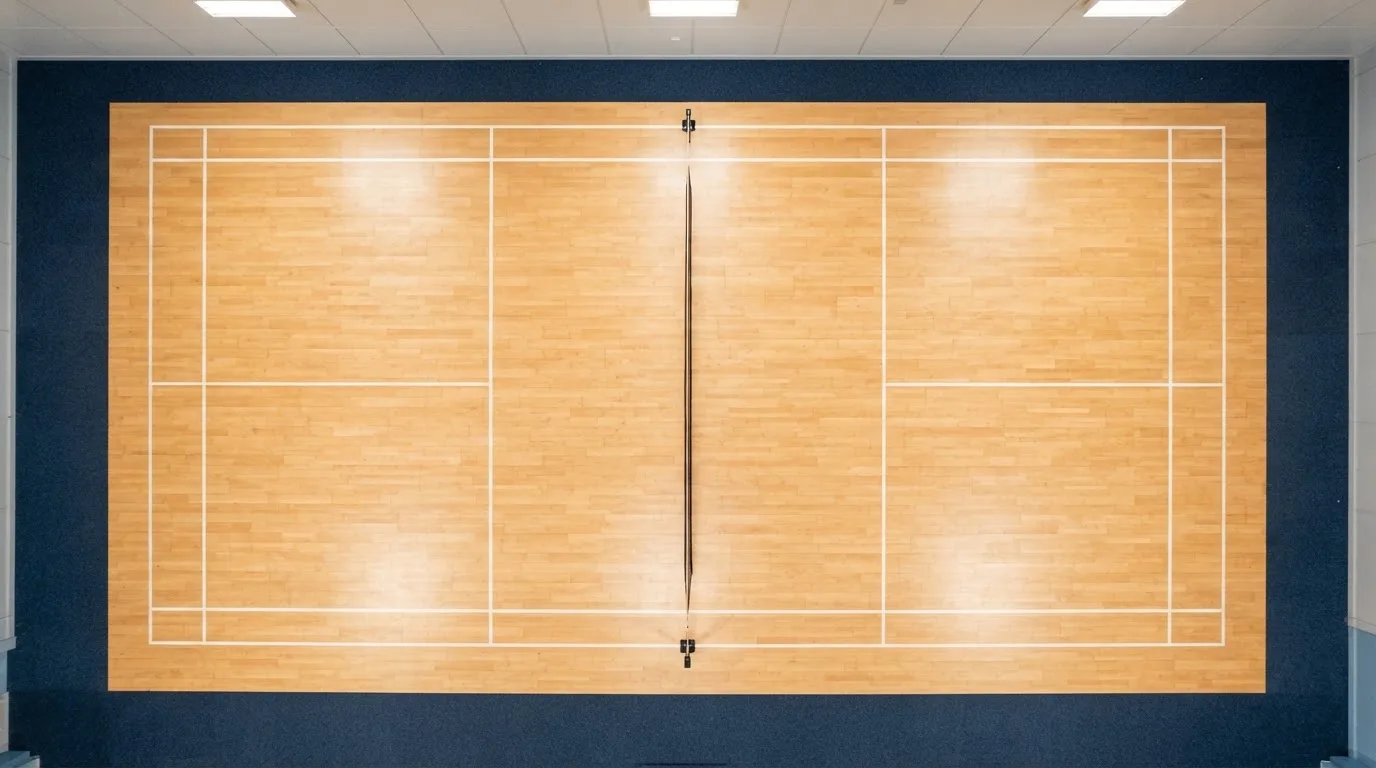
The court is 13.4 metres long, 6.1 metres wide for doubles and 5.18 metres wide for singles. The net stands 1.55 metres high at the edges and 1.524 metres at the centre — a small dip, but it shapes how the shuttle carries across the middle of the court.
The five disciplines
The five Olympic disciplines are men’s singles, women’s singles, men’s doubles, women’s doubles and mixed doubles. Singles markets are the most heavily priced on the BWF World Tour; doubles markets are sparser and tend to settle faster; mixed doubles sits in between and is the most volatile because the pair chemistry varies widely between tournaments. A bettor working the BWF World Tour should know which discipline carries the most depth and the most accurate pricing.
The Olympic cycle
Badminton at the 2024 Paris Olympics followed the standard five-discipline format; the 2028 Los Angeles cycle is the next chance to bet badminton at the Olympic level. The Olympic field is small (around thirty-eight players per singles discipline), the seeding is tight and the favourites are well-known; margins on Olympic badminton are tighter than margins on the BWF World Tour because the field is well studied. In-play markets on Olympic matches are richer than at any other tournament.
How the Bookmakers Compare
What the table covers
The comparison below sets the ten featured operators against four matters: the brand, the Gambling Commission remote licence number and licence holder, and what the operator’s own terms state on the matters that matter to a badminton punter — best odds guaranteed on racing, accumulators and acca insurance, cash out on badminton, bet builder availability, in-play markets and welcome offer mechanics. The licence line is the test of whether the brand serves customers in Great Britain under the Gambling Act 2005 as amended in 2014. Several brands can run under one licensee; Ladbrokes and Coral share LC International, for example, and Paddy Power and Betfair share Flutter. None of the brands below is “the only” licensed bookmaker: the Commission’s register lists more operators than any shortlist can carry.
The comparison
| Brand | Gambling Commission remote licence | What the operator’s own terms state on badminton betting |
|---|---|---|
| Ladbrokes | Remote licence 54743, account 054743-R-330863-014, holder LC International Limited | Acca Boosts on multiples, odds boosts on horse and greyhound racing, Best Odds Guaranteed on UK and Irish racing, in-play markets and cash out on badminton and other sports |
| Copybet | Remote licence 53774, account 053774-R-330743-010, holder Copybet UK Limited | Best Odds Guaranteed all day every day on UK and Irish racing, first-past-the-post payout on racing even if the winner is later disqualified |
| BoyleSports | Remote licence 39469, account 039469-R-319383-025, holder Boylesports Enterprise | Acca Insurance on losing accas — opt-in, £5 minimum stake, 1/2 (1.50) minimum odds, £20 maximum refund as a free bet expiring in 7 days, settled on the day of placement |
| BetTom | Remote licence 64959, account 064959-R-339314-003, holder Bet Tom Limited | Sports welcome offer of 50% back as a free bet up to £50 plus a matching 50% back as free slot funds up to £50 for casino |
| Tote | Remote licence 54779, account 054779-R-331321-008, holder TDCO Limited | Pool-betting operator offering Best Odds Guaranteed on UK and Irish horse racing from 8 AM on race day, single and multiple bets, no ante-post, tote or pari-mutuel coverage |
| Swifty Sports | Remote licence 58957, account 058957-R-334734-006, holder Swifty Global (UK) Ltd | Cash Out on horse racing and football, daily price boosts, live streaming, in-play betting, Bet Builder listed as coming soon |
| Fitzdares | Remote licence 400, account 000400-R-103839-030, holder Fitzdares Limited | Cash out, accumulators, Lucky 15s, specials and antepost markets across horse racing, football, tennis, rugby, cricket, golf and American football with in-play live odds |
| Betmaster | Remote licence 65699, account 065699-R-339929-002, holder BM Solutions GB Ltd | GB-licensed operator running under BM Solutions GB Ltd registered in Malta, gambling markets across the major disciplines |
| Bet600 | Remote licence 44731, account 044731-R-323941-016, holder Tyche Tech Limited | Best Odds Guaranteed on horse racing — starting price paid if bigger than the early or show price taken |
| bet365 | Remote licence 55148, account 055148-R-331498-002, holder Hillside (UK Sports) ENC | In-play betting and live streaming of events worldwide, Bet Track, Match Live and a Live Golf Tracker for following bets in play |
What the comparison does not say
The table does not rank the ten brands. The table does not name the brand with the highest in-play margin or the widest badminton coverage, because badminton market depth varies by event and the depth for the 2026 BWF World Tour will differ from the depth for a BWF International Challenge. The table does not print a welcome bonus headline, because the headline is the part of the offer that does the least work — the conditions carry the offer, and the conditions change frequently. The reader who wants the headline can find it on the operator’s own site, where it is set out clearly and updated regularly.
Badminton Betting in Great Britain: The Legal Frame
What a Great Britain licence means
A bookmaker serving customers in Great Britain needs a Gambling Commission remote operating licence wherever the operator is based. The rule sits in the Gambling (Licensing and Advertising) Act 2014, which amended sections 33 and 36 of the Gambling Act 2005 to bring remote betting within the Commission’s remit at the point of consumption. A Curaçao, Maltese or Gibraltar licence is not a substitute. The Commission’s register can be searched by business name, trading name, domain or account number; it is the whole test of who holds a licence in Great Britain. Northern Ireland sits outside the Gambling Act 2005, so a GB licence regulates only England, Scotland and Wales.
The Commission’s role is licensing, compliance and enforcement. It does not license advertising — that runs through the CAP Code (non-broadcast) and the BCAP Code (broadcast), enforced by the ASA, alongside the Commission’s marketing conditions in the LCCP. CAP Code section 16: marketing must be socially responsible, must not be of strong appeal to under-18s, and no one who is or seems to be under 25 may appear gambling or play a significant role (the rule concerns who may appear in an advertisement, not who may bet). Promotion rules in force since 19 January 2026 cap bonus wagering requirements at 10x and ban mixed-product promotions; whether the cap covers a free bet with no wagering condition is not established.
Identity verification and the first bet
Since 7 May 2019, name, address and date of birth have been verified before a customer can deposit or gamble at a GB-licensed site, including with a free bet or bonus. Verification is the customer-protection baseline; the same framework that protects the customer from bonus abuse also means there is no “no verification” betting at a licensed site. A punter who wants to bet anonymously has to leave the licensed market — and in leaving it, leaves the protections that go with it.
A financial vulnerability check (LCCP condition 3.4.4, in force since 30 August 2024) applies to licensed remote betting when a customer’s deposits minus withdrawals exceed £150 in a rolling 30-day period (the threshold has applied since 28 February 2025). The check is a public-record check (bankruptcy, county court judgments), not an income check and not a credit reference check. Financial risk assessments — the affordability checks of the press coverage — have been announced in a staged plan, with no start date. Deposit limits (RTS 12) require operators to offer a gross deposit limit on a fixed time frame; the first changes applied since 31 October 2025, a second phase was postponed to 30 September 2026, and whether the second phase is live is not established.
What the player does not pay
The player pays no tax on betting winnings in Great Britain. General Betting Duty is the operator’s tax on gross profits, currently 15%; from 1 April 2027 a new remote betting rate of 25% will apply within it, while remote bets on UK horse racing, self-service betting terminal bets, pool betting and in-person betting remain at 15%. Spread betting carries its own rates (3% financial, 10% other). Until 1 April 2027 the remote rate stays at 15%; whether operators pass duty on through the prices they offer is not established, and the customer is never charged duty directly.
Offshore operators and what is lost
A customer who bets on an unlicensed site from Great Britain is not, on the wording of the Gambling Act 2005 as it has been published, committing an offence. The operator is. The customer loses: GAMSTOP coverage, the Commission complaints route, an approved dispute-resolution body, British consumer redress if funds are withheld, the 10x bonus cap, and the £150 vulnerability check. Offshore sites are not bound by the LCCP and do not offer British-named-account protection; the customer takes the operator at its word. Enforcement against unlicensed operators runs through cease-and-desist notices, search-engine referrals, registrar and payment-provider work, and (announced) court-order DNS blocking — ISP blocking is not in operation as of the date on this page.
Responsible Gambling and What the Licensed Bookmakers Offer
Safer-gambling tools
A GB-licensed remote operator must offer a baseline of safer-gambling tools: deposit limits, time-outs, product restrictions, self-exclusion through GAMSTOP, and links to GamCare (the National Gambling Helpline), GambleAware, the NHS gambling clinics and Gamblers Anonymous. The exact set of tools and the exact wording vary by brand; the obligation does not. Several of the operators in the comparison above state their safer-gambling product on their own sites — Unibet (not in the top ten above but representative of the licensed market as a whole), for example, lists deposit limits, a Player Profile test, product restrictions and self-exclusion alongside live chat support and links to the support bodies.
GAMSTOP is the national multi-operator online self-exclusion scheme and a mandatory licence condition for online operators since 31 March 2020. Exclusion periods are six months, one year, five years, or five years with auto-renewal; after the minimum period the exclusion stays in place for a further seven years unless the customer asks GAMSTOP to remove it. GAMSTOP covers online sites and apps; betting shops run a separate scheme.
When to ask for help
The signals that need a response are the same in badminton betting as anywhere else: chasing losses, betting money earmarked for something else, betting under stress, hiding bets from family or partners, lying about the size of stakes, escalating stake size to chase the same feeling. GamCare’s National Gambling Helpline is open 24 hours a day. The NHS runs gambling clinics in several regions. The bettor who recognises the signals in themselves has already done the hardest part.
The bookmaker’s deposit limits are the cheapest tool and the easiest to set. A daily, weekly or monthly deposit ceiling that the customer sets themselves and the operator enforces is the single most effective intervention; everything else is layered on top. The licensed bookmakers have to offer the tool; the bettor has to use it.
Featured Operators in Detail
Ladbrokes
Ladbrokes sits on a remote general betting licence held by LC International Limited, the same licensee that runs Coral. The brand offers odds boosts on horse and greyhound racing, Best Odds Guaranteed on UK and Irish racing, acca boosts on multiples, in-play markets across the major sports and cash out on badminton and other disciplines. The product is built around horse racing, but the in-play book on badminton is staffed at major events. A badminton punter looking for a wide in-play offering and acca insurance on multiples will find what they need; a badminton punter looking for the tightest margins on the main 1X2 lines will want to compare prices elsewhere first. The brand is worth it for the punter who wants a one-account book that covers racing, football and the smaller sports under one login.
Copybet
Copybet is a smaller brand running under Copybet UK Limited and offering Best Odds Guaranteed on UK and Irish racing all day every day, with first-past-the-post payout on racing even when the winner is later disqualified. The product is racing-led. Badminton is offered at the major events but the in-play book is thinner than at the larger brands. A badminton punter who bets racing as well as badminton and wants a smaller, simpler product is the reader Copybet suits; a badminton-only punter will find the in-play offering thin.
BoyleSports
BoyleSports runs under Boylesports Enterprise and offers an acca insurance product with the small print spelled out clearly: opt-in required, minimum stake of £5, minimum odds of 1/2 (1.50), maximum refund of £20 paid as a free bet expiring in seven days, and bets must be placed and settled on the same day. The acca insurance is the headline. Badminton markets are offered at the major BWF events with standard in-play coverage. A badminton punter who bets accas and wants a defined insurance product is the reader BoyleSports suits; a badminton punter who bets singles is paying for a product they will not use.
BetTom
BetTom runs under Bet Tom Limited with a sports welcome offer that returns 50% as a free bet up to £50 and a matching 50% as free slot funds up to £50 for casino. The split between sport and casino is a mixed-product promotion — and mixed-product promotions have been banned at GB-licensed operators since 19 January 2026. The reader should check whether BetTom’s current offer has been restructured to comply, and whether the £50 free-bet component alone is the offer on the table. The badminton product sits inside a multi-product site; the in-play offering on badminton is standard for the size of the brand.
Tote
Tote runs under TDCO Limited and is a pool-betting operator at heart. The Best Odds Guaranteed on UK and Irish horse racing from 8 AM on race day, single and multiple bets, with ante-post, tote and pari-mutuel bets excluded, is the racing offer. Badminton is offered at major events but the in-play book is not the operator’s centre of gravity. A punder whose main value is pool betting on racing with badminton as a sideline is the reader Tote suits; a punder whose main value is badminton betting will find the operator racing-shaped.
Swifty Sports
Swifty Sports runs under Swifty Global (UK) Ltd with cash out on horse racing and football, daily price boosts, live streaming, in-play betting and a Bet Builder listed as coming soon. The product is in build. A punder who wants a smaller brand with a live-streaming commitment and a bet builder on the roadmap is the reader Swifty Sports suits; a punder who needs a mature bet builder today should look elsewhere. Badminton markets are offered but the product is still establishing.
Fitzdares
Fitzdares runs under Fitzdares Limited and offers cash out, accumulators, Lucky 15s, specials and antepost markets across horse racing, football, tennis, rugby, cricket, golf and American football, with in-play live odds. Badminton is not listed in the headline product but is offered at major BWF events. The brand is positioned as a premium bookmaker with a smaller customer base and a higher-touch service. A punder who wants a smaller house with a personalised service and is happy to use the operator’s account team for niche markets is the reader Fitzdares suits.
Betmaster
Betmaster runs under BM Solutions GB Ltd, registered in Malta, with Gambling Commission account number 65699. The product is a standard GB-licensed remote betting book. Badminton is offered at the major BWF events with in-play markets; the price depth on the smaller BWF International events is thinner than at the larger brands. A punder who wants a GB-licensed brand with a complete product is the reader Betmaster suits; a punder who needs the deepest badminton book on the BWF World Tour should look at the larger brands first.
Bet600
Bet600 runs under Tyche Tech Limited and pays Best Odds Guaranteed on horse racing: if the starting price is bigger than the early or show price taken, the bet is paid at the bigger starting price. The product is racing-shaped. Badminton is offered at major events but the in-play book is not the brand’s strength. A punder who bets racing heavily with badminton as a sideline and wants a smaller brand with a clean BOG offer is the reader Bet600 suits.
bet365
bet365 runs under Hillside (UK Sports) ENC and offers in-play betting and live streaming of events worldwide, plus Bet Track, Match Live and a Live Golf Tracker for following bets in play. The in-play book is the deepest in the GB-licensed market and the live-streaming catalogue covers the BWF World Tour at the larger events. Badminton margins on the main 1X2 lines are competitive but not the cheapest; the depth of markets on each tie — match winner, game winner, handicap, total points, next game winner — is wider than at most competitors. A badminton punter who values in-play depth, live streaming and a wide market list is the reader bet365 suits; a badminton punter who buys purely on margin will want to compare prices.
The Bookmaker Margin and How It Shows Up in the Odds
A worked illustration
The margin is the slice of every pound bet that the bookmaker keeps on average. It is the same number, viewed from two sides, as the “payout share” or “return to player” — a market with a margin of 5% pays back 95% of every unit bet across all outcomes, in the long run. The margin is built into every price: a fair two-way market at 50/50 true probability would price each side at 2.00, but a real badminton match-winner market prices each side at 1.90.
Take a two-way market at decimal odds of 1.90 and 1.90 — a balanced tie the bookmaker has priced at 1.90 on each side. The payout share is one divided by the sum of one over each odds, which is one divided by (1/1.90 + 1/1.90) = one divided by (0.5263 + 0.5263) = one divided by 1.0526 = 95.00%. The margin is 1 minus the payout share, which is 5.00%. On every £100 staked across both outcomes in this market, the bookmaker keeps £5 on average and returns £95.
The arithmetic generalises. A three-way market (for example a betting exchange with back and lay at three different prices, or a tournament outright with three leading contenders) adds the implied probabilities; if they sum to 1.10, the margin is 10%. A heavily juiced book is what the operator sells; the bettor’s edge is whatever they can find between the true probability and the implied probability.
Why the margin is the price
The margin is the cost of admission. A bettor who places a single £10 bet at decimal odds of 1.90 on a 50/50 outcome has a fair expectation of winning £9.50 (50% × £19 return) and losing £10 (50% × £10 stake), for a net expected value of negative 50p. The 50p is the margin. Over a season of 100 bets at the same margin, the bettor pays £50 of expected loss to the bookmaker; over 1,000 bets, £500.
A bettor who can price matches better than the bookmaker — who can identify the matches where the true probability is 60% and the bookmaker’s price implies 50% — pays the same 5% margin but wins enough of those bets at the better price to come out ahead. The edge is the gap between the bettor’s probability estimate and the market’s implied probability. The margin is the floor.
Reading the overround
The overround is the sum of the implied probabilities across all outcomes, minus 100%. On a two-way market at 1.90 and 1.90, the implied probabilities are 52.63% each, summing to 105.26%, and the overround is 5.26%. (The overround and the margin are very close but not identical: the overround uses the simple sum of probabilities, the margin uses the payout-share formula. On a balanced two-way market they coincide; on a heavily skewed market they diverge slightly.)
A bettor comparing two bookmakers on the same match looks at the overround on each. The bookmaker with the lower overround is charging the smaller margin on the same match; over a season of bets at the lower overround, the bettor keeps more of every pound.
Where the margin is widest
Margins on badminton are tightest in the men’s singles main-draw matches at the BWF World Tour and the major championships, where the bookmakers have priced thousands of matches and the closing line is well-studied. Margins are widest on the smaller BWF International Challenge and International Series events, where the bookmakers have priced fewer matches and the uncertainty is higher. Margins on live markets are wider than margins on prematch markets, because the bookmaker is pricing into unknown next-rally territory. Margins on outright tournament winner markets are wider than margins on individual matches, because the field is large and the early prices have to absorb more uncertainty.
The bettor who wants the cheapest price looks at the men’s singles main draw, places pre-match rather than in-play, and bets match winner rather than outright. The bettor who wants the cheapest exposure to a specific player bets the outright with a stake sized to the longer odds.
Frequently Asked Questions
How is a bet on badminton placed?
A bet on badminton is placed at a GB-licensed bookmaker by selecting a market (match winner, handicap, total points, set winner or one of the in-play markets once the match has started), choosing a price from the board, entering a stake and confirming the bet. The bookmaker records the bet, displays it on the bet slip and settles it once the match ends. The stake is deducted from the account at placement and returned with profit on a winning bet, or lost on a losing one.
What is a value bet and why is no tip ever certain?
A value bet is a bet whose price is higher than the true probability of the outcome implies. If the bettor’s probability estimate for a player is 60% and the bookmaker’s price implies 50%, the bet has positive expected value. No tip is ever certain because probability is uncertainty about a future event; a tip is one person’s probability estimate, and a tipster’s track record is the only evidence the estimate is more accurate than the market’s. Beating the closing line over hundreds of bets is the only honest test of skill.
What is the bookmaker’s margin and how can it be seen in the odds?
The margin is the slice of every pound bet that the bookmaker keeps on average. It is built into every price and shows up as the gap between the implied probabilities across all outcomes and 100%. On a two-way market at 1.90 and 1.90, the implied probabilities are 52.63% each, summing to 105.26%; the overround is 5.26% and the margin is 5%. The lower the margin on a given market, the cheaper the bet is for the punter.
How is the return on a bet worked out from the stake and the odds?
Decimal odds carry the full return, including the stake. A £10 stake at decimal odds of 3.75 returns £37.50; profit is £27.50. The formula is return = stake × odds, and net profit = stake × (odds − 1). On a combination bet the odds of each leg multiply: a double at 2.00 and 3.00 is priced at 6.00, and a £10 stake returns £60.
How can it be checked that a bookmaker holds a Gambling Commission licence?
The Gambling Commission’s public register can be searched by business name, trading name, domain or licence account number, and lists every operating licence the Commission has issued. A bookmaker serving customers in Great Britain must hold a remote operating licence; the register entry is the test of whether it does. Several brands can share one licence (Ladbrokes and Coral both sit under LC International Limited, for example), and a .com or .co.uk domain is not itself proof of a licence.
Which tools for controlling play does a licensed bookmaker have to offer?
A licensed remote bookmaker must offer deposit limits, time-outs, product restrictions, self-exclusion through GAMSTOP and links to the help services (GamCare, GambleAware, NHS gambling clinics, Gamblers Anonymous). The exact set and wording vary by brand; the obligation does not. The customer can set a daily, weekly or monthly deposit ceiling at any time, and the operator has to enforce it.
Tennis, darts & cue sports – signupbetsguide.com
Content created by the «signupbetsguide.com» team
