
Football Accumulator Bets: A Punter's Guide to Building, Pricing and Staking Accas
 Available in US
An accumulator is a single bet that ties two or more selections together; every leg has to win or the whole stake is lost. The appeal is obvious — a few favourites at short prices, combined into a long price that looks generous — and the cost is less obvious until the betting slip is priced out. This guide is written from the punter’s side of the counter: how an acca is built, how the odds are worked, what the bookmaker’s margin takes out of every line, what the difference is between an accumulator and a full-cover bet like a Trixie or a Heinz, and which of ten Gambling Commission-licensed bookmakers are worth the trouble of opening an account with in Great Britain today.
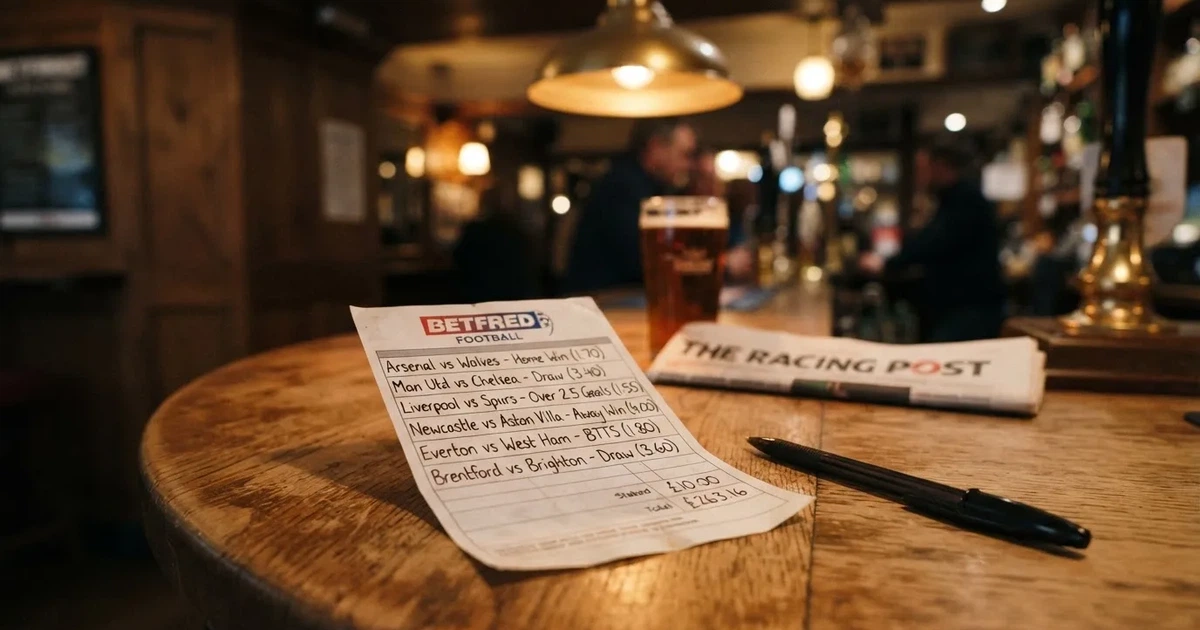
The figures that follow are current as of 30 October 2026 and were verified against the Gambling Commission’s public register of remote operating licences. A snapshot price or margin will not survive the weekend, and a punter who treats one as gospel will pay for it. Where a specific price is given, the snapshot date is in the sentence beside it. Where no date is given, the point is qualitative.
Forecasting Accas: Why Tips Are Not Predictions
Search interest in “football betting tips accumulator” runs ahead of almost everything else in this corner of the market, and that should be a small warning in itself. A tip is somebody’s forecast, dressed up as advice; a prediction is a statement that something will happen. The difference matters, because a punter who follows either one is staking real money on someone else’s guess — and there is no mechanism in UK gambling law that turns a guess into a probability.

The bankroll first, the tip second
The first thing a serious acca punter sets is the bankroll — the sum set aside for this kind of bet, distinct from the rent money and ringfenced against the morning after a bad Saturday. A common rule of thumb among experienced punters is to stake no more than one to two per cent of the bankroll on any single acca, on the grounds that an accumulator is a low-probability bet by construction and a long losing run is what an accumulator does. A punter staking five per cent of the bankroll on a four-fold will be wiped out by the kind of run that the same stake across singles would have ridden out.
The second thing is the price floor. An acca leg priced at 1/10 (1.10 in decimals) adds almost nothing to the combined price and exposes the punter to almost all of the bookmaker’s margin. A price floor of around 1/2 (1.50) on every selection keeps the combined price honest and forces the punter to find selections that the market genuinely rates as competitive. The bookmaker is happy to take 1/10 legs on an acca — the margin is fat and the stake is gone the moment one of them fails, which is most of the time.

The third thing is the format. UK bookmakers quote odds in fractions by convention and accept decimal odds from the punter; a price of 5/1 is the same as 6.00, and an each-way accumulator pays out on both the win and the place portions at the place fraction the operator publishes. A punter who does not know which format they are reading cannot tell what they are being offered, and that is by design at the cheaper end of the market.
Why forecasting services are paid by punters, not by results
Tipsters sell subscriptions. The serious ones publish a verified record; the unserious ones publish a record whose audit is on their own page. A punter who pays for tips is paying for somebody’s view, and the price of that view is set by the tipster, not by the accuracy of the view. If the tipster’s view were reliably better than the market’s, the tipster would be paid by a betting syndicate, not by subscribers. That is the working assumption, and a punter who treats it as cynicism has overpaid for tips more than once.
The honest use of a tip is as a starting point for a punter’s own assessment: does the team news support the forecast, what does the market price imply, does the price still hold once the tip has been added to the betting market and pushed the line. A tip that becomes consensus is a tip that has lost its edge. A punter who reads tips as forecasts has bought somebody else’s research without doing the work; a punter who reads tips as inputs to their own work has bought research at a reasonable price.
Acca Bet Types and How the Odds Multiply
An accumulator and a parlay are the same bet under different names; “acca”, “parlay”, “combo” and “multi” are all the same thing. A treble is an accumulator with three selections, a four-fold has four, and so on. Each leg’s odds are multiplied together to produce the combined price, which is why an accumulator’s price climbs faster than the punter usually expects. Two selections at 2/1 (3.00) each combine to 9.00, not 4.00; three at 2/1 combine to 27.00; four at 2/1 combine to 81.00. The combined price grows as a power of the average leg price, and the implied probability collapses at the same rate.
A worked payout for an accumulator
Take three selections at 1/2 (1.50), evens (2.00) and 6/4 (2.50), and stake £10 on the accumulator. The combined price is 1.50 × 2.00 × 2.50 = 7.50. A winning bet returns £10 × 7.50 = £75, of which £65 is profit. Adding a fourth selection at evens (2.00) multiplies the combined price by 2.00 again, taking it to 15.00 and the return on the same stake to £150. Each leg the punter adds roughly doubles the headline return — and roughly halves the implied probability of the bet winning, because every additional leg is another chance for the whole thing to fail.
The same selections staked as three singles would cost £30 in total stake (£10 × 3) and return varying amounts depending on which selections won; an accumulator with the same stake returns more on an all-win but loses the whole stake if any one leg fails. The trade-off is between variance and expectation: singles are steadier, accumulators are spikier, and the long-run expectation depends on the margin inside the prices rather than on the format.
Trixies, Yankees, Heinz and the full-cover family
A full-cover bet is a package of accumulators and singles built from a fixed set of selections. The bettor picks a number of selections and the bookmaker works out the combinations. The stake is per line, not per selection, and the total stake is the unit stake multiplied by the number of bets in the package. A Trixie covers three selections in four bets: three doubles and a treble. A Yankee covers four selections in eleven bets: six doubles, four trebles and a four-fold accumulator. A Heinz covers six selections in fifty-seven bets. A Super Heinz covers seven selections in one hundred and twenty bets. A Lucky 15 covers four selections in fifteen bets: four singles, six doubles, four trebles and a four-fold.
Full-cover bets give the punter a return even when not every selection wins, because the singles and doubles inside the package pay out on partial success. The cost is the multiplied stake: a £2 Trixie costs £8 in total, a £2 Lucky 15 costs £30, a £2 Super Heinz costs £240. A punter who wants the partial-success protection of a Lucky 15 on a four-fold set of selections is paying thirty times the unit stake for the privilege, and the bookmaker’s margin is applied to every line inside the package.
Push, void and each-way
A selection that ties — a “push” — is removed from an accumulator and the combined price is recalculated on the remaining legs. A void selection — a match that is abandoned before it becomes a completed event, or a player who pulls out before a goalscorer market is settled — is handled under the bookmaker’s own rules, and most UK bookmakers treat voids as pushes for accumulator purposes. The punter should check the bookmaker’s house rules before staking, because the difference between a push and a void is the difference between a recalculated payout and a recalculated stake.
An each-way accumulator is two bets of equal stake: a win portion paid on the win price of each leg, and a place portion paid on the place price of each leg. The total stake doubles. Each-way betting is most common on horse racing but is offered on some football markets — usually outright and top scorer markets, where each-way terms vary by bookmaker and selection. A punter who places an each-way acca on football without reading the place terms has doubled the stake without understanding the place payout.
Cash out, acca insurance and the marketing layer
Cash out lets the punter settle an accumulator before the last leg has been decided, at a price set by the bookmaker. The price reflects the current state of the bet — a five-fold with four winners and the fifth leg leading 2-0 is worth more than the same bet with the fifth leg still 0-0 — and the punter gives up the upside in exchange for locking in a known return. Cash-out availability is not guaranteed, and bookmakers’ own terms say bets stand if cash out is unavailable at the moment the punter wants it. A punter who relies on cash out as a strategy has outsourced the closing decision to the bookmaker’s algorithm, and the price that algorithm offers is set to favour the bookmaker over a large sample of bets.
Acca insurance refunds the stake as a free bet if one leg of an accumulator lets the punter down. The refund is a free bet, not a cash refund, and the free bet is usually subject to its own wagering conditions and a deadline. The marketing word is “insurance”; the arithmetic is a conditional free bet, and the value depends on the price floor on the free bet, the wagering multiple if any, and the proportion of losing accas the punter actually has. A punter who reads “acca insurance” as a guarantee is reading the brochure, not the terms.
The Ten Bookmakers Reviewed
The ten bookmakers below are holders of a Gambling Commission remote operating licence and are listed on the Commission’s public register. The licence number, the licence holder named on the register and a description of what each operator’s own terms say on accumulators appear in the table below; the prose that follows is the page’s own judgement of who the operator suits, written from the punter’s side. The order is the order research gives; a place in the list is not a recommendation.
| Bookmaker | Licence | Licence holder | What the operator’s own terms say on accumulators |
|---|---|---|---|
| Betfred | 039544-R-319290-010 (Commission account 39544) | Petfre (Gibraltar) Limited | Bet Builder is part of the app’s feature set, alongside Extra Places on selected markets |
| Lottoland | 038991-R-319408-020 (Commission account 38991) | EU Lotto Limited | Accumulators on the sportsbook sit alongside the operator’s lottery, casino and scratchcard products |
| Sporting Index | 027343-R-308898-011 (Commission account 27343) | Sporting Index Limited | A £10 fixed-odds bet at minimum odds of 1/2 unlocks fixed-odds free bets and spread-bet free bets on the new-customer offer |
| Swifty Sports | 058957-R-334734-006 (Commission account 58957) | Swifty Global (UK) Ltd | Daily price boosts, in-play betting and live streaming are part of the offering; Bet Builder is listed as coming soon |
| BetMGM | 039198-R-319450-029 (Commission account 39198) | LeoVegas Gaming PLC | A new-customer sports welcome offer pays four £10 free bets — two football accumulators of 4+ selections and two sports multiples of 2+ — after a £10 deposit and a qualifying sports bet within seven days |
| Fafabet | 057385-R-333191-006 (Commission account 57385) | Taichi Tech Limited | Best Odds Guaranteed applies to UK and Irish horse racing from 9am on race days; football accumulators run on the standard sportsbook |
| Ladbrokes | 054743-R-330863-014 (Commission account 54743) | LC International Limited | Acca Boosts are part of the in-app offering, alongside Best Odds Guaranteed on UK and Irish racing |
| DAZN Bet | 048756-R-327274-019 (Commission account 48756) | DZBT Limited | Cash Out, Bet Builder, daily bet boosts and in-play betting are all listed features |
| Dabble | 065677-R-340363-005 (Commission account 65677) | Dabble Sports UK Ltd | The welcome offer pays £10 in free bets on a £10 first deposit, with minimum odds applying and a seven-day expiry |
| Fitzwilliam Sports | 048760-R-335434-009 (Commission account 48760) | SBKI Limited | Prices are based on Oddschecker’s average price for each selection; mobile apps on Apple and Google |
A note on the table: every operator holds a Commission remote licence, and a place in the list is not a ranking. The table describes what each operator’s own terms say about accumulators and the related products around them — acca boosts, bet builders, cash out — at the snapshot date at the top of the page. The verdict on each operator, including who it suits and who it does not, is in the prose below.
Betfred — the high-street name with the in-app extras
Betfred’s licence is held by Petfre (Gibraltar) Limited under Commission account 39544; the brand is one of the largest in UK retail betting and the app carries the weight of that history. The terms surface Bet Builder, Sub Switch, Racing Post data, Extra Places, live casino and bingo — a longer feature list than most rivals and a sign that the operator is built for the punter who wants everything under one roof. Extra Places is a horse-racing product and does not directly affect a football punter’s acca, but the presence of Bet Builder inside the same app matters: a bet builder is the single-leg multi, and an accumulator of bet builders is where most serious football punters spend their money. The app is rated 17+ on the App Store and is published for the GB market.
The verdict: Betfred is the right bookmaker for the punter who wants one account that covers football, racing, casino and bingo without juggling apps. The accumulator pricing is competitive without standing out, and the Bet Builder integration is the feature that matters most for a football-only punter.
Lottoland — the lottery bookmaker with a sportsbook on the side
Lottoland’s licence is held by EU Lotto Limited under Commission account 38991, and the brand is built around lottery betting, scratchcards and casino, with sports added in. A punter opening Lottoland for football accumulators is using a small piece of a wider product; the football markets are there but they are not the operator’s reason for existing. The acca experience on a sportsbook this size is functional rather than rich — fewer acca boosts than the dedicated sportsbooks, fewer price boosts on football markets, and a smaller in-play offering.
The verdict: Lottoland is the right bookmaker for the punter who already plays the lottery side and wants a sportsbook that handles a weekend acca without a separate account. A serious football-only punter will find the dedicated sportsbooks below give a better acca product.
Sporting Index — the spread-betting shop with fixed-odds on the side
Sporting Index’s licence is held by Sporting Index Limited under Commission account 27343, and the brand is primarily a spread-betting operator, with fixed-odds betting added on. A punter reading the new-customer offer should note the shape: a £10 fixed-odds bet at minimum odds of 1/2 unlocks three £10 fixed-odds free bets, three £5 Total Goals spread bets, three £5 Winning Favourites spread bets and a £1 Race Index spread bet. The qualifying bet cannot be placed in-play and cannot be cashed out early. Spread betting is a different product from fixed odds — the punter’s liability is not capped at the stake, and a losing spread bet can lose more than the deposit. The same operator is regulated by the Financial Conduct Authority for the spread-betting side and by the Gambling Commission for the fixed-odds side, which is the right division of regulator for a product that crosses the line between financial and gambling regulation.
The verdict: Sporting Index is the right bookmaker for the punter who wants both fixed-odds accas and spread-betting under the same roof, and who is willing to read the spread-betting terms in full. A punter looking for fixed-odds only will find the dedicated fixed-odds operators below give a wider football product.
Swifty Sports — the new-entrant with the price-boost focus
Swifty Sports’ licence is held by Swifty Global (UK) Ltd under Commission account 58957, and the brand is a newer entrant to the GB market than most on this list. The app surfaces Best Odds Guaranteed, Cash Out on selected markets, daily price boosts, live streaming and in-play betting, with Bet Builder listed as coming soon. The price-boost focus is the angle the operator is selling: a smaller sportsbook with a sharper promotional layer on football markets, where the daily boosts do the work of attracting the punter who would otherwise take a bigger bookmaker’s standard price.
The verdict: Swifty Sports is the right bookmaker for the punter who shops for price boosts and is happy to take a smaller bookmaker’s product in exchange for a more generous daily offer. Bet Builder’s “coming soon” status means a punter who wants same-game multis today is looking at the wrong operator.
BetMGM — the casino-led brand’s UK sportsbook
BetMGM’s UK app is published by LeoVegas Gaming PLC under Commission account 39198, and the brand’s parent is built on casino. The new-customer sports welcome offer is the most conditional on this list: a £10 deposit and a sports bet within seven days unlocks four £10 free bets — two football accumulators of four or more selections and two sports multiples of two or more — with a seven-day expiry on the free bets and minimum odds applying. A punter who is interested in the offer needs to read the free-bet terms: the stake is not returned on a free-bet win, and the qualifying bet cannot be cashed out early.
The verdict: BetMGM is the right bookmaker for the punter who plays the casino side and wants a sportsbook that handles a weekend acca with a structured welcome offer. The seven-day windows on both the qualifying bet and the free bets make the offer tight; a punter who misses the qualifying window loses the free bets.
Fafabet — the racing-focused bookmaker with a football sportsbook
Fafabet’s licence is held by Taichi Tech Limited under Commission account 57385, and the brand’s headline feature is Best Odds Guaranteed on UK and Irish horse racing from 9am on race days — a racing product, not a football one. The football side of the book is a standard sportsbook without the depth of the racing-led brands. A punter opening Fafabet for the racing product gets a competent football sportsbook along with it, not a football-first bookmaker.
The verdict: Fafabet is the right bookmaker for the punter whose racing interest is the primary account and whose football acca is a side bet. A football-first punter will find the dedicated football operators below offer more.
Ladbrokes — the established name with the acca-boost layer
Ladbrokes’ licence is held by LC International Limited under Commission account 54743, and the brand is one of the largest in UK betting, shared with Coral under the same parent. The app surfaces odds boosts on horse and greyhound bets, Best Odds Guaranteed on UK and Irish horse racing, in-play betting and Acca Boosts. Acca Boosts are the football acca product: an in-app enhancement to the combined price of an accumulator, applied on selected markets and selections. The Acca Boosts are operator-set and the punter sees the enhanced price on the betting slip before staking.
The verdict: Ladbrokes is the right bookmaker for the punter who wants an established name with a dedicated acca-boost product, and who is happy to stake on the markets the boost applies to. A punter who wants to build an acca on smaller leagues will find the Acca Boosts narrower than the standard markets.
DAZN Bet — the broadcaster’s sportsbook
DAZN Bet’s licence is held by DZBT Limited under Commission account 48756, and the brand sits on top of DAZN’s sports broadcasting. The app surfaces Cash Out, Bet Builder, daily bet boosts and in-play betting; cash out is on selected markets and is not guaranteed, with bets standing if cash out is unavailable at the moment the punter wants it. A punter reading the cash-out terms should note that “not guaranteed” is not a marketing softening — it is a condition that affects every cash-out decision.
The verdict: DAZN Bet is the right bookmaker for the punter who is already a DAZN subscriber and wants a sportsbook that handles a weekend acca alongside the streaming. The cash-out caveat makes the feature less reliable than it sounds.
Dabble — the social-betting app with the simple welcome
Dabble’s licence is held by Dabble Sports UK Ltd under Commission account 65677, and the brand is built around a social layer where punters can follow and copy each other’s bets. The welcome offer is the clearest on this list: a £10 first deposit returns £10 in free bets on a first qualifying bet, with minimum odds applying, a seven-day expiry on the free bets and the stake not returned. The social layer is the angle the operator is selling: a feed of bets from other punters, copy-bet functionality, and a chat around the betting. A punter who values the social layer gets a different product from a standard sportsbook; a punter who does not will not see the point.
The verdict: Dabble is the right bookmaker for the punter who values a social feed and the ability to copy bets from other users, and who is happy to read the simple welcome offer for what it is. A punter looking for a wide football product and a deep acca experience will find the bigger sportsbooks below give more.
Fitzwilliam Sports — the price-tracking bookmaker
Fitzwilliam Sports’ licence is held by SBKI Limited under Commission account 48760, and the brand’s angle is the pricing: prices on every selection are based on Oddschecker’s average price, which is the average across a panel of bookmakers at the moment of pricing. A punter staking with Fitzwilliam is staking at a market-average price, which is a different proposition from a price-boost bookmaker’s enhanced price or a margin-heavy bookmaker’s compressed price. The football product is competent without being deep; the value is in the price discipline.
The verdict: Fitzwilliam Sports offers market-average pricing, making it a solid choice for the punter who prefers average odds and is happy to take a smaller bookmaker in exchange. A punter looking for price boosts or acca insurance will not find them here.
How an Accumulator Is Built, Settled and Paid Out
The mechanics of an accumulator are straightforward once the price is known. A punter picks two or more selections from one or more markets, the bookmaker combines the odds and presents a combined price on the betting slip, the punter stakes an amount and confirms. From that point on, the bet is a single contract on all the legs winning — not separate contracts on each leg — and settlement depends on every leg being settled as a winner.
Settlement and the dead-heat rule
A selection settles as a winner when the event the market refers to is decided and the selection has won. A selection settles as a loser when the event is decided and the selection has not won. A selection is void when the event is abandoned, the player pulls out, or another void condition in the bookmaker’s house rules applies. A push — the most common form of which is the Asian handicap line that lands exactly on the handicap — is treated as a void by most bookmakers for accumulator purposes, and the leg is removed from the combined price.
Settlement is not a single moment for every leg. The legs settle as their events decide, and the punter can usually see partial settlement in the betting slip’s history: four legs settled as winners, one pending. The bet is not yet won — the pending leg has to settle as a winner — and it is not yet lost unless one of the settled legs has lost. A punter watching a four-fold with the fifth leg 1-0 up at half-time has a winning bet if the fifth leg wins, a losing bet if the fifth leg concedes and the match ends 1-1, and the same losing bet if the fifth leg concedes and the match ends 1-2.
Cash out as a settlement option
Cash out is a settlement option the punter can take before every leg has been decided. The bookmaker sets a cash-out price that reflects the current state of the bet, and the punter either takes it or leaves the bet to settle on the last leg. The cash-out price is the bookmaker’s price for closing the bet at that moment, not the fair price of the bet at that moment. A punter who takes a cash-out price is trading a known return for an unknown one, and the price the bookmaker offers is set to favour the bookmaker on a large sample.
A punter who relies on cash out as a strategy will leave a steady drip of margin on the table. A punter who treats cash out as an emergency exit — the fifth leg’s striker has gone off injured, the match is going to extra time — uses the feature for what it is.
Odds, Margins and What the Bookmaker Keeps
Every price a bookmaker offers is built from two things: the bookmaker’s estimate of the true probability of the outcome, and the bookmaker’s margin. The margin is the cut the bookmaker takes from every unit bet on the market; it is how the bookmaker makes money, and it is the reason two bookmakers quote different prices on the same selection.
A worked margin on a 1×2 market
Take a Premier League match priced at Home 2/1 (3.00), Draw 5/2 (3.50), Away 6/4 (2.50). The implied probabilities are 1/3.00 + 1/3.50 + 1/2.50 = 33.3% + 28.6% + 40.0% = 101.9%. The 1.9% above 100% is the bookmaker’s margin — the cut the bookmaker keeps of every unit bet on this market. A market with a margin of 2% returns 98p on average for every pound bet, across all outcomes. A market with a margin of 8% returns 92p. A market with a margin of 15% returns 85p.
The margin on a 1×2 match market at a serious football bookmaker sits between 2% and 8% before kick-off. The margin widens during the match on in-play markets and on smaller leagues, where the bookmaker has less information and a wider uncertainty band to price against. The punter looking for a sharp price finds it on a major league, pre-match, at a bookmaker that takes a thin margin; the punter looking for an easy bet on a small league at 11pm on a Tuesday pays for the privilege through the margin.
Margin is hidden inside the accumulator price
An accumulator’s combined price is the product of the leg prices, and the margin on the combined price is the product of the leg margins. Four legs at a margin of 5% each combine to a margin of roughly 1 − (0.95)^4 = 18.5%. Eight legs at 5% combine to a margin of roughly 34%. The punter staking an eight-fold is paying a margin that is several times the margin on a single, and the long-run return on the same £1 stake is correspondingly lower.
This is the part of accumulators the marketing does not explain. An eight-fold at 100/1 sounds like a 1% chance of winning and a £100 return on £1; in practice it is closer to a 0.7% chance of winning (because the margin has compressed every leg’s true probability) and the return is the headline number minus the margin the bookmaker has already taken. A punter who reads an accumulator’s combined price as the true probability of winning is reading a number the bookmaker has already adjusted.
The Licence and the Register
A bookmaker taking bets from customers in Great Britain needs a Gambling Commission licence, and the Commission’s public register is the whole test of who holds one. The register is searchable by business name, trading name, domain or account number, and an operator whose name does not appear on the register is not licensed to take bets in Great Britain. Since the Gambling (Licensing and Advertising) Act 2014 an operator whose remote facilities are used in Great Britain needs a Commission licence wherever it is based, and a Curaçao, Maltese or Gibraltar licence is not a substitute.
What the licence covers and what it does not
A remote general betting standard (real events) licence covers fixed-odds and pool betting on real sporting events, the categories most football punters stake on. A remote betting intermediary licence covers betting exchanges. Spread betting that is not a financial product sits inside General Betting Duty but on its own licence category. The Commission’s licence conditions and codes of practice (LCCP) sit on top of the licence and set the operator’s day-to-day duties: customer verification, social responsibility, marketing standards, financial vulnerability checks.
A licence does not guarantee a competitive price, a wide market, or a generous welcome offer. A licence guarantees the floor: identity checks, deposit limits on the customer’s terms, GAMSTOP coverage, the 10x bonus wagering cap since 19 January 2026, the financial vulnerability check at £150 in net deposits over a rolling 30 days, the complaints route to an approved dispute-resolution body, and the Commission’s enforcement powers behind the lot. A punter who stakes with an unlicensed operator gives up all of those protections, including the recourse to recover funds if the operator decides not to pay out.
Identity verification before the first deposit
Since 7 May 2019, GB-licensed remote operators have verified the customer’s name, address and date of birth before a deposit or a gamble — including a free bet or a bonus. Verification uses document checks, database checks and, where the spend justifies it, source-of-funds questions under the money-laundering rules. The punter who wants to remain anonymous is not the punter the licensed market serves; the licensed market serves the punter who has accepted that gambling in Great Britain comes with the same kind of identity checks as a bank account.
This is the trade at the heart of the GB regime. A licensed operator checks identity, monitors deposits, applies GAMSTOP, and runs vulnerability checks; an unlicensed operator does none of those things. A punter who chooses the unlicensed side has chosen the absence of those protections, and the consequence is the absence of British consumer redress if the operator withholds funds.
Responsible Gambling and the Puntery Side of an Acca
Football accumulators are the highest-volume product in the GB sportsbook market, and the product most likely to attract the punter whose stake is too large for the bankroll behind it. A punter placing a £50 acca on a Saturday morning is staking 5% of a £1,000 bankroll, and a Saturday afternoon of four legs letting them down is a £250 loss — a quarter of the bankroll, gone before the 3pm kick-offs. A punter placing a £5 acca is staking 0.5% of the same bankroll, and the same Saturday costs £25.
Deposit limits and the customer’s own controls
GB-licensed operators offer a gross deposit limit on a fixed time frame — the first changes have applied since 31 October 2025, with a second phase postponed to 30 September 2026 — and the limit is set by the customer, not by the operator. A punter who wants to limit the Saturday-morning drift sets the limit before the Saturday morning, not after it. The limit applies to deposits across the licensed operator’s product and does not, on its own, cap the stake on a single bet.
The punter who wants to cap a single stake sets a stake limit at the bookmaker, where the option exists. A punter who wants to walk away from the product for six months signs up to GAMSTOP, the national multi-operator self-exclusion scheme, which covers online sites and apps and runs for six months, one year, five years, or five years with auto-renewal. After the minimum period the exclusion stays in place for a further seven years unless the customer asks GAMSTOP to remove it. A punter who wants help on a shorter timescale calls GamCare on the National Gambling Helpline, or contacts GambleAware or the NHS gambling clinics.
Where the punter with a problem gets help
The help lines and counselling services are listed at the foot of every licensed operator’s responsible-gambling page, and a punter who is staking more than they can afford knows the page is there. GamCare runs the National Gambling Helpline; GambleAware funds treatment and research; the NHS runs gambling clinics in several regions; Gamblers Anonymous runs peer-support meetings. A punter who is gambling with the rent money, the bill money, or the money set aside for someone else’s needs has crossed the line that no offer, no boost, no price advantage can justify.
The honest framing of an accumulator is that the long-run expectation is negative for every punter and sharply negative for the punter who chases losses with a larger stake. The bookmaker’s margin is the tax on every bet, and the punter who pays the tax on a hundred bets a year has paid it on every one. The punter who treats an accumulator as a Saturday-morning habit rather than a stake on a forecast has stopped reading the prices.
The Arithmetic of a Payout Legs and What It Means for the Stake
The calculation at the heart of an accumulator is the product of the leg prices, and the answer is the return on a winning stake. For three selections at 1/2 (1.50), evens (2.00) and 6/4 (2.50), the combined price is 7.50, and a £10 stake returns £75 on a win, of which £65 is profit. For four selections at the same prices plus an extra leg at evens, the combined price is 15.00, and the same stake returns £150, of which £140 is profit. The profit grows as a power of the average leg price, and the stake stays the same.
A full-cover bet on the same four selections at £2 a line gives a different total stake and a different shape of return. A Lucky 15 is fifteen lines at £2, so the total stake is £30; the package contains four singles, six doubles, four trebles and a four-fold. A punter who wins on two of the four selections gets paid on the two singles plus the one double inside the package; a punter who wins on three gets paid on the singles, the doubles and the trebles; a punter who wins on all four gets paid on the whole package. The full-cover structure pays on partial success, and the price is the multiplied stake.
The relationship between stake, odds and return
A stake of £s on a single at decimal odds o returns £s × o, of which £s × (o − 1) is profit. A stake of £s on an accumulator of n legs with decimal odds o₁, o₂, …, oₙ returns £s × (o₁ × o₂ × … × oₙ), of which the profit is the same minus £s. The combined price o₁ × o₂ × … × oₙ grows as more legs are added, and the punter trades a higher price for a lower probability of every leg winning. The arithmetic is not negotiable; the punter’s job is to find the legs where the bookmaker’s margin is thin and the punter’s own information is real.
The same arithmetic, applied to a free bet, gives a smaller return because the stake is not paid back. A £10 free bet at odds of 5.00 returns £40 in profit, not £50, because the £10 stake is a free bet and is not returned with a win. A punter who reads a free bet as a £10 stake at full price is reading the offer wrong; the offer is the profit, not the stake plus the profit.
Frequently Asked Questions
How do football accumulator bets work?
An accumulator is a single bet that ties two or more selections together: every leg has to win, or the whole stake is lost. The combined price is the product of each leg’s decimal odds, so two selections at 2/1 (3.00) each combine to 9.00, not 4.00. A selection that ties (a push) is removed and the price is recalculated; a void selection is handled under the bookmaker’s own rules. A full-cover bet like a Trixie or a Lucky 15 is a package of accumulators and singles built from a fixed set of selections.
Where can I place football accumulator bets?
At any bookmaker licensed by the Gambling Commission to take bets from customers in Great Britain. Every operator on this page is on the Commission’s public register; the register is searchable by business name, trading name, domain or account number. A licensed operator takes bets under the country’s cover verification, GAMSTOP and the 10x bonus wagering cap. An unlicensed operator takes bets without any of those protections, and a customer of an unlicensed site has no British consumer redress if funds are withheld.
How does an accumulator work in football betting?
The bookmaker combines the odds of every leg into a single price and the punter stakes on the combined price. The bet wins if every leg wins, and the payout is the stake multiplied by the combined price. A push removes the leg and recalculates the price. Cash out lets the punter settle before the last leg, at a price the bookmaker sets. Acca insurance refunds the stake as a free bet if one leg lets the punter down, subject to the free bet’s own terms.
How is it checked that a bookmaker holds a Gambling Commission licence?
The Commission’s public register lists every licensed operator by business name, trading name, domain or account number. A punter who wants to verify a bookmaker searches the register at the Commission’s site, or reads the licence number on the bookmaker’s own responsible-gambling page and checks it against the register. The licence number, the licence holder named on the register, and the categories on the register (such as remote general betting standard for real events) are the three pieces of information that confirm a bookmaker’s status.
How is the return on a bet worked out from the stake and the odds?
For a single at decimal odds o and stake £s, the return is £s × o and the profit is £s × (o − 1). For an accumulator of n legs at decimal odds o₁, o₂, …, oₙ, the return is the stake multiplied by the product of the odds, and the profit is the return minus the stake. The same formula applies to fractional odds once they have been converted to decimals: 5/1 is 6.00, 11/4 is 3.75, evens is 2.00.
What is the bookmaker’s margin and how can it be seen in the odds?
The margin is the cut the bookmaker keeps of every unit bet on a market. It can be seen by converting every price in a market to its implied probability (1 ÷ decimal odds), adding the implied probabilities together, and subtracting the sum from 100%. On a 1×2 match market priced at Home 2/1 (3.00), Draw 5/2 (3.50), Away 6/4 (2.50), the implied probabilities are 33.3% + 28.6% + 40.0% = 101.9%, and the 1.9% above 100% is the bookmaker’s margin. A lower margin means a sharper price and a higher long-run return to the punter.
Bet types & in-play – signupbetsguide.com
Content created by the «signupbetsguide.com» team
