
What online greyhound racing betting really costs in Great Britain
 Available in US
Bookmakers love greyhound racing for the same reason readers should be wary of it: it is fast, the betting windows are short, and the betting public has less time to think than the form students want. A 30-second race is the perfect backdrop for a market with a built-in take. This guide looks at online greyhound racing betting from the angle the punter cares about — what the offer costs, what the odds actually return, what the licence rules demand of a brand before it can take a bet, and which bookmaker in the reviewed set makes that calculation cleanly and which one asks the reader to do it for them.
The state of the market and the dates the data on this page was checked against: information current as of 30 October 2026 and verified against the Gambling Commission’s public register and the operators’ own terms.
Greyhound offers: what the marketing words hide
A “free bet” on greyhounds looks like a gift until the small print runs a ruler over it. The advertising on every sportsbook in the reviewed set leans on three words — “free”, “boosted” and “risk-free” — and the small print on each of them pulls a margin of its own. Three numbers to keep in mind before claiming any of them:
- Wagering on bonuses is capped at 10× the bonus amount since 19 January 2026. A £10 bonus can require no more than £100 of qualifying bets under the CAP and BCAP Codes.
- Mixed-product offers — a free spin or casino credit bundled with a sports bet — are banned.
- Free-bet stakes are not usually returned with winnings, so a £10 free bet at 3/1 returns £30 of profit, not £40.
Sky Bet’s free-bet terms make the rule explicit: the free bets expire 30 days after crediting, are usable only on single or each-way markets (not multiples) excluding virtuals, are non-withdrawable, and the stake does not return with winnings. Coral’s “Get £40 in Free Bets when you bet £20” requires a deposit plus a £20 sports bet at minimum odds of 2.0 (1/1), issues £40 in free bets within seven days, and those free bets expire seven days after issue — a 14-day window from qualifying bet to free-bet expiry. BetGoodwin’s welcome breaks a £15 free-bet package into three pieces: a £5 sports bet, a £5 acca and a £5 Sub-Cover bet, so the punter who only wants a single is paying for the rest of the wrapper. None of these is generous or stingy by market standards. They are ordinary. “Ordinary” is what an offer is when the CAP and BCAP Code’s 10× cap has already taken the worst excesses off the table.
What costs the punter is what each offer asks back. A 10× cap on a £10 bonus is £100 of qualifying bets, all of them at or above the minimum price the operator sets, and the market margin of greyhound racing eats a percentage of that £100 before the bonus converts. The bonus is the carrot. The carrot’s cost is the rollover.
Greyhound apps: which handsets the racing fits on
Greyhound racing is not the sport punters sit down at a desktop to watch. The meeting windows are short, the cards run back-to-back and the in-play market is where most of the betting lives. The app is the betting surface. Four things matter:

- Bet builder support for greyhound markets — combining a winner pick with a fastest-time pick on one race, for instance, into a single price.
- Cash out — closing a flag before the traps open, or in early-trap markets after the race has started.
- Live streaming of the meeting, or at minimum a live-trap feed.
- Account verification flow that does not block the first deposit on a Friday night meeting.
bet365 publishes Bet Builder+ on its UK product and supports combining markets from one event into a single bet both pre-match and in-play, so a flag-trap pick and a forecast can sit on one slip. Super Boosts, daily Bet Boosts and Winnings Boosts on Bet Builders and selected singles sit alongside. The in-play suite includes Bet Track, Match Live and a Live Golf Tracker — greyhounds are not on the named tracker, but the same live data layer carries the meeting card. bet365 also holds the official global betting partnership of the UEFA Champions League and is the most-downloaded sports betting app in the UK per its own App Store listing.
Coral’s app carries its full sportsbook into a mobile wrapper with cash out, accumulators and live in-play markets, and its welcome offer routes through the app the same way as on desktop. Fitzdares’ app adds cash out, accumulators, Lucky 15s, specials and ante-post markets across horse racing, football, tennis, rugby, cricket, golf and American football, with in-play live odds — greyhound racing is not on its named list of in-app markets, so a reader who wants the racing specifically should check the Wettprogramm on the Fitzdares site for the meeting card before installing.
Lottoland UK’s app combines casino, lottery betting, sports betting and scratchcards under one licence, which makes it useful for a reader who wants lottery alongside greyhounds without running two wallets. 10bet covers football, tennis and horse racing on its sportsbook with Cash out, Bet Builder and Live Streaming built into the app — greyhound racing is not on 10bet’s named sport list, so the live-streaming and Bet Builder window is closed for this subject. NetBet Sport layers Daily Boosts, Profit Boosts and free-bet offers over a Bet Builder with instant dynamic odds, and the same app surfaces sports stats for major leagues. Sky Bet’s app is built around its 30-day free-bet expiry and its single-or-each-way free-bet restriction.
The pocket the betting surface has to fit is the meeting card. An app that runs live odds but only on football or horse racing is a partial fit. The best greyhound apps in this set are the ones whose Bet Builder and live in-play markets extend to the trap card, not the ones whose marketing material says “sports betting” and hopes the reader does not look.
Live greyhound betting and cash out
Live greyhound betting lives in the last sixty seconds before the traps open. A flag market opens on the first entry; an in-play market opens once the hare has gone past the traps. The price on the favourite moves fastest in this window — the favourite’s price shortens as money comes in, the outsider drifts as the public pulls back. That is the market, and it is the place the bookmaker’s margin is hardest for the punter to see because the price changes before the slip is filled.
Cash out is the lever on a race the punter no longer wants to hold. bet365’s in-play suite includes cash out alongside Bet Track, Match Live and the Live Golf Tracker; in-play markets on the meeting card settle through the same engine. Coral’s app carries cash out across the sportsbook. Fitzdares’ app lists cash out as a named feature with in-play live odds. NetBet Sport runs a Bet Builder with instant dynamic odds — a price that updates with each leg the punter adds — which is the bet-builder cousin of the cash-out button.
Three things to know about in-play greyhounds:
- The market opens before the race starts and usually closes when the first trap springs. The bookmaker does not always reopen it during the race.
- Cash out is offered at the bookmaker’s price, not the price the punter originally took. That price carries its own margin.
- “Live streaming” on greyhounds is more often a live-trap data feed than a video feed. The bookmakers that carry real video of the meeting are not in this set.
In-play is also the place where the marketing word “best odds” lands hardest. A bookmaker that shortens the favourite faster than the rest of the market looks like the best odds on the board. The reader paying for that shortening is the bookmaker’s margin, and the in-play book is where that margin is widest.
Greyhound predictions, strategy and the systems that do not exist
Search traffic for greyhound betting splits into two camps: the punter who wants a tip for tonight’s card, and the punter who wants a system. The honest answer to both is that no system beats the bookmaker’s margin over time, and no tip service can tell the reader which dog is about to cross the line first. The arithmetic is the ceiling on what any system can promise.
A staking plan that survives one bad week can be wiped out by the next bad race. Bankroll management is real — the punter who keeps stakes to one or two per cent of a betting bank survives longer than the punter who chases. “Forecasting” the winner of a six-dog race is harder than the betting public thinks; the favourite wins about a third of the time, and the longshots win often enough that a flat-stake favourite-following punter is paying the bookmaker’s margin for the privilege.
What actually moves a greyhound betting bank forward:
- Form reading: race grades (A1 to A11), trap stats, recent times, kennel form, going and the meet’s draw bias.
- Each-way staking on outsider places at enhanced place terms, where the bookmaker offers a quarter or a third the odds for two or three places.
- The starting price: the on-course fixed-odds price when the race begins, which is what non-spa bets settle at in many shops. A dog that drifts on course from 3/1 to 7/1 is a value play only at the SP, not at the 3/1 the book was offering pre-race.
- The Rule 4 deduction: a bookmaker rule that deducts from winning stakes when a runner is withdrawn, so the price the punter took no longer matches the field that ran.
The greyhound-specific tip is not a winning model. It is a discount on the bettor’s margin bill if the form reading is honest and the staking is disciplined. Anyone selling a system is selling the bookmaker’s margin, not a way to beat it.
Bet types, odds and how a greyhound price is built
A greyhound meeting card carries the same bet types as a horse racing card — single, double, treble, accumulator (a.k.a. acca), each-way, forecast and tricast — plus the racing-specific ones: BOG (Best Odds Guaranteed), SP (starting price), ante-post and the reverse-forecast and tricast variants. The each-way is two bets of equal stake, so the punter paying £10 each-way on a 5/1 shot is paying £20 of stake and the place half pays a fraction of the win price (a quarter the odds for three places on a six-runner race, a fifth the odds for four places on bigger fields, and so on).
The accumulator system bets common on greyhounds are Trixie (4 bets), Patent (7), Yankee (11), Lucky 15, Super Yankee / Canadian (26), Heinz (57) and Goliath (247) — the unit stake multiplied by the number of bets is the total stake, and a Lucky 15 at £1 per line costs £15 in real money, not £1.
Decimal odds are the cleanest reading form: a £10 stake at 3.25 decimal (5/4 fractional) returns £32.50 (£10 stake plus £22.50 profit), and the fraction-to-decimal conversion is a/b → a ÷ b + 1. The bookmaker’s margin is what sits between the fair odds of a two-way market and the actual odds. Take a two-way book priced at 1.90 / 1.90 decimal (9/10 each side). The fair payout share of that market — the share of the stake that returns to winning punters if there were no margin — is one divided by the sum of the implied probabilities:
- 1 ÷ 1.90 = 0.5263 for each side, so the fair payout share is 2 × 0.5263 = 1.0526, which is more than one — not a sustainable book. The margin is what subtracts back from that number to land at one.
- The actual payout share at 1.90 / 1.90 is one divided by (1 ÷ 1.90 + 1 ÷ 1.90) = one divided by (0.5263 + 0.5263) = one divided by 1.0526 = 0.95.
- The margin is 1 − 0.95 = 0.05, or about 5%.
The bookmaker keeps roughly 5p of every £1 staked on this two-way greyhound market. Across a card of six races with the same margin, the punter who runs a flat-stake system loses 5p per pound staked before counting winners. The price the bookmaker quotes always sits inside that margin. The price the punter takes is never the price the form says is fair.
The same arithmetic on a six-runner greyhound race with a typical book of 4.0 / 6.0 / 8.0 / 13.0 / 21.0 / 34.0 decimal returns a payout share of about 0.78 and a margin around 22% — the overround is heavy on outsider-heavy cards, and the favourite-only punter pays the same margin as the longshot punter.
The greyhound bet calculator is the spreadsheet the punter can build on the back of that. The same calculation runs in reverse to read a price: the implied probability of a 5.2 decimal is 1 ÷ 5.2 = 0.192, or about 19%. The fair odds of that probability is the reciprocal: 1 ÷ 0.192 = 5.20. The bookmaker’s margin is what sits between the fair odds and the quoted price on the slip.
Greyhound sports and tournaments: the British meeting card
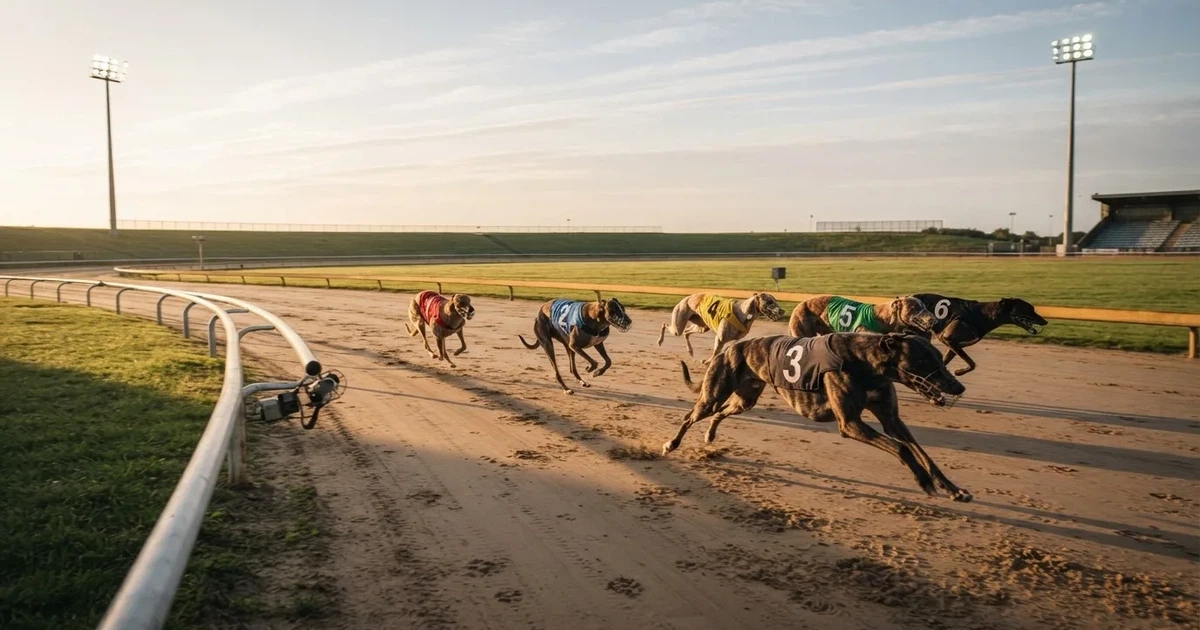
Greyhound racing in Great Britain is regulated by the Greyhound Board of Great Britain (GBGB), which holds 18 licensed stadia. The races run a lure operated mechanically along a rail ahead of the dogs — parimutuel pools at the track and fixed-odds books at the off-course bookmaker both stand behind the result. Starting prices apply to greyhound racing as to horse racing: the SP is the price on an entry in the on-course fixed-odds market when the race begins, and SP bets settle at that price regardless of what the off-course book was offering before.
The British meeting card is dense. Stadium meetings run year-round, with graded racing (A1 to A11) at the major tracks, open racing at the smaller stadia and a schedule of feature meetings through the year. The Scottish Greyhound Derby and the English Greyhound Derby are the headline events of the British card and the meetings the bookmakers price most heavily; each carries its own offer cycle — boosted odds, ante-post markets, each-way enhanced terms — that the rest of the calendar does not. The Irish Derby at Shelbourne Park and the Irish Oaks at Kilcohan Park sit alongside the British feature meetings for the punter who wants the cross-channel calendar.
Greyhound racing in New Zealand was ended by the Racing Industry (Closure of Greyhound Racing Industry) Amendment Act 2026, passed on 2 April 2026, with the phase-out set for 1 August 2026. Winston Peters announced on 10 December 2024 that greyhound racing in New Zealand would be banned and phased out by 2026. Before the ban, Greyhound Racing New Zealand (GRNZ) organised seven affiliated clubs: Auckland, Waikato, Whanganui, Palmerston North, Canterbury, Otago and Southland. The closure is the end of the New Zealand meeting calendar for British punters, but the British and Irish cards continue under the GBGB. The New Zealand closure is the reason a “global greyhound schedule” carries an asterisk from 1 August 2026 onwards.
Spreadex sits outside the racing-only scope: it is regulated by the Financial Conduct Authority for spread betting on financial markets, and by the Gambling Commission for fixed-odds betting. Its greyhound betting is fixed-odds and falls under the Commission licence, but the spread-betting product (financial or sports spread) carries the FCA’s standard “losses can exceed the deposit” warning, which the fixed-odds book does not.
The reviewed bookmakers: a ten-name comparison
| Brand | Gambling Commission remote licence | What the operator’s own terms state on greyhound betting |
|---|---|---|
| Bar One Racing | 056516-R-332750-007 (Bar-One Racing Limited) | Irish independent bookmaker with shops and horse racing sponsorships at Dundalk, Fairyhouse, Navan, The Curragh, Curraheen Park and Cork |
| BetGoodwin | 002927-R-327985-008 (Goodwin Racing Limited) | Welcome: “Bet £10 & Get £15 in Free Bets” — £5 sports, £5 acca, £5 Sub-Cover |
| Fitzdares | 000400-R-103839-030 (Fitzdares Limited) | Cash out, accumulators, Lucky 15s, specials, ante-post and in-play live odds on horse racing, football, tennis, rugby, cricket, golf and American football |
| Coral | 054743-R-330863-014 (LC International Limited) | Welcome: “Get £40 in Free Bets when you bet £20” — min odds 2.0 (1/1), 7-day free-bet expiry, 7-day issue window, GB customers, opt-in |
| Kalooki Sportsbook | 057730-R-333396-005 (Kalooki Sportsbook Limited) | Operated by Kalooki Sports Book Ltd (company 12938274), GAMSTOP member |
| Betmaster | 065699-R-339929-002 (BM Solutions GB Ltd) | App covers football, cricket, horse racing, NFL and eSports (League of Legends, Dota 2) |
| Sky Bet | 067370-R-341330-005 (SBG Sports Limited) | Free bets expire 30 days after crediting; single or each-way only (not multiples, excluding virtuals); non-withdrawable; stake not returned with winnings |
| 10bet | 043173-R-322899-023 (Blue Star Planet Limited) | Sportsbook covers football, tennis and horse racing; Cash out, Bet Builder, Live Streaming |
| NetBet | 039170-R-319343-032 (Netbet Enterprises Limited) | Daily Boosts, Profit Boosts, free bet offers; Bet Builder with instant dynamic odds; major-league sports stats |
| Fitzwilliam Sports | 048760-R-335434-009 (SBKI Limited) | Dublin bookmaker with capped membership; instant deposits, fast withdrawals, timeouts, deposit limits; links to GambleAware, GamStop and Gamblers Anonymous |
The single column of licence numbers is a reminder of what every other column is: the bookmaker’s own terms. The Commission account number is the test of whether the brand is licensed, and the public register carries every licence the Commission has issued. The reader who wants the headline price on a number sits in the right-hand column, not the left.
Greyhound betting in Great Britain: the landscape
Greyhound racing sits inside the Gambling Commission’s remote general betting standard (real events) licence category, which is one of five categories a remote bookmaker can hold under the Gambling Act 2005: remote general betting standard (real events), remote general betting standard (virtual events), remote general betting limited, remote pool betting and remote betting intermediary. Betting exchanges run under the betting intermediary licence; greyhound pool betting on the tote is a separate category. The Act covers Great Britain — England, Scotland and Wales. Northern Ireland runs its own older law and is outside the Act, so a “GB licence” does not regulate Northern Ireland.
Since the Gambling (Licensing and Advertising) Act 2014 an operator whose remote facilities are used in Great Britain needs a Commission licence wherever it is based, under sections 33 and 36 of the 2005 Act as amended. A Curaçao, Maltese or Gibraltar licence is not a substitute, and providing gambling facilities in Great Britain without the licence the Act requires is an offence under section 33 of the Act — on summary conviction up to 51 weeks’ imprisonment, a fine up to level 5, or both, six months in Scotland. The offence is aimed at the operator. No offence aimed at a customer who merely bets on an unlicensed site was found in the framework: the loss for the customer is the loss of the Commission’s complaints route, the approved dispute-resolution body, the GAMSTOP coverage, the 10× bonus cap and the £150 vulnerability check, and the risk of funds being withheld without British consumer redress.
The licence categories on the register determine which features of the offer can run. Bet Builder, cash out, in-play, live streaming, acca insurance and price boosts are operator-side licence conditions, not statutory rights. The Commission’s enforcement on the greyhound market itself runs through the licensed operators: an offer that does not meet the licence conditions or the LCCP social responsibility code can be suspended or removed.
The gambling duty sits on the operator, not the punter. General Betting Duty is 15% on the operator’s gross profits, with a remote rate set to rise to 25% from 1 April 2027 inside that headline rate; remote bets on UK horse racing, bets on self-service betting terminals in licensed premises, pool betting and in-person betting stay at 15%. Until 1 April 2027 the remote rate stays at 15%. Spread betting carries its own rates (3% financial, 10% other). The punter pays no tax on betting winnings in Great Britain, and the duty does not show up on the betting slip as a line item.
Responsible gambling: the rules the licence demands
Every operator in the reviewed set holds a Gambling Commission licence and is therefore bound by the licence conditions and codes of practice that govern player protection. Six rules the punter meets the moment a licensed account is opened:
- Identity verification before the first deposit. Name, address and date of birth are verified before a customer can deposit or gamble — including with a free bet or bonus. No anonymous play at a licensed site.
- GAMSTOP coverage. The national multi-operator online self-exclusion scheme is a mandatory licence condition for online operators since 31 March 2020. Periods are six months, one year, five years, or five years with auto-renewal. After the minimum period the exclusion stays in place for a further seven years unless the customer asks GAMSTOP to remove it. Betting shops use a separate service.
- The £150 vulnerability check. When a customer’s deposits minus withdrawals exceed £150 in a rolling 30 days (since 28 February 2025), a public-record check runs — bankruptcy, county court judgments — under LCCP condition 3.4.4. It is not an income check and not a credit reference check.
- The financial risk assessment. A staged plan announced by the Commission on 7 July 2026 with no start date. Write “announced, staged, no start date”, not “in force”.
- Deposit limits. Operators must offer a gross deposit limit on a fixed time frame; the first changes have applied since 31 October 2025, a second phase was postponed to 30 September 2026, and whether that second phase is live is not established. There is no state-set deposit or loss ceiling: limits are the customer’s choice.
- Credit-card ban. Credit cards are banned for gambling in Great Britain since 14 April 2020, including credit-card-funded payments through an e-wallet. Debit cards and bank-based payments are not covered.
The bonus cap is part of the same framework: wagering on bonuses is capped at 10× the bonus amount since 19 January 2026, and mixed-product offers — a free spin or casino credit bundled with a sports bet — are banned. A free spin given in exchange for a sports bet is no longer a lawful offer at a GB-licensed brand.
Where to get help: GamCare (the National Gambling Helpline), GambleAware, NHS gambling clinics, Gamblers Anonymous. The reviewed operators in this set each surface the safer-gambling routes — Fitzwilliam Sports, for instance, links to GambleAware, GamStop and Gamblers Anonymous from its home page. The reader who has hit a wall on deposits, timeouts or self-exclusion has the routes already on the page they are using. The reader who has hit a wall beyond that has the routes above.
Coral
Coral’s £40-in-free-bets welcome is the headline, and the 7-day expiry on the free bets is the constraint. A punter who qualifies on a Monday meeting has until the following Monday to find the four £10 free bets a place to land, and each one of them has to find a market at minimum odds of 2.0 (1/1) or the stake does not convert. Coral is one of the LC International Limited brands — Ladbrokes sits on the same licence — so the betting intermediary licence category on the register means Coral can also run exchange-style products on greyhounds where liquidity exists. The full sportsbook and the in-play markets sit behind the same login. For the punter who can use a £40 free-bet envelope inside a fortnight, Coral’s welcome is ordinary by GB standards.
BetGoodwin
BetGoodwin’s £15 free-bet package splits into three pieces: £5 sports, £5 acca and £5 Sub-Cover. The acca leg requires the punter to find an accumulator to use the £5 on, which is a constraint the headline number hides. Sub-Cover is BetGoodwin’s own product — a refund-style offer on a single — and it is the leg a £5 stake fits most easily. The welcome is below the £40 Coral envelope and below the £40 Sky Bet envelope. For a punter who already bets singles and accas, BetGoodwin is a smaller-grunt welcome that does not ask much of the qualifying bet.
Sky Bet
Sky Bet’s free-bet envelope is generous — £40 in free bets is the headline number across the bigger brands. The constraint sits on what the free bets can do: single or each-way markets only, not multiples, virtuals excluded, 30-day expiry, non-withdrawable, stake not returned. A punter who wants to use the £40 on a Lucky 15 cannot. The 30-day window is twice the Coral envelope’s window, which matters for a punter who is waiting on a specific meeting or ante-post market. The sportsbook sits behind SBG Sports Limited’s licence and carries the in-play markets Sky’s platform is known for.
Fitzdares
Fitzdares’ product is the ante-post book and the specials on horse racing, with football, tennis, rugby, cricket, golf and American football on the in-play side. Greyhound racing is not on Fitzdares’ named list of in-app markets, which is the gap this set asks the reader to notice. For a punter who wants Fitzdares for the racing product, the racing product is horse racing, not greyhound. The £40-in-free-bets welcome is the headline number when one runs; the cash out, Lucky 15s and in-play live odds sit across the rest of the sportsbook. Fitzdares is the brand the racing-meets-other-sports punter will recognise — and the brand the greyhound-only punter should skip.
NetBet
NetBet Sport layers Daily Boosts, Profit Boosts and free-bet offers over a Bet Builder with instant dynamic odds and a major-league sports stats page. The Bet Builder is the differentiator: a price that updates as each leg is added is the closest thing the market has to a real-time acca pricing engine. Greyhound racing sits inside the Bet Builder framework but the dynamic-odds layer is the football-and-tennis surface, and the punter who wants greyhound-specific dynamic odds should check the NetBet meeting card before staking. The free-bet envelope and the Daily Boosts are the marketing wrapper. The Bet Builder is what the operator’s own terms push to the front of the page.
10bet
10bet covers football, tennis and horse racing on its sportsbook with Cash out, Bet Builder and Live Streaming in the app. Greyhound racing is not on 10bet’s named sports list, so a punter checking 10bet for the meeting card will find horse racing where greyhounds would sit. The Live Streaming and Bet Builder framework is in place, but the greyhound meeting card is not the surface 10bet’s app markets itself on. For a punter who bets football and tennis and wants greyhounds as a sideline, 10bet is the wrong primary; for a punter who bets horse racing and wants 10bet for the streaming and the cash out, the racing they get is horse racing.
Kalooki Sportsbook
Kalooki Sportsbook is operated by Kalooki Sports Book Ltd (company number 12938274), licensed under Commission account 57730 and a GAMSTOP member. The brand sits at the smaller end of the GB-licensed set. The licence is the same as the bigger brands’ licences. For a punter who wants a smaller-brand bookmaker with a Commission licence and GAMSTOP coverage, Kalooki is the kind of brand the Commission’s register surfaces.
Betmaster
Betmaster is published by BM Solutions GB Ltd and covers football, cricket, horse racing, NFL and eSports (League of Legends, Dota 2) on its app. Greyhound racing is not on Betmaster’s named sport list, so a punter checking the Betmaster meeting card will find cricket and the eSports vertical where greyhounds would sit. The sportsbook sits behind the same Commission licence the bigger brands hold. For a punter who wants eSports alongside horse racing, Betmaster is a fit; for a greyhound-first punter, it is the wrong primary.
Fitzwilliam Sports
Fitzwilliam Sports is a Dublin bookmaker with capped membership — the welcome is described as a “High Stakes Welcome” subject to compliance criteria, which puts the brand outside the small-stake punters’ reach. The bookmaker runs instant deposits, fast withdrawals, timeouts and deposit limits and links to GambleAware, GamStop and Gamblers Anonymous from the home page. The greyhound product sits inside the same book as the rest of the racing. For a Dublin-based or capped-membership punter who can pass the compliance criteria, Fitzwilliam is the kind of brand the Commission’s register surfaces; for the £5 acca punter, it is the wrong end of the market.
Bar One Racing
Bar One Racing has rebranded as BAR 1 Betting — an Irish independent bookmaker with shops across Ireland and horse racing sponsorships at Dundalk, Fairyhouse, Navan, The Curragh, Curraheen Park and Cork. The GB licence is the licence that lets the brand take a GB remote bet, and the on-the-ground book is the Irish shop estate. The greyhound product is the smaller piece of the BAR 1 offering. For a punter who bets Irish racing and wants the brand’s shop estate behind the online book, BAR 1 is the brand the Irish calendar surfaces; for a greyhound-first punter, it is a smaller-grunt GB-licensed bookmaker with a Commission account.
The arithmetic that sits inside every price
A greyhound race with two runners priced at 1.90 decimal (9/10 fractional) on each side looks like a 50/50 market. The arithmetic says it is not. The fair payout share — the share of every £1 staked that returns to winning punters in a no-margin market — is one divided by the sum of the implied probabilities of both sides:
- 1 ÷ 1.90 = 0.5263 (about 53%) for each side.
- The sum of the implied probabilities is 0.5263 + 0.5263 = 1.0526.
- The actual payout share is 1 ÷ 1.0526 = 0.95 (95%).
- The margin is 1 − 0.95 = 0.05, or about 5%.
The bookmaker keeps roughly 5p of every £1 staked on this two-way greyhound market. Across a card of six races at the same margin, the punter who runs a flat-stake system loses 5p per pound staked before counting winners — and that is the assumption only that the card is priced symmetrically at 1.90 / 1.90, which a real card rarely is. A heavy favourite-shortening book will sit at a wider margin; an outsider-heavy book on a six-runner race with a 4.0 / 6.0 / 8.0 / 13.0 / 21.0 / 34.0 spread will run a payout share of about 0.78 and a margin around 22%. The greyhound punter who reads “5% margin” should read it as a band — closer to 5% on a symmetric two-way book, much wider on a heavy outsider card.
The same margin sits inside the spread betting product. Spreadex is regulated by the FCA for spread betting and by the Gambling Commission for fixed-odds betting, and its spread-betting product carries the FCA’s “losses can exceed the deposit” warning, which the fixed-odds book does not. The spread is a different product and a different margin, and the punter who reads “greyhound betting” and reaches for a spread book is paying a different cost than the punter who reaches for a single. The greyhound punter who uses the spread book on purpose is reading the spread as a price band — and the punter who uses it by accident is reading it as a number that does not exist on a fixed-odds slip.
What an online greyhound bet actually returns
The formula is the simplest on the page. Return on a winning bet = stake × decimal odds. Net profit = stake × (decimal odds − 1). A £10 stake at 5.00 decimal returns £50 (the £10 stake plus £40 profit). A £10 stake at 1.50 decimal returns £15 (the £10 stake plus £5 profit). The same conversion runs from fractional odds: 4/1 fractional = 4 ÷ 1 + 1 = 5.00 decimal, evens = 1 ÷ 1 + 1 = 2.00, 9/10 = 9 ÷ 10 + 1 = 1.90. The conversion sits at a/b → a ÷ b + 1 and the slip settles at the decimal number the bookmaker quotes.
A combination bet multiplies the odds of each leg into one price. A double at 2.50 and 3.00 decimal is a 7.50 decimal combined price — a £10 stake returns £75 (the £10 stake plus £65 profit) if both legs win. A Lucky 15 is 15 bets across 4 selections (4 singles, 6 doubles, 4 trebles, 1 four-fold), each at the unit stake, so a £1 Lucky 15 costs £15 in real money. The same combination arithmetic applies to Trixie (4 bets), Patent (7), Yankee (11), Super Yankee / Canadian (26), Heinz (57) and Goliath (247).
The free-bet value is a different formula. For a free bet whose stake is not returned with winnings — the standard rule at GB-licensed brands — value = free-bet amount × (decimal odds − 1) ÷ decimal odds × the payout share of the market. A £10 free bet at 5.00 decimal on a market with a 95% payout share is worth £10 × (5.00 − 1) ÷ 5.00 × 0.95 = £10 × 0.80 × 0.95 = £7.60. The punter who takes a £10 free bet at 5.00 and wins gets £40 of profit back from the bookmaker, not £50 — the £10 stake is the bookmaker’s kept margin on the free bet. That is what the “free” word hides.
What a bonus really costs to clear
The arithmetic on a bonus runs on the turnover, not the headline number. A £10 bonus at the 10× cap that the CAP and BCAP Code has applied since 19 January 2026 needs £100 of qualifying bets at the minimum price the operator sets. The expected cost of clearing the bonus is the turnover times the margin of the market the punter is clearing the bonus on. On a greyhound market with a 5% margin (the two-way 1.90 / 1.90 example above), the expected cost of £100 of qualifying bets is £100 × 0.05 = £5. The punter clears the £10 bonus for an expected cost of £5 — a net of £5 if the bonus clears cleanly, less if some qualifying bets lose at the bookmaker’s price.
A heavier bonus carries a heavier expected cost. A £40 bonus at 10× needs £400 of qualifying bets, and at the same 5% margin the expected cost is £400 × 0.05 = £20. The punter clearing the £40 bonus for an expected cost of £20 walks away with a £20 net if the bonus clears cleanly and the qualifying bets are at the minimum price. The real cost is higher if the qualifying bets are placed on margin-heavy outsider cards (22% margin) — £400 × 0.22 = £88 of expected cost on the same £40 bonus — which is why the punter who clears the bonus on the symmetric two-way market clears it for less than the punter who clears it on the outsider-heavy card.
The free bet sits on top of this. A £10 free bet at 5.00 decimal on the 95% payout-share market is worth about £7.60 on average, as calculated above. The £10 headline minus the £7.60 expected value is £2.40 of margin the bookmaker keeps. The “free” word on the marketing is the £2.40 the punter pays for the marketing.
The decisions the framework leaves the punter
Six decisions sit between a licensed greyhound bookmaker and the punter’s stake:
- The bookmaker. The reviewed set is ten brands; the Commission’s register carries the whole market. The brand a punter picks is the brand whose meeting card carries the race they want.
- The market. Winner, each-way, forecast, tricast, accumulator — each carries a different margin and a different stake layout. The each-way is two bets of equal stake; the Lucky 15 is 15 bets at the unit stake; the accumulator is one bet at the unit stake.
- The price. The decimal price on the slip is the price the punter takes. The fair price — the price with no margin — is the reciprocal of the implied probability. The margin is what sits between the two.
- The offer. Free bet, enhanced odds, price boost, acca insurance, deposit bonus — each has a different cost in turnover and minimum price. The 10× cap is the ceiling on the bonus turnover, not the floor.
- The stake. The punter’s stake is the punter’s stake. The bookmaker can cap the maximum stake, and the punter’s bankroll caps the punter’s stake from below.
- The bookmaker’s licence. The Commission’s public register is the test. The licence number on the brand’s own terms page can be checked against the register.
The framework does not pick the bookmaker. The framework picks the cost, and the cost is what sits inside every price on every slip at every brand in the reviewed set. The punter’s stake picks the bookmaker — by the meeting card they want, the offer they can use, and the limit their bankroll can carry. The framework’s job is to make that decision visible.
A note on the brands a reader sees named but never reviewed
The brands a reader meets across the rest of the greyhound market — the betting exchanges, the on-course bookmakers, the international brands that take a GB remote bet under their own Commission licence — are not in this reviewed set. They are not worse for not being reviewed. They are simply outside the ten names the spec carries. The Commission’s register is the place a reader checks any brand they meet outside this set, and the public register is the test that does not depend on this page.
Frequently asked questions about online greyhound racing betting
How does greyhound racing betting work?
A greyhound race carries a meeting card of runner entries and trap numbers, priced by the bookmaker in decimal or fractional odds. A single bet picks one dog to win, with the stake returned plus profit at the quoted odds; an each-way bet is two equal stakes — one on the win, one on a place at a fraction of the win price. The starting price (SP) settles the bet at the on-course fixed-odds price when the race begins.
How do bets on greyhound dogs settle?
A winning single returns stake × decimal odds, with net profit = stake × (decimal odds − 1). A combination bet — a double, treble, accumulator or system bet like a Lucky 15 — multiplies the prices of each leg into one combined price and settles if every leg wins. A non-runner triggers the Rule 4 deduction, which reduces the odds on winning bets to reflect the smaller field.
Is there a way to win at greyhound betting?
No betting system beats the bookmaker’s margin over time. A symmetric two-way market priced at 1.90 / 1.90 decimal carries roughly a 5% margin, so the bookmaker keeps about 5p of every £1 staked before winners are counted. Form reading, bankroll discipline and staking each-way on outsiders with enhanced place terms can extend a bankroll, but the margin is the ceiling on what any system can promise.
How is a Gambling Commission licence checked?
The Commission’s public register can be searched by business name, trading name, domain or account number, and it is the whole test of whether a brand holds a GB remote betting licence. A licensed brand’s home page carries the Commission account number; entering that number in the register’s search returns the licence holder’s name, the licence categories and the licence’s status. Every brand in this reviewed set has been verified against it.
How is the return on a bet worked out from the stake and the odds?
Return = stake × decimal odds; net profit = stake × (decimal odds − 1). A £10 stake at 3.50 decimal returns £35 (the £10 stake plus £25 profit). Fractional odds convert to decimal via a/b → a ÷ b + 1, so 5/2 fractional = 2.50 + 1 = 3.50 decimal. The decimal price the bookmaker quotes on the slip is the price the bet settles at.
What is the bookmaker’s margin and how can it be seen in the odds?
The margin is the share of every £1 staked that the bookmaker keeps across all outcomes of a market, calculated as 1 minus the payout share. For a two-way market priced at 1.90 / 1.90 decimal, the payout share is 1 ÷ (1 ÷ 1.90 + 1 ÷ 1.90) = 0.95 and the margin is 1 − 0.95 = 0.05 (about 5%). The margin sits inside every price on the slip and is the difference between the fair odds — the reciprocal of the implied probability — and the quoted price.
Horse racing & greyhounds – signupbetsguide.com
Content created by the «signupbetsguide.com» team
