
Netball Betting Odds: What the Numbers Mean and What They Take
 Available in US
Current as of 30 October 2026 and checked against the Gambling Commission’s public register for Great Britain.
Netball sits in a peculiar corner of the British betting market. It is governed by a single world body, played under one set of rules almost everywhere it is played, and contested on a court that has not changed dimension in living memory — yet it draws a fraction of the handle that football, horse racing or tennis pull in. The thinness shows up in the odds. A two-way market on a netball fixture is rarely priced as tightly as a Premier League match, and the wider the price gap between two well-matched teams, the more a punter gives back to the bookmaker before a ball is thrown. Understanding that gap is the first thing a sharp read on netball odds delivers.

This page reads that market from the punter’s side of the counter. Where bonus money is offered, the question is how much betting it takes to clear it, what minimum price the qualifying bet must carry, and how long the offer runs before it expires. Where in-play betting is sold, the question is whether cash-out is offered on the same match, or only singles, and what happens to a multi when one leg goes live. Where a tipster suggests a “best bet”, the page asks what data it draws on, what stake size the suggestion implies, and whether the price that made the tip attractive is still the price available. None of these questions is a moral judgement. Each is arithmetic.
The licensed brands reviewed below all hold a Gambling Commission remote licence for fixed-odds betting on real events. Netball is offered inside that licence, not as a separate permission, and the same operator’s terms govern it. That is why a single page can sit across ten brands and one sport: the licence frame is the same, the markets differ, and what a punter pays for them differs more.
Bonuses and Free Bets on Netball
Netball bonus offers are rarely crafted for netball bettors. Most sit inside a broader sports welcome package that covers every market the bookmaker prices, from football to Gaelic hurling, and netball is one of many. Reading them on their own terms takes a beat. The headline number — “Bet £10, Get £10” or “Get £40 in Free Bets when you bet £20” — is what costs the punter, and the cost is the qualifying bet, the minimum price that bet must carry, the deadline by which it must be placed, and the free-bet expiry that starts the clock the moment the bonus lands.
A “free bet” in this market is, almost always, a bet credit whose stake is not returned with a win. Stake-not-returned, sometimes abbreviated SNR, is the difference between a free bet and a cash refund: the same winning odds on £10 produce a £10 return with a cash refund and a £40 return with a £10 free bet on odds of 5.00 — because the £10 stake is given back in one case and not in the other. That difference is what “free” quietly loses. A free bet on odds of 1.91 with the stake not returned is worth approximately £4.55 in expected cash terms once the market’s payout share is priced in; the same nominal value in a cash refund would clear £9.10 in expected terms, almost double. The mathematics is on the punter’s side only when the free bet is staked at a price materially higher than the qualifying minimum.
Welcome packages carry a wagering requirement or a minimum price. The 19 January 2026 promotion rules cap wagering requirements at 10x the bonus across all GB-licensed operators — meaning a £10 bonus requires no more than £100 of qualifying bets before it can be withdrawn. A bonus above the cap, or a bonus that mixes products (a sports free bet bundled with casino free spins, for example) cannot be lawfully marketed to GB customers at all. That cap is the single largest constraint on bonus generosity introduced in this market for years, and it makes a 50x rollover — once common in casino, occasionally seen in cross-product sports offers — unlawful for new GB-licensed sports bonuses.
Each of the brands reviewed has a published offer. Some are deposit-gated — a minimum first deposit before any bonus is issued. Some are bet-gated — the bonus lands after a single qualifying bet at the stated minimum price, regardless of deposit size. Some are split, with one half usable on sports and the other half on the casino side of the same account. Each has a deadline. The reviews below name the offer, name the qualifying condition, and judge whether the deal clears its own headline.
Incentive design has moved away from the heaviest rollovers precisely because the 10x cap now makes them impossible. What has replaced them is the price boost — a single-event enhancement, often available on a pre-selected match, with no wagering and no expiry beyond the match itself. Price boosts sit in a different cost frame from free bets because they don’t gate withdrawal: a winning boosted-odds bet pays out in cash, in full, at the boosted price. They are smaller in nominal value than a free bet, but cleaner to clear. For the netball market they are particularly relevant: bookmakers tend to boost netball fixtures around major events such as the Netball World Cup or the domestic Superleague play-offs, because those are the fixtures whose volume justifies a margin concession.
A bet booster on netball may look like “Australia to win from 1.50 to 4.00” in the days before a World Cup semi-final. The boosted price is still subject to the bookmaker’s margin — the overround at the boosted price is wider than the unboosted line because the free-bet equivalent of the boost is paid out by the bookmaker, not by the punter’s stake. A punter chasing only boosted odds over the long run is not arbitraging the bookmaker; the bookmaker is paying for the headline, and the headline carries the cost.
Netball-specific promotions occasionally appear in season: a free-bet refund if one selection in a designated netball accumulator lets down, an each-way extra on a Superleague winner market, or a price boost on the first match of a Quad Series weekend. These tend to be short and time-bounded. Reading them with the same cost frame as the welcome offer is the correct move — minimum price, expiry, whether the stake is returned, whether the bonus converts to withdrawable cash.
The cheapest way to use a bonus on netball is to clear it at the minimum qualifying price on a market with the lowest margin. Two-way markets with evenly priced teams generally sit closer to the bookmaker’s theoretical floor than three-way markets (which add the draw to two evenly priced teams), and three-way markets are closer than exotic markets such as first-quarter leader or margin-of-victory. Whether the bookmaker’s lowest-margin market is the one the bonus qualifies on is the question that decides whether the bonus is worth claiming.
Live Betting and Cash Out on Netball Matches
Live betting on netball mirrors the structure of the sport itself. Four 15-minute quarters, breaks between them, a clear score that resets each quarter. A 2-point goal is the scoring event, and there is no injury time, no stoppage for video review, and no clock that pauses for substitutions. This makes netball a relatively clean sport to price in-play: the model’s job is to forecast the rest of the quarter from the current score, the time left, and possession, and the bookmaker’s job is to refresh the odds quickly enough that the price reflects that forecast.

Not every bookmaker offers live netball betting through to the same depth. Some price only the head-to-head market, with home and away updated after each goal. Others price the quarter winner, the next goal, and over/under total points at quarter intervals. The fewer markets the bookmaker prices live, the more disciplined a punter has to be about which bookmaker they use for which fixture. A feature-light in-play product is not a bad product — it is a narrower product, and a punter with a focused strategy may prefer it.
Cash out closes a bet before the match finishes. The bookmaker pays out at a price derived from the live odds at the moment of cash-out, less a margin that varies by operator and is rarely published. The cash-out price on a winning selection is lower than a wait-and-let-it-run settlement would have produced, because the bookmaker keeps a slice for closing the bet early. Cash-out is not free money — it is a transaction the punter pays for, and the price is the gap between the cash-out quote and the live price that the same bet would settle at.
Cash-out on netball works in principle on every market the bookmaker offers in-play. In practice, bookmakers restrict cash-out on some combination bets during live play, hold cash-out during quarter breaks, and suspend cash-out entirely during the final two minutes of close matches. The restriction is operational: the bookmaker needs a moment to refresh prices after a goal, and a millisecond-late settlement could cost it or the punter a meaningful sum.
The arithmetic of in-play betting is not kind to a punter who fires on every price move. Each click of the bet slip is a fresh commission — the margin between the back and lay prices, plus the bookmaker’s own in-play overround — paid by the punter to the bookmaker for the privilege of betting. The cover charge is invisible on the slip; it shows up only across many bets at the end of the month.
A punter who uses live betting sparingly, on markets where they have a read, finds a different pattern. They use the quarter break to place a bet that the pre-match odds priced too long. They use cash-out to lock in a profit on a multi when one leg has already landed and the others are live. They do not use live betting as a separate product; they use it as a tool inside the same match, on the same fixture, with the same read on the teams.
Some bookmakers offer live streaming of netball, often via a partnership with the broadcaster holding the rights. Live streaming and live betting are sold together because the cost of providing one is partly recovered through the other. A live stream with no in-play product is unusual in this market; a market with live betting but no stream is the commoner offering, and the punter who values both has fewer bookmakers to choose from.
Match trackers — animated visualisations of the court, the ball, and the score — are a cheaper alternative to live streaming. They tell the punter where the ball is and what the score is, without paying for broadcast rights. They are particularly useful on domestic Superleague matches that don’t attract a TV broadcast.
The decision of which bookmaker to use for a given netball fixture is partly decided by which bookmaker offers in-play on that fixture and at what depth. A fixture that draws only head-to-head live markets is best left to one bookmaker. A fixture that draws quarter-by-quarter and per-goal markets is open to a sharper play, and the punter comparing live markets across two or three brands has the cleanest edge.
Predictions, Tips and the Question of Who Knows What
Netball is one of the smaller sports by betting volume, and the tipster ecosystem around it is correspondingly small. A handful of websites publish pre-match previews ahead of major events — Netball World Cup, Commonwealth Games, Quad Series, Superleague play-offs — and a smaller number publish model-based forecasts for domestic league matches. Below that tier the predictions market thins out fast.
The cost frame on a tip is what the tip costs the punter versus what it returns. A free tip that recommends a £10 single at 3.00 carries a stake of £10 and a payout of £30 if it lands — net £20. The same recommendation from a paid service might cost £5 per tip or £30 per month, leaving a thinner net return on the same winning bet. A punter paying for tips and breaking even on them is paying for the time saved reading form guides, not paying for an edge.
The honest reading of any tip is that the tipster’s data is mostly public. World Netball publishes rankings. Netball Superleague publishes fixtures and results. Player statistics are tracked on third-party platforms. What a tipster sells, when a tipster sells anything, is interpretation: the reading of the form, the weight put on head-to-head results, the read on injuries. That interpretation has value, but it is not predictive in the sense that makes a confident system. A tipster with a 55% strike rate at average odds of 1.91 is making a small profit after the bookmaker’s margin; a tipster at 52% is making a small loss; a tipster at 60% is rare and probably cherry-picking from a larger sample.
Bankroll management is the other half of any prediction strategy, and it is the half most tipster write-ups skip. A flat £10 stake on every selection is a strategy. A stake proportional to the perceived edge — 2% of bank for a thin edge, 5% for a fat one — is a different strategy. The two strategies produce the same return on a winning selection but very different drawdowns on a losing run. A punter clearing a £100 bonus by the turnover rule benefits from the second strategy because smaller stakes mean more bets cleared at the minimum price, which means the bonus clears faster.
Following tips is one way to bet on netball. Building a model is another. Building a model on netball is harder than it looks because the public data is thin: scoring events are sparse, possession is hard to track without broadcast data, and quarter-by-quarter splits are not routinely published. A model that works on football data, with shots and expected goals and pressing metrics, doesn’t translate cleanly to netball’s two-point goals and clean positional play. Some tipsters make claims based on machine-learning models; the data underlying those claims is rarely published, and a punter paying for the tip is buying a black box.
Pre-match prices on netball sharpen closer to tip-off. Three hours out, the price on a Superleague match might be 1.85/1.95 on a balanced matchup. At tip-off it might be 1.91/1.91 — closer to the book’s mid. The narrowing reflects the bookmaker’s willingness to take a thinner margin on a market where it has more information and tighter risk controls. A punter who has done the work at 9am and finds the price has tightened by 7pm is on the right side of the move.
In-play prices can move sharply at quarter breaks. A team leading by 8 at the end of the first quarter is a different proposition than the same team leading by 8 at the end of the third. The bookmaker’s algorithm understands this and reprices accordingly; the casual punter reading the score on a stream does not always see the implicit margin in the prices offered at each break.
The sharpest reading on netball prediction is that there is no system. There is a price, a stake, a moment. The punter who has a clear read on both takes the price at the moment. The punter who doesn’t has no business taking the price at all.
Understanding Bet Types and Margin
The odds on a netball bet express two things at once: the bookmaker’s estimate of the outcome’s probability, and the book’s margin, embedded in the price. Reading them well means seeing both.
The simplest netball market is the head-to-head: home to win, away to win, no draw. Goals are two-point scores, and ties are broken by extra time in knockout formats or by goal difference in league formats. The two-outcome structure makes this the cleanest market to price and the cleanest market to read. A price of 1.91/1.91 implies a payout share of about 95.3% on a balanced matchup — the bookmaker keeping roughly 4.7% of every unit bet as margin.
The margin is the gap between the sum of implied probabilities and 1.00. For a balanced match, 1/1.91 + 1/1.91 = 1.048 — the overround. The margin is 1 − (1 ÷ 1.048) = 0.046, or about 4.6%. That is a typical margin for a well-priced two-way market. A market priced at 1.80/1.80 carries an overround of 1.111, a margin of about 10% — twice the margin of the tighter market, and a costly premium for the punter.
Three-way netball markets — home, away, draw — are rarely offered because the draw in netball is rare and the margin on a three-way bet is harder to price. The bookmaker that does offer a three-way runs a different calculation: a balanced three-way at 2.75/2.75/2.75 implies a payout share of about 92.3% and a margin of nearly 7.7%. The extra outcome eats about three percentage points of margin compared with the two-way market.
Each-way betting is offered on outright markets such as the Netball World Cup winner, the Superleague champion, or the league season top scorer. Each-way doubles the stake — half on the selection to win, half on the selection to place, with place terms varying by operator and event. The place terms generally pay 1/2 or 1/4 of the win odds on a top-three finish, with larger fields paying out further down the places. The arithmetic is straightforward: a £10 each-way bet costs £20 and returns the win portion plus the place portion at the stated place fraction.
Accumulator bets — “accas” — multiply the odds of each leg into a single price. A four-fold on four evenly priced 1.91 selections becomes 1.91⁴ = 13.30. The margin compounds: each leg’s 4.7% margin layers onto the next, and the overall accumulator margin reaches about 18% on a four-fold of balanced events. The punter feels the compounding as the upward pull on stake size needed to clear a bonus; the bookmaker harvests it as a higher share of handle on a market where the punter thinks they are getting a discounted price.
Bet builders — same-game multis — combine several markets from one match into a single price. A bet builder combining “Australia to win”, “over 50.5 total goals”, and “first quarter margin over 5” produces a price that reflects the correlation between the three selections, not just the sum of independent probabilities. Bookmakers price bet builders generously — sometimes explicitly stating a margin floor of 5% per leg, sometimes pricing tighter on correlated events. The marketed price is the price the punter sees; the margin is not published and is wider than on a single market.
Cash-out is its own market, with its own margin. The cash-out price is the current live price adjusted by the operator’s cash-out margin (typically 5-10%), calculated on the live odds of the bet at the moment of cash-out. A punter who cashes out on a winning selection at half-time is effectively paying the cash-out margin to lock in the profit earlier. The cost is the difference between the cash-out quote and the wait-and-let-it-run settlement.
Free bets fit inside this market as their own arithmetic. A free bet’s expected value depends on the odds the bet is placed at and the payout share of the market it’s placed on. For a free bet at odds of O on a market with payout share P, the expected return is approximately freebet × (O − 1) / O × P. A £10 free bet at odds of 5.00 on a market with a 95% payout share returns roughly £7.60 in expected cash — the stake is not returned. The same nominal value at odds of 1.91 returns roughly £4.55 — half as much, because the price is closer to the book’s mid and the upside is compressed.
The minimum qualifying price on a bonus bet is the floor above which a bonus bet counts toward turnover. A bookmaker requiring minimum odds of 2.0 (1/1) on a qualifying bet is restricting the bonus to bets whose implied probability is 50% or less — bets the punter thinks are somewhere between fair and a longshot. A bookmaker at minimum odds of 1.50 (1/2) is more permissive, allowing bets close to favourites. The first bookmaker’s bonus is harder to clear because fewer markets comfortably exceed the floor; the second bookmaker’s bonus is easier but the qualifying bet is also closer to a coin flip.
Decimal odds and fractional odds describe the same thing in different notation. Decimal odds of 6.00 express the total return per unit stake: a £1 bet returns £6 (£5 profit plus £1 stake). Fractional odds of 5/1 express the profit per unit stake, with a £1 wager yielding a £6 total payout (£5 profit plus the stake). Conversion is a/(b) + 1 in decimal terms, or (D-1)/1 in fractional terms, where D is the decimal price. A punter reading British terms will meet fractions; a punter reading European and most international platforms will meet decimals. Both are correct.
The total return on a winning bet is stake × odds for decimal odds, with the profit being odds − 1 times the stake. For a £10 single at decimal odds of 3.75, return = £37.50, profit = £27.50. For a £4 accumulator at decimal odds of 15.00, return = £60, profit = £56.
Netball: The Sport and the Betting Context
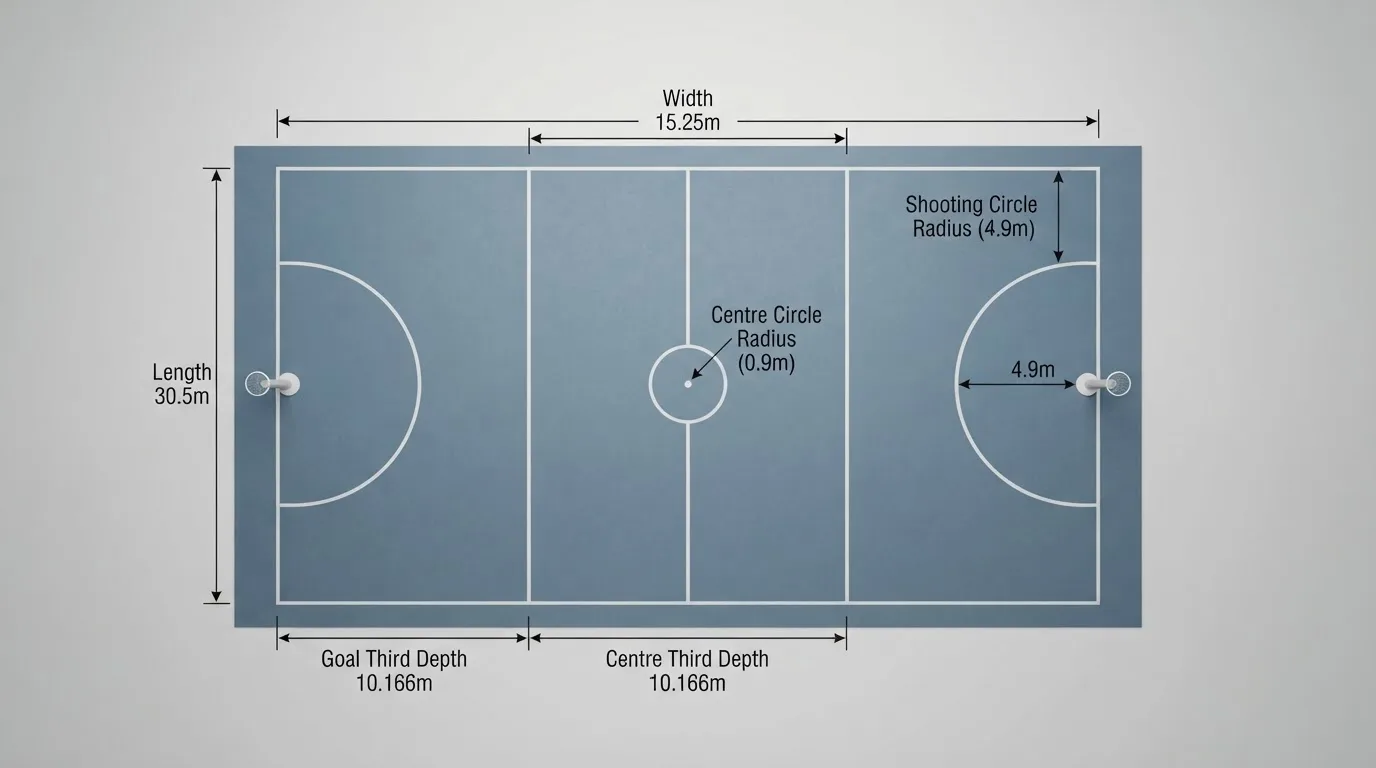
Netball is one of the simplest team sports to read. A team has seven players on court, and the game consists of four 15-minute quarters. The court is a fixed 30.5 m by 15.25 m rectangle, with goal posts 3.05 m high at each end and a shooting circle of 4.9 m radius that determines where a goal can be scored from. Every two years the international rule book adjusts a touch zone here, a penalty there; the basic geometry has not changed.
The governing body, World Netball, is based in Manchester. Founded in 1963 at the first Netball World Cup in Eastbourne, the international federation now governs the sport across roughly 80 national bodies. Eleven nations played that first tournament; more than 30 nations now qualify for the modern World Cup.
The Netball World Cup is held every four years. It has rotated between Africa, Oceania, the Caribbean, Asia and Europe, with the United Kingdom, Australia and New Zealand dominating the medals for most of the tournament’s history. The current cycle sits within an international calendar bookended by the Commonwealth Games (every four years on the same cycle, alternating with the World Cup) and the Quad Series / Nations Cup, which pits the top four ranked nations against each other in a closed-format series.
Great Britain’s domestic competition is the Netball Superleague, established in 2005. The Superleague runs from late winter into the summer, with team franchises attached to clubs across England and Wales and a final series that culminates in a Grand Final. Coverage has been a perennial challenge — the Superleague has lived on Sky Sports, BBC iPlayer and various streaming platforms, but the sport’s broadcast footprint remains smaller than its attendances would suggest.
In the southern hemisphere, Super Netball (Australia) and the ANZ Premiership (New Zealand) replaced the former ANZ Championship in 2017. Both leagues operate under different calendar windows, with Super Netball running mid-year and the ANZ Premiership running alongside the southern winter. Australian and New Zealand national teams are the dominant forces in international netball, with Jamaica, England and South Africa forming the next tier.
The betting market on netball reflects this geography. The Australian and New Zealand domestic leagues are priced more extensively than the British Superleague, simply because bookmakers in this market have larger customer bases there. British punters looking for Superleague prices find fewer bookmakers offering them at depth; international punters looking for Super Netball find them everywhere.
The handicap market on netball is the second-most-popular market after head-to-head, and it works the same way as in football or basketball: a positive handicap is added to the underdog’s score, a negative handicap to the favourite’s. The handicap line moves with the form, and a price of +6.5 at 1.91 means the underdog starts the match effectively six goals ahead.
Margin-of-victory markets are the exotic, allowing bets on the exact gap between two teams’ scores at the final whistle. They are harder to price and carry wider margins than the head-to-head, often 15-20% overround. They are also more interesting to the punter who has a strong read on form, because the prices are wider and the edge, where one exists, can be larger.
Total points over/under markets price the combined score at a stated line — usually 50.5 or higher for international fixtures, lower for some domestic ones. These markets are priced similarly to football totals and carry similar margins.
The cleaner the market, the more competitive the price. Head-to-head on a balanced matchup between two well-known teams runs close to the book’s mid. Margin-of-victory and quarter-by-quarter markets run wider. The punter who bets narrowly on the cleanest markets is paying less margin; the punter who bets exotics is paying more — sometimes for a reason.
The volume of netball betting increases around major events. The Netball World Cup, the Commonwealth Games netball, and the Superleague Grand Final all draw disproportionate handle in their week. Prices on these events sharpen accordingly, with bookmakers willing to take a tighter margin because the volume is concentrated and the risk spread across more customers.
The Ten Bookmakers: A Side-by-Side Read
The table below compares the ten GB-licensed operators reviewed in this article across two matters: the Gambling Commission remote licence number and the licence holder, and what the operator’s own terms state about the subject of the page. The licence holder is the entity named on the Commission’s public register; the trading name (the brand) is sometimes the same as the holder and sometimes a separate brand owned by a parent. Where a brand sits inside a group, the licence still attaches to one legal entity, and that entity is the named protection route.
| Brand | Gambling Commission licence and holder | Operator’s own terms on netball and pricing |
|---|---|---|
| Fafabet | Remote licence 057385-R-333191-006; account 57385. Holder: Taichi Tech Limited. | Sports welcome offer described in the brand’s GB promotion terms. Best Odds Guaranteed applies to UK and Irish horse racing from 9am on race days. |
| BetTom | Remote licence 064959-R-339314-003; account 64959. Holder: Bet Tom Limited. | Sports welcome offer: 50% back as a free bet up to £50 with a matching 50% back up to £50 in free slot funds for casino, full terms apply. |
| QuinnBet | Remote licence 061011-R-335683-004; account 61011. Holder: QuinnBet (Gibraltar) Limited. | Best Odds Guaranteed on UK and Irish horse racing from 10:00am daily on singles, multiples and system bets, capped at £150 benefit per customer per race. |
| Matchbook | Remote licence 039504-R-319407-024; account 39504. Holder: Triplebet Limited. | Betting exchange: customers bet against other users. Bet Builder, multiples, in-play betting and live streaming of horse racing and greyhounds are offered. |
| Unibet | Remote licence 045322-R-324275-019; account 45322. Holder: Platinum Gaming Limited. | Operating since 1999. Sports welcome: £40 in free bets when you bet £20 at minimum odds of 2.0 (1/1), free bets expire within 7 days. |
| Bar One Racing | Remote licence 056516-R-332750-007; account 56516. Holder: Bar-One Racing Limited. | Irish independent bookmaker rebranded as BAR 1 Betting, with shops across Ireland and horse racing sponsorships at Dundalk, Fairyhouse and elsewhere. |
| Midnite | Remote licence 101839-R-342850-001; account 101839. Holder: Midnite Limited. | Site shows in-play events, acca builder, popular accas and price boosts with maximum-stake limits. Sports welcome: bet £5 at EVS or greater, receive £25 in free bets and 50 free spins, valid 7 days. |
| Lottoland | Remote licence 038991-R-319408-020; account 38991. Holder: EU Lotto Limited. | Combined casino, lottery betting, sports betting and scratchcards. Holds a Gambling Commission licence for GB customers. |
| Coral | Remote licence 054743-R-330863-014; account 54743. Holder: LC International Limited. | Sports welcome: £40 in free bets when you bet £20 at minimum odds of 2.0 (1/1), £40 free bets issued within 7 days, expiring 7 days after issue. |
| Dabble | Remote licence 065677-R-340363-005; account 65677. Holder: Dabble Sports UK Ltd. | Sports welcome: bet £10, get £10 in free bets on first deposit, minimum odds apply, 7-day free bet expiry, stake not returned. |
Fafabet
Fafabet runs a sportsbook under a single Commission licence (057385-R-333191-006), with Taichi Tech Limited as the licence holder. The brand’s main feature is its Best Odds Guaranteed concession on UK and Irish horse racing, which moves on from 9am on race days — if the starting price beats the price the punter took, Fafabet pays the bigger number. The concession is a horseracing-only offer; netball punters don’t see it. The terms Fafabet publishes are standard remote betting terms, with full promotion details on the GB-facing terms page.
For netball, the price Fafabet offers is the price Fafabet offers on its own market. The brand is one of the smaller Commission-licensed names, and the depth of its netball pricing reflects its scale: head-to-head markets on major events, occasional handicap markets around the World Cup, fewer exotics. For the punter with a focused betting strategy on a small sport, that focus is fine. For the punter looking for the broadest menu of netball markets, fewer selections is the cost of a smaller book.
BetTom
BetTom is a smaller brand licensed under account 64959, with Bet Tom Limited as the licence holder. Its headline promotion is the 50% back-as-free-bet offer on sports, paired with a matching 50% back-as-free-slot-funds offer for the casino side of the same account. The two halves are governed by separate wagering terms — the sports side clears at sportsbook minimums, the casino side at the casino’s bonus rules. The mixed-product offer is the kind of structure that the 19 January 2026 promotion rules are designed to scrutinise: it bundles betting and casino into one promotion, which the rules ban as a marketing mechanism for new GB customers.
Reading the offer against the rule matters. Where a promotion bundles “bet on football, get free spins on slots”, that structure is no longer available to GB punters; the casino half would have to be claimed separately, with its own qualifying deposit and own opt-in. BetTom’s terms detail the full structure and the qualifying bet threshold.
Netball-specific markets at BetTom are limited; the brand’s scale is the constraint. For punter strategy this means BetTom is a useful bookmaker for the welcome bonus and a thinner option for ongoing netball pricing thereafter.
QuinnBet
QuinnBet’s remote betting licence sits under account 61011, held by QuinnBet (Gibraltar) Limited. The brand’s signature offer is its Best Odds Guaranteed on UK and Irish horse racing, applied from 10:00am daily across singles, multiples and system bets, with a £150 maximum benefit per race per customer. The cap is more conservative than some competitors’ uncapped BOG and reflects a tighter margin policy on the racing side.
Netball pricing at QuinnBet runs deeper than the smaller brands’ because QuinnBet’s sportsbook footprint is broader. Head-to-head, handicap and total points markets are standard for internationals and larger domestic fixtures. This mid-sized operator provides consistent Super Netball pricing, which makes it useful for the punter who wants exposure to the Australian league.
Matchbook
Matchbook’s structure is fundamentally different from the rest of the table. It is a betting exchange: customers bet against each other rather than against a bookmaker, with Matchbook taking a commission on net winnings rather than embedding margin in the price. The licence under account 39504 is held by Triplebet Limited and covers both remote general betting standard (real events) and remote betting intermediary (the licence for exchanges).
The distinction matters. A betting exchange’s prices are set by customers laying and backing each other, with the platform’s commission deducted from net winnings at settlement. Commission rates vary by account type and bet type. The resulting margin is materially lower than a traditional sportsbook’s — typically 2-5% commission on net winnings compared with 5-10% overround in sportsbook pricing. For the punter with both a Matchbook account and a traditional sportsbook account, the same selection may carry materially different prices.
Matchbook’s published product list includes Bet Builder, multiples, in-play betting and live streaming of horse racing and greyhounds. Netball is offered, though the depth of markets is thinner than on the racing and football products. The exchange model suits a punter comfortable laying selections — betting on something not to happen — which is a different discipline from straightforward backing.
The 2-5% commission band is the asset to weigh on Matchbook. A £100 winning back bet on netball at decimal odds of 1.91 returns £191 minus commission — £185 to £191 depending on the rate. The same bet at a traditional sportsbook at odds of 1.85 returns £185. On a thin-spread market Matchbook is the cheaper place to back a selection; on a market with wide public opinion the liquidity is lower and the price may be worse.
Unibet
Unibet is one of the longest-running remote betting brands in this market, having operated since 1999. The UK site is run by Platinum Gaming Limited under account 45322. The corporate footprint behind Unibet is one of the larger in European remote betting, and the brand’s product range matches that footprint.
The headline sports welcome offer is “Get £40 in Free Bets when you bet £20”: deposit and bet £20 or more at minimum odds of 2.0 (1/1), receive £40 in free bets expiring within 7 days of issue. The structure is the standard two-bet bonus, with a 7-day expiry that is the period’s shortest alongside some competitors. The minimum odds of 2.0 are at the upper end of common qualifiers, restricting qualifying bets to roughly coin-flip-or-longer.
Unibet’s netball offering sits on the broader sportsbook platform, which is one of the deeper product menus in the market. Head-to-head, handicap, total points, and quarter-by-quarter markets on major internationals and on Superleague matches. The price competitiveness is a function of the platform’s scale — large sportsbooks price close to the industry mid on popular markets, with the wider margins showing on quieter fixtures.
Bar One Racing
Bar One Racing operates under account 56516, with Bar-One Racing Limited as the licence holder. The brand has been rebranded as BAR 1 Betting and is an Irish independent bookmaker with a chain of shops across Ireland and a portfolio of racecourse sponsorships at Dundalk, Fairyhouse, Navan, The Curragh, Curraheen Park and Cork. The identity is racing-first, with sports betting running as a smaller secondary product.
For netball specifically, BAR 1 Betting’s pricing is thinner than that of the multi-product sportsbooks reviewed above. Head-to-head markets on international matches are standard; handicaps and totals are available on the bigger fixtures. The brand’s strength on Irish racing does not translate directly into netball depth.
The publication of the new BAR 1 Betting brand in 2025 marks a consolidation of the racing-first side of the business, and the punter who values the racing concessions will value the brand accordingly. For the netball-only punter, the platform offers a focused netball selection alongside the wider racing menu that defines the operator’s service.
Midnite
Midnite’s licence under account 101839 is held by Midnite Limited. The site positions itself as a modern sportsbook with extensive in-play products and acca-builder features, alongside promotions including daily price boosts with maximum-stake limits.
The sports welcome offer is the lightest on this list by stake: new customers who bet £5 or more on pre-match odds of EVS (2.0) or greater within 14 days of sign-up receive £25 in free bets and 50 free spins, valid for 7 days. The 14-day qualifying window is the longest among the reviews here, which gives the punter time to find a qualifying selection. The minimum odds of EVS are at the upper end of common qualifiers; the qualifying bet is restricted to roughly coin-flip-or-longer.
Midnite’s in-play offering and acca-builder depth suit the punter who wants both products on one platform. Netball coverage here ranks as a notable option among the smaller sportsbooks reviewed, with consistent pricing on major international fixtures.
Lottoland
Lottoland UK operates under account 38991, with EU Lotto Limited as the licence holder. The product mix is distinctive: casino, lottery betting, sports betting and scratchcards in one app. The licence covers gambling broadly within the Commission’s categories.
The sportsbook offering is a smaller component of the brand, and netball pricing is accordingly limited. Head-to-head markets on major internationals are standard. The punter using Lottoland for netball is using a bookmaker whose primary product is elsewhere. For the casual punter, the bundle of products suits a casual stake. For the focused punter, the sportsbook pricing is the limiting factor.
Coral
Coral’s licence sits under account 54743, held by LC International Limited. The corporate group behind Coral also operates Ladbrokes and other retail brands, but Coral itself is named as a separate brand for the purposes of the public register. The licence attaches to LC International Limited and covers both remote general betting standard (real events) and remote betting intermediary.
The sports welcome offer mirrors Unibet’s headline: “Get £40 in Free Bets when you bet £20” — a deposit and sports bet of £20 or more at minimum odds of 2.0 (1/1), with £40 in free bets issued within 7 days and expiring 7 days after issue. Two bookmakers running the same headline at the same minimum odds is a function of the shared corporate parent, with the LC International umbrella covering both.
Coral’s netball pricing sits on one of the deeper sportsbooks in the market. The brand’s retail history carries through to its in-play experience, and the platform supports a wider range of markets — including the same-game-multi product — than most of the smaller brands reviewed here.
Dabble
Dabble operates under account 65677, held by Dabble Sports UK Ltd. The headline sports welcome is “Bet £10, Get £10 in Free Bets” on a first deposit for new customers, with minimum odds applying, 7-day free bet expiry and the stake not returned. The 1:1 stake-to-bonus ratio sits between Midnite’s lighter 5:25 ratio and Unibet’s heavier 20:40 — a middle-ground offer.
Dabble’s product range is built around social features that distinguish it from the more traditional bookmakers on this list. Punters can follow tipsters, copy their bets and chat in-app. The social layer doesn’t change the licence frame or the price competitiveness, but it does change the punter experience.
Netball pricing on Dabble is standard mid-size sportsbook fare: head-to-head and handicap on the bigger fixtures, occasional total points markets. The social features make it a useful bookmaker for the punter who values community insight alongside the price, and the welcome offer makes it a useful bookmaker for the punter who values a moderate-size free bet at reasonable minimum odds.
What the Margin Takes on a Netball Bet
The bookmaker’s margin is the share of every pound wagered that the book keeps as profit, on average across many bets. For a balanced two-way market — a netball head-to-head at equal-strength teams, decimal odds 1.91/1.91 — the implied probabilities sum to 1.048, which means the bookmaker’s payout share is about 95.4% and the margin is roughly 4.6%.
To restate the arithmetic in plain prose: at decimal odds of 1.91 on each side, the cumulative implied probability across both outcomes is 1.048. Dividing 1 by 1.048 gives the payout share of about 95.4%. The margin is 1 minus that, or roughly 4.6%. That 4.6% is the bookmaker’s theoretical commission on this market: across many bets at this margin, the book keeps about 4.6p of every pound staked.
On a tighter two-way market at 1.95/1.95 the implied sum is 1.026, the payout share rises to 97.5%, the margin falls to about 2.5%. On a wider two-way market at 1.80/1.80 the implied sum is 1.111, the payout share drops to about 90.0%, the margin rises to about 10.0%. The band across real markets is wide: from about 2.5% margin on the tightest head-to-head to about 10% or higher on the looser exotics.
Three-way markets (home, away, draw — rare on netball but priced where offered) compound the margin. Balanced odds of 3.50/3.50/3.50 imply an overround of 0.857 (a sum of implied probabilities below 1.0, suggesting underround; in this case the decimal odds sit at a level implying about 95% overround — which is impossible on a fair three-way market), so realistic three-way pricing sits at odds of 3.00/3.00/3.00 for balanced outcomes, with implied probabilities summing to 1.000 and a margin of zero — the kind of pricing only seen at promotional or market-clearing moments. Realistic three-way odds sit at 2.75/2.75/2.75, where the implied sum is 1.091 and the margin is about 8.3%, or around 4 percentage points above the tightest two-way market.
The margin compounds on accumulators. A four-fold of balanced events each priced at 1.91/1.91 carries a margin per leg of roughly 4.6% — and the overall four-fold margin compounds to about 17.8%. A six-fold runs to roughly 26.5%. The punter backing each leg as a single would pay less margin than the punter backing the same selections as an accumulator, and the difference is what the acca sells on: small-stake, large-payout potential.
The margin varies by event. A Netball World Cup final balances bookmaker limits across the global customer base and prices closer to the mid. A mid-tier Superleague match between two teams outside the league’s top four may carry wider margins because the bookmaker is pricing in less liquidity. The punter shopping across bookmakers on a single fixture will see prices that differ by 5-10% of the implied margin — meaningful, on a market already running at the book’s theoretical floor.
The most useful thing a punter does with the margin is see it. Once visible, the margin is a baseline: a market pricing at a wider margin is costing the punter more; a market pricing at a tighter margin is costing the punter less; the difference is what the comparison between two bookmakers’ prices on the same fixture actually measures.
How Netball Odds Are Regulated in Great Britain
Netball odds in this market are offered by operators licensed by the Gambling Commission under the Gambling Act 2005. The licence frame is one of the simpler parts of the British gambling industry: there is no statutory list of permitted sports or markets, no state monopoly and no per-operator cap on the number of licences. The Commission’s public register is the whole test of who holds a licence, and every operator detail attached to a brand comes from that brand’s own published terms.
A bookmaker serving customers in Great Britain needs a Commission licence wherever it is based. Since the Gambling (Licensing and Advertising) Act 2014, a Curaçao, Maltese or Gibraltar licence alone is not enough — the operator must also hold a GB licence where it takes GB customers. The register can be searched by business name, trading name, domain or account number; a single brand’s licence and category are listed, as is the legal entity that holds it. Several brands sometimes run under one licensee — Ladbrokes and Coral, for example, sit under LC International Limited, and Paddy Power and Betfair share a parent. The licensed entity is the legal route for any dispute; the brand is the trading name.
The licence categories relevant to netball are remote general betting standard (real events), covering fixed-odds betting on real-world sport, and remote betting intermediary, covering betting exchanges where customers back and lay against each other. Both categories are taken out by every bookmaker reviewed here. Beyond the licence, each operator offers the markets it chooses to offer, subject to the Licence Conditions and Codes of Practice (LCCP) and the Commission’s social responsibility code.
In-play betting is offered by GB bookmakers and is not “unrestricted” as a legal matter — it is governed by the operator’s licence conditions and the LCCP. Esports are treated like any other real event under the general betting standard licence; virtual events (computer-simulated sport, raced at fixed intervals) are a separate licence category. Bets on politics, TV shows and novelty markets are offered by GB bookmakers with no statutory prohibition in force.
The minimum age for placing a bet is 18. Identity verification happens before the first deposit and before the first bet. Since 7 May 2019, GB-licensed remote operators must verify name, address and date of birth before any gambling activity, including with free bets or bonus funds. Verification is matched against public-record and credit-reference data and is the basis on which a GB-licensed platform differs from an unregulated one.
A bookmaker running a financial spread betting product — Spreadex is the reviewed example — also holds a separate Financial Conduct Authority licence for that side. Spread betting can lose more than the deposit, and that asymmetry sits in a different regulatory frame than fixed-odds netball betting.
There is no state-set deposit ceiling, no state-set loss cap and no per-operator stake limit imposed by law on netball betting. The bookmaker sets its own maximum stake and may restrict individual customers. The Commission announced, in July 2026, a staged plan for financial risk assessments (often called “affordability checks”) with no start date — the announced framework, not the in-force rule. Until the start date, the working position is that operators apply customer-protection measures under the LCCP’s general requirements.
Bonus marketing in the GB market is now subject to a 10x wagering cap and a ban on mixed-product promotions, both in force since 19 January 2026. The cap is a hard ceiling on the ratio of qualifying bets to bonus value across all GB-licensed sportsbook and casino marketing. Operators under the cap must structure their bonuses accordingly, and offers above the cap cannot lawfully be marketed to GB customers. The structural change is the largest constraint on bonus generosity introduced in this market for years.
Advertising rules are enforced through the ASA and the CAP Code (non-broadcast) and BCAP Code (broadcast), with the LCCP’s marketing conditions running alongside. Section 16 of the CAP Code: marketing must be socially responsible, must not appeal strongly to under-18s, and no one who is or appears to be under 25 may be featured gambling or playing a significant role. The rule concerns who appears in advertisements, not who may bet. The “whistle-to-whistle” TV ban — no betting advertising from five minutes before a live sporting event to five minutes after it, except horse and greyhound racing — is an industry code, applied since 1 August 2019, not a statutory rule.
Players’ betting winnings in Great Britain are not taxed. General Betting Duty is the operator’s tax, currently 15% on gross profits, with a new 25% remote betting rate inside it scheduled from 1 April 2027. Neither rate is a tax on the punter; the punter keeps winnings in full. A professional gambler’s tax position is a separate matter and should be discussed with HMRC or a tax adviser.
The offshore alternative to a GB licence is a real option for some customers, and it carries real differences. An offshore brand offers none of the protections the GB licence provides: no GAMSTOP coverage, no Commission complaints route, no approved dispute-resolution body, no recourse if funds are withheld, no obligation to apply the 10x bonus cap or the £150 vulnerability check. The licensed alternative is also not anonymous: identity verification happens before the first deposit, on the GB-licensed side. The choice is between two cost frames, and the cost on the licensed side is the verification step a customer sits through once.
Tools for Safer Play at a Licensed Bookmaker
Every bookmaker in this comparison is a member of GAMSTOP, the national multi-operator online self-exclusion scheme that GB-licensed operators were required to join by 31 March 2020. GAMSTOP covers online sites and apps; betting shops use a separate service. Self-exclusion periods are six months, one year, five years, or five years with auto-renewal. After the minimum period, an exclusion stays in place for a further seven years unless the customer asks GAMSTOP to remove it.
The LCCP also requires operators to offer deposit limits, time-out periods, reality checks and access to account history. Deposit limits are set by the customer — there is no state-set ceiling. Time-outs are short breaks from the platform (24 hours, 48 hours, a week). Reality checks are pop-up notifications during play showing how long the customer has been logged in and how much they have staked or lost. Account history is the customer’s own record of deposits, withdrawals and bets.
The £150 financial vulnerability check (LCCP 3.4.4, in force since 30 August 2024) is a public-record check applied to remote betting customers whose deposits minus withdrawals exceed £150 in a rolling 30-day period. The check is not an income check, not a credit reference check, and it triggers on the public-record side: bankruptcy, county court judgments, similar markers. Whether the check is itself an inconvenience is the question to test at each bookmaker on the basis of real use, not the promotion.
Remote Technical Standard 12 specifies deposit limits on a fixed time frame: the first changes applied from 31 October 2025 and a second phase was postponed to 30 September 2026. Whether the phase-two changes are in force at any given moment is not established by this page’s inputs — a puntter checking on the day should confirm via the operator’s own terms.
Help is available from GamCare (the National Gambling Helpline), GambleAware, the NHS gambling clinics and Gamblers Anonymous. Each operator reviewed here links to one or more of these services, and the Commission’s LCCP requires that link to be present, prominently, throughout the platform.
The cost frame on safer-play tools is small but real. A punter who self-excludes via GAMSTOP cannot use the platform during the exclusion — even to withdraw remaining funds in most cases. A punter who sets a deposit limit below their usual stake size may find the limit constrains their betting. The tools exist for use; they carry the same direction of consequence as the gambling itself.
Putting It Together
A netball betting strategy that pays its way has three moving parts: a price, a stake and a moment. The price is the odds offered on the selection, which embed both the bookmaker’s view of the outcome and the book’s margin. The stake is the size that clears a bonus or fits a bankroll, sized to the punter’s read on the edge. The moment is the time of betting — pre-match at odds of 1.95, in-play at 2.10 after a 4-goal swing, the cash-out at half-time for a locked-in profit.
Reading the market well means comparing prices across bookmakers, knowing which bookmaker offers which markets in-play, knowing how the £40 welcome offer’s 7-day expiry interacts with the netball fixture list, knowing the margin on a head-to-head and the wider margin on a margin-of-victory market. The ten bookmakers reviewed here are the licensed options a GB customer has; each takes a different approach to the bonus, to the in-play product and to the netball pricing.
The cheapest way through the market is the cleanest: pre-match head-to-head bets on well-priced markets, sized to clear the bonus at minimum qualifying odds. The most expensive way is the accidental way: chasing boosted odds on every price move, accumulator bets with thin legs and compounding margins, paying the cash-out margin to lock in a thin profit. Each of these is a frame, and the frame dictates what the numbers turn out to be.
FAQ
Is betting on netball available to GB customers?
Yes, on every bookmaker reviewed above. Netball is offered under each operator’s remote general betting standard (real events) licence — the same category that covers football, tennis and horse racing. The depth of the netball menu varies: internationals and World Cup matches carry full pricing; mid-tier Superleague matches carry head-to-head and handicap only on some books. The full menu is on each bookmaker’s netball page.
How is it checked that a bookmaker holds a Gambling Commission licence?
Search the Commission’s public register by business name, trading name, domain or account number. The register lists each licence, the licensee and the categories covered. A live licence is the test; a licence that has been surrendered, lapsed or is in the application phase is not. Domains prove nothing — licensed operators use both .com and .co.uk. The licence is the legal protection route for any dispute.
What does a winning bet return on netball?
The return equals stake × decimal odds, with the profit being (odds − 1) × stake. A £10 single at decimal odds of 3.75 returns £37.50; the profit is £27.50. For an accumulator, the decimal odds multiply: a four-fold at decimal odds of 2.00/3.00/1.50/4.00 has combined odds of 36.00. A £1 stake on that four-fold returns £36; a £5 stake returns £180.
What is the bookmaker’s margin and how is it visible in the odds?
The margin is the share of every pound wagered that the book keeps on average. For a balanced two-way market at 1.91/1.91 decimal odds, the implied probabilities sum to 1.048, the payout share is about 95.4% and the margin is roughly 4.6%. A wider market at 1.80/1.80 carries a margin around 10%. Reading the price across bookmakers shows which is tighter.
How do fractional odds convert to decimal odds?
Divide the fractional numerator by the fractional denominator and add 1. Fractional odds of 5/1 become 5 ÷ 1 + 1 = 6.00 decimal. Fractional odds of 11/4 become 11 ÷ 4 + 1 = 3.75. Fractional odds of evens (1/1) become 2.00 decimal. Fractional odds of 4/6 become 4 ÷ 6 + 1 = 1.67 decimal.
Rugby, cricket & Gaelic – signupbetsguide.com
Content created by the «signupbetsguide.com» team
