
Golf betting odds, what they really cost a British punter
 Available in US
Golf betting odds look like a list of numbers until you realise each one carries two things: the payout if the bet wins and a slice of every pound that goes into the market, kept by the bookmaker before a ball is teed up. The two are welded together, and the seam between them is where the value lives or disappears. On a sport where two-thirds of the 156-man field at a typical PGA Tour event miss the cut, the price on every player is doing a lot of work that the headline number hides.

This page reads those numbers for a British punter. It walks from the cost of an offer and an in-play sector through the market structure and the tournament calendar, then settles on ten Gambling Commission bookmakers and their golf products, and ends with the rules that decide what happens when a bet goes wrong on the course.
Current as of 30 October 2026 against the Gambling Commission’s public register and each bookmaker’s own terms on the same day.
The cost of a bonus in golf betting
The marketing lands first. “Bet £10, get £10” sounds like ten pounds for ten. It rarely is. A welcome package is a small front-end sweetener attached to a chain of conditions that decide how much of the headline stays in the punter’s pocket and how much gets paid back into the market at the house’s margin.
What a free bet really pays
A free bet on golf is what the wagering terms say it is, and what the marketing wants it to sound like are usually two different things. Bet Ahoy’s welcome offer is structured as a £5 sports bet and a £5 acca for staking £10 on a first bet that loses. The stake on a losing free bet is rarely returned with a win, so the value of that free slice is not £5 but the expected payout a market at the offered price would produce.
Worked on the calculation a £5 free bet at decimal odds of 4.00 (3/1) earns a £5 stake multiplied by (4.00 minus 1) divided by the odds, then multiplied by the market’s payout share. At a market margin around five per cent, that comes out near £2.85 in expected value, well under the £5 the advert names. The headline number is paid out in concept. Real money is the result after the bookmaker’s edge has been taken off, and the edge is the same five per cent the margin section below turns into numbers.

The pattern holds across free-bet products. Betway’s Free Bet Club issues up to £10 in free bets each week after opt-in once the punter has staked £25 on sports, delivered as two £5 free bets. Vbet offers £10 back as a free bet if a first £10 stake loses. Each one pays the stake back to itself in marketing and pays out the rest in money conditional on the bet winning. Punters who skip the small print lose the difference.
Wagering rules and what they cost
A wagering requirement is the turnover the bonus needs to reach before any winnings become the punter’s to withdraw. Since 19 January 2026, the cap on wagering requirements on bonuses sits at 10x. A £10 bonus at 50x, the kind of multiple that lived on casino offers, would mean £500 of qualifying bets; under the current cap, no more than £100 of qualifying turnover stands between the bonus and a withdrawal.
Golf markets qualify for turnover more or less like other sports. What does not qualify, often, is the bet type. Each-way bets count as two stakes of the same value for turnover, so a £5 each-way at an operator that contributes each-way on each way spends £10 of qualifying stake and clears at twice the apparent pace. The cap is 10x of the bonus amount, and on a £10 bonus that is £100 of qualifying stake.
A punter who reads the wagering rules before opting in saves themselves the most common frustration: clearing a bonus on selections the operator does not count, then starting over. A punter who reads the minimum odds rules saves the next one. Most operators require qualifying bets at minimum price, often 1.50 (1/2) decimal, sometimes 2.00 (evens). The price floor is the operator’s filter against turning the bonus into an arbitrage machine, and any bet priced below the floor is wiped off the turnover total.
Deposit offers and mixed-product traps
A deposit offer ties the bonus to the size of the first deposit, usually 100 per cent of it up to a cap. The maths is simple until the operator chains a casino free spin to it. A mixed-product promotion, where claiming a sports bonus requires a bet on a casino game or a spin on a slot, has been banned since 19 January 2026. Any offer still asking for a casino spin to release a sports bonus has stopped being legal under that rule, and a punter who sees one should treat it as a sign the rest of the marketing needs scrutiny.
Cash-out and free-bet conversion
Cash-out lets a punter settle a bet before the tournament ends. The price offered is the bookmaker’s current view of the position, marked down for the margin and the operator’s risk. The bookmaker keeps a slice the punter would not have lost had they waited, and the slice is bigger when the in-play market is thin or the bet is a multi-leg accumulator with most legs already landed. 888sport offers Cash Out on a wide market range and lists it alongside Bet Builder and daily boosted odds. Sporting Index offers auto cash-out as part of its sportsbook. Each one prices the early settlement at a discount, and the discount is what cash-out really costs.
The honest read on the cost of a bonus
A bonus in golf betting costs what its terms demand, not what the headline names. A punter who reads the wagering multiple, the minimum qualifying odds and the deadline before opting in has done ninety per cent of what is needed. A punter who reads the bonus as cash has done nothing useful.
Mobile apps for golf betting
The British sports betting market runs through the phone in front of the punter more than through the laptop on the desk. The App Store listings on which most of these apps live are the clearest signal a brand ships a mobile product, and a golf betting app that crashes mid-round is the kind of thing a punter remembers.
What a golf betting app needs to do
A serious golf betting app does four things well. It holds a deep outright market with prices on every player in the field and a fast refresh when one withdraws. It runs an in-play product with hole-by-hole updates, ideally with a live leaderboard so the price on a hole winner has something to anchor to. It carries cash-out without hiding the early-settlement discount. It pushes notifications only when there is something the punter actually wants to know about, not as a marketing channel.
Midnite’s app shows in-play events, an acca builder, popular accas and price boosts with maximum-stake limits. Betfred’s app is published by Done Brothers (Cash Betting) Ltd and covers 21 sports plus over 2,000 casino-style games. Betfair Sportsbook runs in-play markets, Bet Builder, free live streaming of UK and Irish horse racing and football inside the app, and a 90 Minute Payout market on football. Bet365 is described as the most downloaded sports betting app in the UK and offers Bet Builder+, Super Boosts, Winnings Boosts on Bet Builders and selected singles, and daily Bet Boosts.
The case for the desktop over the phone
A golf tournament is a four-day event with fields that move. A punter who wants to lay a player off after round two, or wants to check a withdrawal’s effect on the each-way terms, may want a larger screen and the operator’s full market view. Mobile apps trim the live markets to fit a handset, and the trimming is not always even: some operators show every player in a Major field on the desktop outright and only the favourites on the app. The bookmaker BetVictor lists Best Odds Guaranteed on UK and Irish horse racing, enhanced live race streaming and a BetFinder feature for finding racing bets, alongside Smart Stats. The features are the same on desktop and app; the depth is not always.
Live streaming and data quality
A live stream in a betting app is two products in one: the stream itself and the data feed that drives the in-play price. The stream on a smaller tour event is often a low-frame-rate picture with no commentary; the data feed that drives the price is the operator’s own. Where the data lags the picture, the punter is watching a market priced against yesterday’s scorecard. The difference is invisible until the bet loses on a result the punter saw before the price moved.
App security and verification
Every GB-licensed bookmaker verifies a punter’s name, address and date of birth before the first deposit, since 7 May 2019, including when a free bet is on the line. Mobile apps deliver the verification step through photo ID and a selfie, and the punter who treats the verification as a one-time chore rather than a recurring check is treating the licensed market correctly. Apps that do not ask for verification before a deposit are not GB-licensed.
The verdict on apps
The phone is where the bet lands. The punter who reads the app as a smaller version of the bookmaker has the right idea. The punter who treats the app as a different product with different rules is one of the ones who learns the difference by losing a withdrawal on a market that was never available on mobile.
Live betting and cash-out on golf
In-play betting on golf has matured. Where once a round produced only a settled result at the end, the in-play market now updates hole by hole, and cash-out sits on top of it as a settlement option the punter can take at any time. The technology that makes this possible is mostly the live scoring feed that turns every putt into a number the price reacts to.
What in-play on golf looks like
Live golf betting splits into two products. The first is the outright market that updates as the tournament progresses, with prices shortening on the leaders and drifting on those who fall back. The second is the hole-by-hole market that prices the next hole, the next drive, the outcome of a specific shot on a specific hole by a specific player. The first is a long-cycle product the punter tracks for four days. The second is a fast product the punter takes and leaves in minutes.
The mid-round outright market is thin on most events. The field at a PGA Tour stop is 156, the live cut takes the top 70 and ties, and the in-play prices on the leaders react quickly while the prices on a backmarker drift on volume that has gone. A multi-leg accumulator with several golf legs is the product that loses the most value to a slow in-play market, because by the time the punter notices one leg drifting, the rest of the price has already locked in.
Cash-out in real time
Cash-out is the bookmaker’s bid to settle a bet before the bet is settled by the result. The price offered is the bookmaker’s current view, with a discount the operator does not publish. Betfair Sportsbook runs in-play betting, Bet Builder and a 90 Minute Payout market on football. Swifty Sports offers Cash Out on markets including horse racing and football, daily price boosts, live streaming and in-play betting. Sporting Index offers auto cash-out. Each operator’s cash-out price is a different number on the same bet at the same moment, because each operator’s margin and risk view are different.
The punter who cashes out a winning each-way at the right moment makes money the bet would not have made at settlement. The punter who cashes out a losing each-way at the wrong moment takes a smaller loss than waiting, but pays the operator for the privilege. The cost is what the operator kept in the price.
Why in-play margin is wider than pre-match
A bookmaker’s margin on a pre-match outright market sits in the 5 to 8 per cent range on the favourites at a typical PGA Tour event, wider on the longshots. The in-play market adds a second margin: the operator’s view of the next hole, marked up against a data feed the operator pays for and the punter does not see. The margin is wider on the in-play market than on the pre-match market, and the difference is what live betting costs the punter relative to betting the night before.
The verdict on live betting
Live betting on golf is a real product with real margins. The punter who treats it as a fast version of the pre-match market is leaving money on the table that the in-play margin has taken. The punter who treats it as a different product with different rules is right, and the rules start with a wider margin and end with a cash-out price the operator sets.
Predictions and tips in golf betting
Search traffic on golf betting tips this week is the kind of thing a bookmaker is happy to fund and a tipster is happy to monetise. The reality is less clean. Tips on golf are a forecast from someone who has read more form than the average punter and is willing to publish their view. The price on the selection is the bookmaker’s, the result is the course’s, and the tipster’s record is the only thing a punter can audit.
What a tipster actually offers
A tipster service in golf offers three things: a shortlist of players for a tournament, a stake suggestion, usually in units of the punter’s bankroll, and a record the tipster publishes of how the tips have done over time. The shortlist is selection. The stake is bankroll management. The record is the only piece of independent evidence on whether the tipster is any good.
A tipster who publishes a record is one thing. A tipster who publishes a record with the closing odds they took is a better one, because the closing odds are the price that did the work. A tipster who publishes a record with the bookmaker, the price and a stake is the kind of tipster a punter can verify. Anyone publishing only selections and asking for money before showing the record is asking the punter to back them without the data they need to judge.
Bankroll management in a four-day sport
Golf is a four-day sport with weekly fields and longshots. The bankroll advice is the boring kind: stake a fixed percentage of the bankroll on each bet, usually one to two per cent, and accept the losing weeks as part of the variance. A punter who chases the week’s losses with a double-up bet on the next tournament will run out of bankroll long before they have run out of tournaments.
The mathematical fact behind the rule is this: a 156-player field at a Major has a small favourite and a long tail. The favourite at 8/1 (9.00) covers a third of the field’s implied probability and still loses most weeks. The bet on the favourite at 8/1 loses on most tournaments and pays on the rest. Staking more than a small percentage on any one bet raises the risk that a bad week wipes out the bankroll before the next tournament starts.
Systems and staking plans
A “system” in golf betting is usually a set of rules: back players in form, lay players in poor recent form, avoid debutants at Majors, take early prices before the market settles. The system is the easy part. The harder part is following it through the bad weeks. A punter who runs a system through a six-tournament losing streak will have tested the system harder than a punter who runs it through three winners in a row, and the result of the test is more informative.
The verdict on tips and systems
Tips are a forecast. The forecast is not a guarantee. The record is the evidence and the bankroll management is what keeps the punter in the game long enough for the record to mean anything. A punter who treats tips as a forecast has the right idea. A punter who treats them as a way to win has misunderstood what tips are.
Markets and odds in golf betting
The odds on a golf event are a list of prices on every player in the field, each one doing two jobs: telling the punter the payout if the player wins and telling the bookmaker how much of every pound wagered on the market to keep. The first is a number the punter can multiply against the stake. The second is the number that decides whether the bookmaker’s market is worth the punter’s money.
Decimal odds and fractional odds
Decimal odds show the total return on a £1 stake. A price of 4.00 returns £4 for every £1 staked, including the stake. A price of 2.50 returns £2.50 for every £1 staked, including the stake. The payout is the stake multiplied by the decimal odds.
Fractional odds are the British native form. A price of 5/1 (five-to-one) means a £1 stake returns £5 in profit plus the £1 stake, so £6 in total. The decimal equivalent is the fractional first number divided by the second, plus one: 5/1 becomes 6.00. A price of 11/4 (eleven-to-four) becomes 11 divided by 4 plus 1, which is 3.75. A price of evens (1/1) becomes 2.00.
The two formats say the same thing. A punter who reads decimal has the easier multiplication; a punter who reads fractional has the form the British horse racing press uses. Either way, the payout on a winning bet is the stake multiplied by the decimal odds, and the profit is the stake multiplied by (decimal odds minus one).
The market structure of a tournament
A typical PGA Tour event offers four products: the outright winner, the each-way (place) market, the first-round leader, and the head-to-head matchup. The outright winner is the headline market and the one that pays the most for the largest stake. The each-way bet splits the stake in two: one half on the player to win, the other half on the player to place, usually in the top five, six or eight depending on the field size. The first-round leader is a short-cycle market on the lowest scorer after round one. The head-to-head matchup is a one-versus-one market, often priced without the third option of the tie, where the two players are paired and the punter backs one to beat the other over the course of the round.
Each market is priced separately, and each market has its own margin. The outright margin on a Major with a 156-player field is wider than the outright margin on a small-field opposite event, because the long tail of the field is harder to price and the bookmaker keeps more of every pound wagered on it.
Margin and overround
The margin is the slice of every pound wagered on a market the bookmaker keeps before a ball is teed up. The payout share is the share returned to winning punters. On a two-way market with decimal odds 1.90 and 1.90, the payout share is 1 divided by (1 divided by 1.90 plus 1 divided by 1.90), which is 1 divided by (0.5263 plus 0.5263), so 1 divided by 1.0526, which is about 0.95. The margin is 1 minus 0.95, which is 0.05 or 5 per cent.
Worked the long way: a £1 stake on each side of a 1.90 / 1.90 market gives the bookmaker £2 in stakes. The winning side pays £1.90 in return. The bookmaker keeps £0.10. Five per cent of the total stake is the operator’s slice of this market on this bet.
The same rule applies to a three-way market with decimal odds 3.00, 3.40 and 3.40. The payout share is 1 divided by (1 divided by 3.00 plus 1 divided by 3.40 plus 1 divided by 3.40), which is 1 divided by (0.3333 plus 0.2941 plus 0.2941), so 1 divided by 0.9216, which is about 1.085. The payout share cannot exceed 1, and a result above 1 is the signal that the prices are wrong, that the sum of implied probabilities is over 100 per cent, and that the margin calculation needs to be redone with the prices that make the sum come out under 1.
On a 24-player tournament field, the same calculation applied across 24 prices sums to well above 1 and the margin is the part above 1. The bigger the field, the wider the margin on the long tail of the market, and the wider the margin is the bigger the slice the operator keeps of every pound wagered on the long tail.
Worked example on the margin
On the illustrative two-way market at decimal odds 1.90 / 1.90, the bookmaker keeps 5 per cent of every pound wagered, the punter keeps 95 per cent on the winning side, and the offer’s headline is the 95 per cent the punter sees, not the 5 per cent the operator keeps. A punter who bets at 1.90 / 1.90 over the long run loses 5 per cent of turnover to the operator’s slice, regardless of which side wins.
Rule 4 and non-runner deductions
Rule 4 is a bookmaker rule that adjusts the odds of the remaining runners when one is withdrawn from a race or a tournament. The rule exists because a withdrawal changes the implied probability of every runner still in the field: the withdrawn player’s stake is refunded, and the operator recalculates the prices on the rest of the field to keep the margin intact. The deduction is a function of the withdrawn runner’s odds at the time of withdrawal: the shorter the odds of the withdrawn runner, the bigger the deduction on the rest of the field.
A non-runner in golf applies the same way. A player who withdraws before the first tee shot triggers Rule 4 on every other selection in the market. The punter who placed an each-way bet on the withdrawn player gets the stake on the win half refunded and the stake on the place half adjusted by the Rule 4 deduction table.
Each-way betting and place terms
An each-way bet splits the stake: one half on the player to win, the other half to place. At a Major, place terms are typically 1/4 of the win odds for the top four to seven positions. For smaller events, it is usually 1/4 for the top three. A £10 each-way at 20/1 pays out the win half at 20/1 if successful, and the place half at 5/1 if the player finishes within the stipulated top-five positions.
Each-way doubles the stake and halves the price, so the punter is paying for the place insurance the same way they would pay any other insurance premium. A punter who backs the favourite each-way has paid for place insurance on a horse or a player who was likely to place anyway, and the place terms have eaten half the value of the bet.
Ball coupons and group betting
A ball coupon is a market that prices the lowest individual hole score across a small group of players, often a three-ball in the first two rounds of a tournament. The product is fast, the margin is wide, and the outcome is tied to a number that the leaderboard updates at every hole. A punter who backs the favourite in a three-ball pays the operator’s slice of a small market on a fast cycle.
The verdict on markets and odds
The market on golf is structured the way the sport is structured: a long-shot favourite, a long tail, and a place market the punter can buy. The margin on the favourite is the smallest slice of the market the operator keeps. The margin on the long tail is the largest. A punter who reads the margin at the long tail as the cost of the bet has the right idea.
Tournaments, sportsbooks and the annual calendar
Golf runs on a calendar that the British punter follows with two pairs of eyes: one on the major championships in spring and summer, one on the Ryder Cup and the team events in autumn. The four men’s Majors are the Masters in April, the PGA Championship in May, the US Open in June, and The Open Championship in July. The Masters is played at Augusta National Golf Club in Georgia, and the tournament marks the start of the major season on the PGA Tour.
The men’s major championships
The Masters in April opens the major season. The field is small by the standards of a regular PGA Tour event, and the course at Augusta National rewards accuracy over distance in a way the bookmaker’s outright market prices with a tighter margin than a regular event. The PGA Championship in May is the second major of the year and moves between American courses. The US Open in June is the third, played on a US Open setup that punishes wayward driving and rewards patience. The Open Championship in July is the fourth and only major played outside the United States, on a links course on the British or Irish coast.
The 2026 Open Championship was played from 16 to 19 July 2026 at Royal Birkdale, Southport; Ryan Fox of New Zealand won with 270 (-10), one stroke ahead of Cameron Young. The result is a useful reference point: a winner at one stroke, a runner-up in second, and a four-day score at ten under par.
The women’s majors and the team events
The women’s major championships follow a similar shape with five events across the LPGA season. The women’s game is covered by most GB-licensed bookmakers with an outright market and a place market, with a smaller field and a narrower range of players at the head of the market.
The Ryder Cup in odd-numbered years and the Presidents Cup in even-numbered years are the team events at the top of the calendar. Both are priced as outright and three-ball markets, and the margin on a three-ball is wider than the margin on an outright because the bookmaker has less data on a small market.
The weekly PGA Tour and DP World Tour
The Majors are the headline events. The weekly PGA Tour and DP World Tour events are the body of the golf betting calendar, and the margin on the weekly events is wider than the margin on the Majors because the field is bigger and the form is harder to price. A punter who treats the weekly events as a different product from the Majors is right, and the product is the same golf with a different margin.
The format of the sport
Golf is played under two main formats: stroke play and match play. In stroke play, the player with the lowest total number of strokes over the round or the tournament wins. Stroke play is the most common format at the elite level and the format of all four men’s Majors and almost every PGA Tour event. Match play is a head-to-head format where the player or side winning the most holes wins, and the format is used at the Ryder Cup and the Presidents Cup, the Dell Technologies Match Play on the PGA Tour, and the amateur game worldwide.
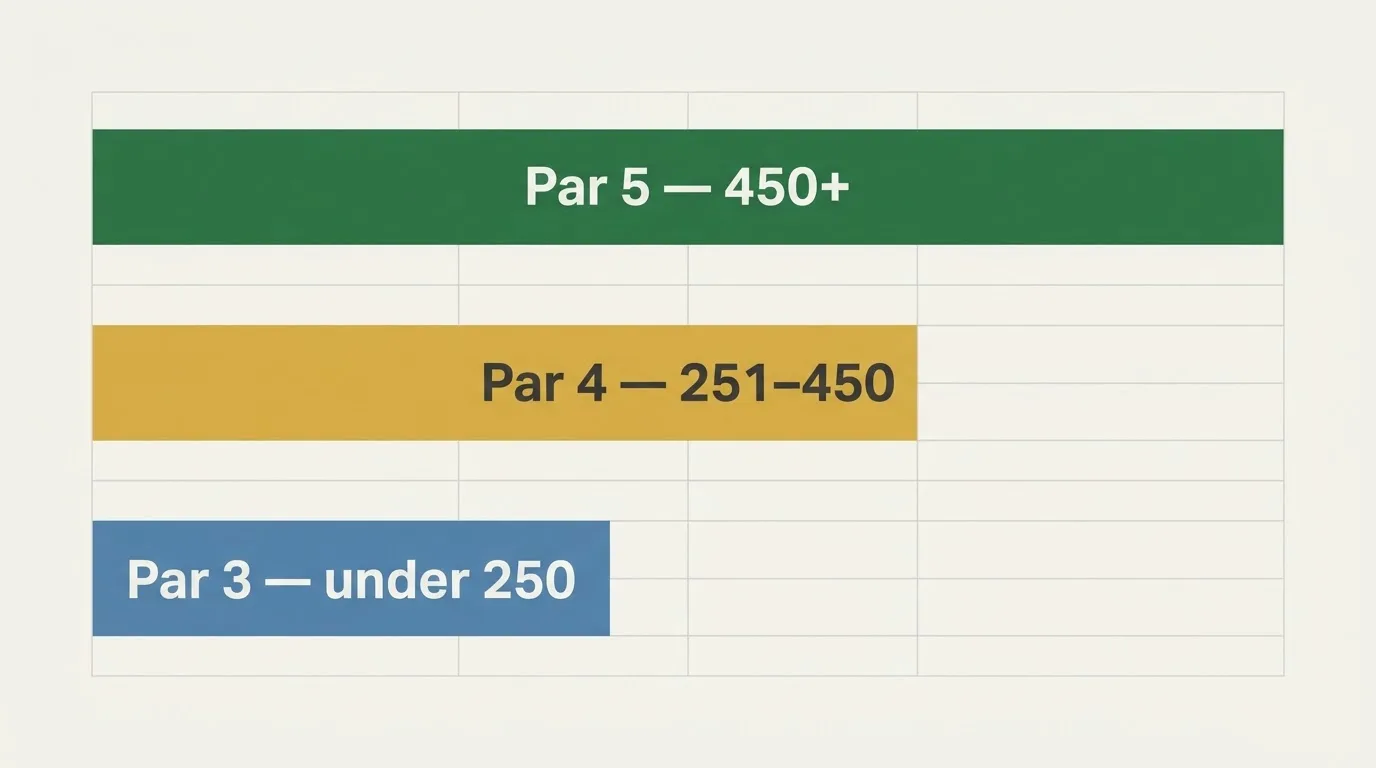
A regular golf course has 18 holes. Par 3 holes are under 250 yards for men, par 4 holes 251 to 450 yards, and par 5 holes over 450 yards. An 18-hole course typically totals par 70 to 72. A player may carry a maximum of 14 clubs in a stipulated round. The 14-club rule is one of the game’s oldest and rarely enforced at the elite level, but it is the kind of rule a punter might meet on a side market at a smaller event.
Records and benchmarks
Jack Nicklaus holds the men’s record of 18 major championships. The record has stood since 1986 and is the benchmark against which every modern career is measured. The current men’s world number one is a different benchmark that the outright market prices on a weekly basis, and the punter who backs the world number one at a Major has paid the price the market has set on a player at the top of his form cycle.
The verdict on the sport catalogue
Golf runs on a calendar the punter follows by the week. The Majors are the events with the deepest markets and the tightest margins, and the weekly events are the bulk of the betting volume. A punter who follows the calendar is following the sport. A punter who follows the Majors is following the headline. The choice is between a wider market with a tighter margin and a longer one with a wider margin, and the right answer is the calendar the punter wants to bet on.
Ten GB-licensed bookmakers and their golf products
Ten Gambling Commission-licensed bookmakers carry a golf outright market in 2026. Each is named below with the licence number on the Commission’s public register and a feature that distinguishes the product. The list is a roster of who holds a licence, not a ranking of who to bet with.
Betfred
Betfred is a long-standing British name. The app, from Done Brothers (Cash Betting) Ltd, includes 21 sports and over 2,000 casino games. It holds GB remote general betting licence 039544-R-319290-010 via Petfre (Gibraltar) Limited. The platform offers Best Odds Guaranteed on UK and Irish horse racing, and its golf product provides comprehensive outright and place markets for major tours. It is a mainstream option for standard punters.
Sporting Index
Sporting Index combines a sportsbook with spread betting. Customers switch between fixed-odds and spread markets, featuring in-play betting and Bet Builders. It operates under GB licence 027343-R-308898-011, held by Sporting Index Limited. While the sportsbook is Commission-regulated, the financial spread-betting product is FCA-regulated. This brand is tailored for punters who understand the distinction between these two betting types.
VBet
VBet offers new verified customers a £10 free bet if their initial stake of £10 or more loses. It is licensed by the Gambling Commission as SCGO Limited, under account number 44662. The welcome offer acts as insurance; punters sacrifice the initial stake in exchange for a smaller free bet should the first prediction fail. Golf markets are standard outright and place options.
Bar One Racing
Bar One Racing, now trading as BAR 1 Betting, is an Irish independent bookmaker with extensive shop presence and horse racing sponsorships. It operates under GB licence 056516-R-332750-007, held by Bar-One Racing Limited. The platform focuses primarily on horse racing, offering a supplemental golf product that caters to niche interests. It is particularly strong for punters who focus on Irish racing events.
BetVictor
BetVictor is a heritage British brand known for its racing focus, including Best Odds Guaranteed, live streaming, and form tools like BetFinder and Smart Stats. It is licensed under GB number 039576-R-319370-028, held by BV Gaming Limited. Its golf offering is a standard outright and place market, well-suited for punters who rely on form-based data analysis.
Betfair
Betfair provides both a traditional sportsbook and a betting exchange. The sportsbook includes in-play betting and live streaming, while the exchange operates under a separate betting intermediary licence (039439-R-319330-013, held by PPB Counterparty Services Limited). It is the primary option for punters seeking to lay bets, offering different dynamics compared to standard bookmakers. Punters should manage the sportsbook and exchange accounts distinctly due to separate terms.
888sport
888sport operates under licence 039028-R-319297-014, held by 888 UK Limited. The platform is a comprehensive sportsbook featuring pre-match markets, Cash Out, and live feeds. It is built for multi-sport punters who appreciate feature-heavy interfaces and frequent price boosts. The outright and place golf markets are standard, supported by the brand’s broad utility across different sports.
Betway
Betway offers a competitive Free Bet Club, granting up to £10 in weekly free bets following a £25 qualifying spend. It operates under GB licence 039372-R-319367-029, held by Betway Limited. The platform’s value proposition centres on recurring weekly rewards for active punters, complementing standard golf outright and place markets. It is suitable for those who bet consistently throughout the week.
Bet Ahoy
The licence is remote general betting standard (real events) under account 100094, held by Bet Ahoy Ltd. The free-bet structure is the kind of split welcome that gives back a sports bet and an accumulator bet, and the accumulator half is the kind of product that loses value to a slow in-play market faster than a single. This bookmaker appeals to punters who prefer a more focused welcome experience.
Swifty Sports
Swifty Sports is a sportsbook with a mainstream feature set. The bookmaker offers Best Odds Guaranteed, Cash Out on markets including horse racing and football, daily price boosts, live streaming and in-play betting; Bet Builder is listed as coming soon. The licence is remote general betting standard (real events) under account 58957, held by Swifty Global (UK) Ltd. The product is the kind of mainstream British sportsbook with a horse-racing-led feature set, and a punter who bets on racing as the main product will recognise the brand. The Bet Builder is the missing feature on a sportsbook that is otherwise mainstream.
Comparison across the ten
The table that follows summarises the ten on four matters: brand, Gambling Commission remote licence number and licence holder, and what the operator’s own terms state on the subject. The licence numbers are the entries on the Commission’s public register; the holder column names the company that holds the licence, which is sometimes different from the brand name a punter sees on the app; the third column quotes the operator’s own terms on the most distinctive feature of the product.
| Brand | Gambling Commission remote licence number and licence holder | What the operator’s own terms state on the key’s subject |
|---|---|---|
| Betfred | 039544-R-319290-010, held by Petfre (Gibraltar) Limited | App covers 21 sports plus over 2,000 casino-style games |
| Sporting Index | 027343-R-308898-011, held by Sporting Index Limited | Lets customers switch between fixed odds and spread betting, with in-play and Bet Builder |
| VBet | 044662-R-324273-022, held by SCGO Limited | Welcome offer is a £10 free bet if a new, verified customer stakes £10 or more on a first bet that loses |
| Bar One Racing | 056516-R-332750-007, held by Bar-One Racing Limited | Irish independent bookmaker with shops across Ireland and horse racing sponsorships at Dundalk, Fairyhouse, Navan, The Curragh, Curraheen Park and Cork |
| BetVictor | 039576-R-319370-028, held by BV Gaming Limited | Best Odds Guaranteed on UK and Irish horse racing, enhanced live race streaming, BetFinder and Smart Stats |
| Betfair | 039439-R-319330-013, held by PPB Counterparty Services Limited | In-play betting, Bet Builder, free live streaming and a 90 Minute Payout market |
| 888sport | 039028-R-319297-014, held by 888 UK Limited | Pre-match and in-play betting, Cash Out, Bet Builder, racing streams, BetFinder, a live bet feed and daily boosted odds |
| Betway | 039372-R-319367-029, held by Betway Limited | Free Bet Club gives up to £10 in free bets every week after opt-in; £25 on sports earns 2 x £5 free bets |
| Bet Ahoy | 100094-R-341742-003, held by Bet Ahoy Ltd | Welcome is “Bet £10 & Get £10 in Free Bets” as a £5 sports bet and a £5 acca |
| Swifty Sports | 058957-R-334734-006, held by Swifty Global (UK) Ltd | Best Odds Guaranteed, Cash Out on horse racing and football, daily price boosts, live streaming and in-play; Bet Builder coming soon |
Verdict across the ten
The ten bookmakers in this comparison are all licensed by the Gambling Commission for remote betting in Great Britain and all carry a golf outright market in 2026. The product depth on golf varies: the horse-racing-led brands run a smaller golf product than the sports-led brands, and the spread-betting brands run a sportsbook that is one of two products on the platform. The welcome offer is the right place for a punter to start, but the welcome is not the long-run value: the long-run value is the margin the bookmaker keeps of every pound wagered, and the margin is what the odds on the outright market show. A punter who reads the welcome as the offer has missed the offer; a punter who reads the margin as the offer has read it right.
How the British market on golf is licensed
Golf betting in Great Britain is licensed by the Gambling Commission, a non-departmental public body sponsored by the Department for Culture, Media and Sport, under the Gambling Act 2005. The Act covers Great Britain, which is England, Scotland and Wales; Northern Ireland sits outside the Act under its own older law, so a GB licence does not regulate Northern Ireland.
The licensing framework
A bookmaker whose remote facilities are used in Great Britain needs a Commission licence wherever it is based, since the Gambling (Licensing and Advertising) Act 2014 amended sections 33 and 36 of the 2005 Act. A Curaçao, Maltese or Gibraltar licence is not a substitute for a GB licence. The Commission runs five remote licence categories relevant to a sportsbook: remote general betting standard (real events), remote general betting standard (virtual events), remote general betting limited, remote pool betting and remote betting intermediary. The category on the licence decides what the operator may offer under its own terms, and the operator’s own terms decide what markets appear on the site.
The Commission’s public register can be searched by business name, trading name, domain or account number. The register is the whole test of whether a brand holds a licence; the test is not the brand’s own claim. The licence numbers above are taken from the register; each one names a licence holder, which is sometimes a parent company and sometimes a subsidiary, and the licence holder is the legal entity that holds the right to operate, not the brand on the punter’s app.
Minimum age and identity verification
The minimum age to bet in Great Britain is 18. The operator verifies the punter’s name, address and date of birth before the first deposit or the first bet, since 7 May 2019, including when a free bet or a no-deposit bonus is the first product on the account. The verification step is the operator’s licence condition, not the punter’s choice, and the licensed market does not run anonymous accounts. The punter who treats the verification as a one-time chore before betting has the right idea; the punter who treats it as a barrier has chosen the wrong market.
In-play, virtual events, novelty markets
GB bookmakers offer in-play betting, and the controls are the operator’s licence conditions and customer-protection duties. Esports are treated like any other event under a general betting licence. Virtual events are a separate licence category. Novelty markets on politics, TV shows and awards are offered by GB bookmakers, and no statutory prohibition was found.
Financial spread betting
A financial spread bet is a financial product regulated by the Financial Conduct Authority, not the Commission. A sports spread bet that is not a financial product sits inside General Betting Duty under the Commission’s remit. The punter who reads the term “spread betting” as a single product is wrong; the FCA-regulated product and the Commission-regulated product are two different products with two different regulators and two different sets of risks.
The verdict on the licensing framework
The GB licence is the test of who may offer a sportsbook to a punter in Great Britain, and the public register is the test of who holds one. The punter who reads the brand’s own claim as the proof has read the wrong test. The punter who reads the register has read it right.
Player protection and the safer-gambling rules
A licensed bookmaker in Great Britain operates inside a tighter player-protection regime than an unlicensed one, and the regime costs the operator in margin and costs the punter in verification. The trade is what the licence buys: the same protections an unlicensed site cannot promise.
GAMSTOP
GAMSTOP is the national multi-operator online self-exclusion scheme. Since 31 March 2020 every online operator licensed by the Commission is a GAMSTOP member, and every punter who self-excludes through GAMSTOP is excluded from every member’s site and app. Periods are six months, one year, five years, or five years with auto-renewal, and after the minimum period the exclusion stays in place for a further seven years unless the punter asks GAMSTOP to remove it.
GAMSTOP covers online sites and apps. Betting shops use a separate self-exclusion scheme. The punter who wants to exclude from online betting excludes through GAMSTOP; the punter who wants to exclude from the betting shop on the high street excludes through the shop’s own scheme.
Financial vulnerability checks and risk assessments
A financial vulnerability check applies to licensed remote betting when a punter’s deposits minus withdrawals exceed £150 in a rolling 30-day window, since 28 February 2025. The check is a public-record check, for example bankruptcy or county court judgments; it is not an income check and it is not a credit reference check. The check is the Commission’s licence condition 3.4.4, in force since 30 August 2024.
Financial risk assessments are the affordability checks the press has called “affordability checks”. The Commission announced a staged plan on 7 July 2026 with no start date. The punter who treats financial risk assessments as in force has the wrong test; the assessment is announced, staged, and has no start date.
Deposit limits
Operators must offer a gross deposit limit on a fixed time frame, under RTS 12. The first changes have applied since 31 October 2025, and a second phase was postponed to 30 September 2026; whether the second phase is live is not established. There is no state-set deposit or loss ceiling for betting: limits are the punter’s choice, not the regulator’s cap.
Help and counselling
GamCare runs the National Gambling Helpline and is the main counselling service for gambling harm in Great Britain. GambleAware funds treatment and education. NHS gambling clinics offer face-to-face support in several regions. Gamblers Anonymous runs peer-led meetings across the country. A punter who wants help has the four organisations above to start with, and each one is independent of the bookmaker.
Advertising and the under-25 rule
The CAP Code section 16 is the marketing rule book for non-broadcast advertising, and the BCAP Code is the broadcast equivalent, enforced by the ASA. The rule on under-25s is that no one who is or seems to be under 25 may be featured gambling or play a significant role in an advertisement (with an exception for marketing placed where a bet can be made directly). The rule is about who may appear in the advertisement, not about who may bet.
The bonus cap on wagering requirements at 10x since 19 January 2026 and the ban on mixed-product promotions on the same date are the promotional rules that decide what an offer can ask the punter to do. Whistle-to-whistle is an industry code, not law: since 1 August 2019 betting advertisements are not shown on TV from five minutes before a live sporting event to five minutes after it, before the 9pm watershed; horse and greyhound racing are excluded.
Payments
Credit cards are banned for gambling in Great Britain since 14 April 2020, including credit-card-funded payments through an e-wallet. Debit cards and bank-based payments are not covered by the ban. No state list of permitted payment methods was found: the operator’s terms decide what is and is not accepted.
The offshore question
A GB licence is compulsory at the point of consumption. Providing gambling facilities in Great Britain without the licence the Act requires is an offence under section 33 of the Gambling Act 2005, on summary conviction up to 51 weeks’ imprisonment, a fine up to level 5, or both; six months in Scotland. The offence is aimed at the operator, not the punter. No offence aimed at the punter who merely bets on an unlicensed site was found. The cost of betting on an unlicensed site is the loss of protection: no GAMSTOP coverage, no Commission complaints route, no approved dispute-resolution body, no British consumer redress if funds are withheld, and no guarantee the bonus cap or the vulnerability check applies.
The verdict on safer gambling
The licensed market costs the punter in verification and in checks. It buys the punter the protections an unlicensed site does not provide. A punter who treats the licensed market as the only market has the right idea for anyone who wants help to be available when they ask for it.
What the odds on golf cost the punter
Golf betting odds are a price on every player in the field, and the price carries two numbers: the payout if the player wins and the slice of every pound wagered the bookmaker keeps. The first is the headline. The second is the cost.
The cost on the outright market
A £1 stake on a player at decimal odds 21.00 returns £21 if the player wins. The bookmaker’s slice on the £1 is whatever the rest of the market’s margin is. On a 156-player field with a margin of 8 per cent across the field, the slice is 8 p of every £1 wagered on the field, and the punter is paying 8 per cent for the privilege of betting on the field.
The cost is the same regardless of which player the punter backs. The punter on the favourite at 8.00 (7/1) pays the same 8 per cent on the stake; the punter on the longshot at 201.00 (200/1) pays the same 8 per cent. The difference is that the punter on the longshot wins less often and pays the 8 per cent more times than the punter on the favourite.
The cost on the place market
An each-way bet splits the stake in two. The punter on a £10 each-way at 21.00 (20/1) at a Major with 1/4 odds places one to five pays £10 multiplied by (1/4 multiplied by (21.00 minus 1)) on the place half if the player places, which is £10 multiplied by 5.00, so £50 in place profit, plus the £5 place stake back. The win half pays if the player wins.
The cost is what the place half would have paid as a single bet, halved because the punter paid for two halves. The punter pays the bookmaker’s slice on both halves.
The cost on the in-play market
The in-play market adds a second margin to the price. The punter on a player who birdies the 14th hole and shortens from 21.00 to 11.00 has paid the in-play margin on the bet at 21.00 and is now facing the in-play margin on the cash-out at 11.00. The cost is what the operator kept in both margins.
The cost on the welcome offer
A welcome offer costs the punter what the wagering requirements cost the punter. A £10 bonus at 10x wagering costs £100 of qualifying bets, and the cost is the margin on those £100 of qualifying bets. The 5 per cent margin on £100 is £5, so the punter has paid £5 of expected margin to clear the £10 bonus.
The cost on the recurring offer
A recurring offer costs the punter what the qualifying stake costs the punter. A Free Bet Club that issues £10 in free bets after £25 of qualifying stake costs the punter the margin on the £25 of qualifying stake, which at a 5 per cent margin is £1.25, and the free-bet value is what the margin on the subsequent free-bet stake costs.
The cost on a Rule 4 deduction
A Rule 4 deduction is a refund of a small slice of the stake when a runner is withdrawn. The deduction is taken from the stake on every other runner still in the market, and the slice is bigger when the withdrawn runner was a shorter price. A punter who backs a player at 21.00 and a player at 4.00 withdraws sees a deduction on the £10 stake at 21.00, with the size of the deduction set by the operator’s Rule 4 table.
The verdict on the cost of odds
The cost of odds on golf is the margin on the market and the margin on the offer, and the two are independent. The punter who reads the headline as the cost has missed the margin; the punter who reads the margin as the cost has read it right. The bookmaker’s slice is the slice of every pound the punter wagers that the bookmaker keeps, and the slice is the difference between betting and not betting on a market.
Frequently asked questions
How do you bet on golf in Great Britain?
Open an account with a Gambling Commission-licensed bookmaker, complete the verification of name, address and date of birth before the first deposit, browse the outright market for the tournament, and place a single, each-way or accumulative bet. The settlement rule depends on the bet type: a single bet pays the stake multiplied by the decimal odds, an each-way bet pays the win half at the full odds and the place half at the place terms. The licence is the test of who may offer the bet, the public register is the test of who holds one, and the verification is the operator’s licence condition, not the punter’s choice.
What is Rule 4 in golf betting?
Rule 4 is the bookmaker’s rule on deductions when a runner is withdrawn from a race or a tournament. The deduction is taken from the stake on every other selection still in the field, and the size of the deduction is set by the operator’s Rule 4 table. The rule exists because a withdrawal changes the implied probability of every runner still in the market, and the operator recalculates the prices to keep the margin intact. The punter who backs a player at 21.00 and a player at 4.00 withdraws sees a deduction on the remaining stake; the size depends on the odds of the withdrawn player at the time of withdrawal.
What are ball coupons in golf betting?
A ball coupon is a market that prices the lowest individual hole score across a small group of players, often a three-ball in the first two rounds of a tournament. The product is fast, the margin is wider than the outright market because the bookmaker has less data on a small market, and the outcome is tied to a number the leaderboard updates at every hole. The punter who backs the favourite in a three-ball pays the operator’s slice of a market the operator has priced against a fast-moving data feed. The product is a side market at most GB-licensed bookmakers.
How can it be checked that a bookmaker holds a Gambling Commission licence?
The Commission’s public register can be searched by business name, trading name, domain or account number. The register is the whole test of who holds a licence; the test is not the brand’s own claim. Each entry on the register names the licence holder, the licence category, the account number, and the activities the licence covers. The licence holder is the legal entity that holds the right to operate, which is sometimes a parent company and sometimes a subsidiary, and the brand on the punter’s app is the trading name of that holder.
How is the return on a bet worked out from the stake and the odds?
For a single bet, the return is the stake multiplied by the decimal odds, and the profit is the stake multiplied by (decimal odds minus one). A £10 stake at decimal odds 4.00 (3/1) returns £40 and pays £30 in profit. For an each-way bet, the stake is split in two equal halves and the return on each half is worked out separately: the win half at the full odds, the place half at the place terms. A £10 each-way at 21.00 (20/1) at a Major with 1/4 odds places one to five pays £50 in place profit plus the £5 place stake back if the player places in the top five.
What is the bookmaker’s margin and how can it be seen in the odds?
The margin is the slice of every pound wagered on a market the bookmaker keeps. On a two-way market with decimal odds 1.90 / 1.90, the payout share is 1 divided by (1/1.90 plus 1/1.90), which is 0.95, and the margin is 0.05 or 5 per cent. The margin is the difference between 1 and the payout share, and the payout share is the inverse of the sum of the inverse of every price on the market. On a 156-player tournament field, the same calculation applied across 24 prices is a slice the bookmaker keeps of every pound wagered on the field, and the slice is what the punter is paying for the privilege of betting on the field. The wider the field, the wider the margin on the long tail.
Tennis, darts & cue sports – signupbetsguide.com
Content created by the «signupbetsguide.com» team
