
Rugby Union Betting Odds: How They Are Built, What They Cost and Where the Line Sits
 Available in US
A rugby union match produces a small set of clean scoreline moves — try, conversion, penalty, drop goal — and that simplicity is what the betting market hangs on. Prices move fast when the scoreboard moves, slow when it does not, and the difference between what a bookmaker quotes and what a fair price would look like is the only number on the page that matters to a punter who reads it. This guide is built around that one number: the margin the bookmaker keeps inside every quoted price, and the way it shifts when the market changes shape. The ten brands reviewed below all hold a Gambling Commission remote licence; none is recommended, and the offers listed are described from each operator’s own published terms.

Current as of 30 October 2026 — checked against the Gambling Commission public register.
What a Rugby Union Betting Offer Actually Costs
Welcome offers in this market look generous on the landing page and considerably less so once the small print lands. Take a moment with the formula before signing up to anything: a free bet token whose stake is not returned with a win, a turnover requirement that must be cleared at or above a minimum price, a deadline by which qualifying bets must settle — each of these is a cost the headline number does not show. The point of reading an offer is to see the cost, not the headine.

A matched free bet of up to £25 sounds like a free £25. Read the terms and the same offer is a token whose value depends entirely on the odds you take it at. A losing first bet triggers the credit; the credit then has to be turned into withdrawable cash through further wagering, and the minimum price rule cuts out the markets where a token would clear fastest. That is not a knock on free bets — they exist, they have a real expected value, and they are described in more detail in the live-betting section below — but the headline number is the smallest part of the offer. The terms are the rest.
The Welcome Bonus, Stripped to Its Components
Three components decide what a welcome offer is worth. The first is the trigger: a £10 deposit, a first bet of a stated size, sometimes a debit card only. The second is the reward shape, which on rugby union odds tends to be one of three — stake-back as free bets on a losing qualifier, a matched free bet on the first wager, or a bundle of free bet tokens split by sport. The third is the clearing rule: turnover, minimum selections per bet, minimum odds per leg, and a settlement deadline.
Hollywoodbets gives back up to £30 in free bets on a losing first accumulator (stake £10+, three or more legs, minimum odds of 4/1, settled within seven days, one per customer). The token only arrives after a loss, so it is a hedge against an unlucky first weekend — useful for a punter testing a new book on a tournament outright — but the seven-day window means the qualifying acca has to be picked with timing in mind. Betboro’s matched free bet of up to £25 carries a similar shape but anchors on a different trigger: a debit card deposit of at least £10, a first wager between £5 and £25, three or more selections at minimum odds of 3/5 (1.60 decimal).
BetGoodwin and Bet Ahoy ship the same skeleton in a tidier form. BetGoodwin credits the welcome as three £5 tokens (£5 sports bet, £5 acca, £5 Sub-Cover bet), while Bet Ahoy credits a £5 sports bet and a £5 acca. The structure matters because it pushes the punter towards multi-leg bets and away from the singles book — a higher margin market — but the qualification is straightforward. Each token will have its own minimum odds rule and its own settlement window; treat each as a separate offer rather than a bundle.
A bonus-cap rule applies broadly. Since 19 January 2026, wagering requirements on GB-licensed bonuses are capped at 10x the bonus amount, and mixed-product offers that demand play across two product types are banned. A £10 bonus at 50x wagering needs £500 of qualifying bets before the cap; under the new cap, no more than £100 of qualifying stakes is required to clear the same bonus. The cap does not abolish turnover — it bounds it. The clearing grind is still on the punter’s side of the line.
Free Bets, Turnover and the Real Math
A free bet is a token with a price. Take it at longer odds and the expected value rises; take it at short odds and the value crumbles because the bookmaker’s margin eats most of it. The formula is straightforward: for a token of stake S at decimal odds O on a market with payout share P, the expected value is
EV = S × (O − 1) / O × P
The free-bet stake is not returned with a winning bet; that is the discount built into the formula. A £10 free bet at decimal odds of 5.00 on a market returning 95p in the pound has an expected value of £10 × 4/5 × 0.95 = £7.60. Move the odds down to 1.80 and the same token is worth £10 × 0.80/1.80 × 0.95 = £4.22. The token did not shrink — the market on which it was used did.
The punter’s job is to spend a free bet in a market with thin margin, at prices well clear of the minimum allowed, before any expiry on the token kills it. The biggest mistake is grabbing the closest odds on the coupon because the deadline is short; the second biggest is racing to use the token on an outright market weeks from settlement when the qualification on the original offer requires settled bets inside a tight window. Both errors are common, both are expensive, and neither is fixed by the marketing copy on the offer page.
Live Rugby Union Betting and Cash Out
Live betting on rugby union is a smaller market than live football, but the mechanics are the same: prices run on a two-way line during play, the bookmaker’s margin is wider than the pre-match line because the information is moving faster than the model, and a bettor who wants to take a price has to be quicker than the next punter. Stoppages in rugby union are not counted against the clock, so games tend to run past eighty minutes — useful context when an in-play market is settling on total points at the 80-minute mark.
What Makes In-Play Markets Different on Rugby Union
Three things change between pre-match and live. First, the bookmaker’s margin widens — a two-way line that opened at 1.90/1.90 pre-match will often reappear in-play at 1.83/1.83 or wider, because the cost of updating the line mid-game is real and the bookmaker prices that cost into every quote. Second, the suspension markets — the half-time and full-time score markets, the next-points markets — appear only in-play, and the suspension-priced bookmaker can hold the line when it wants to. Third, the bookmaker’s risk tolerance changes during a match: pre-match, a £5,000 wager on a Test match is a normal stake; live, the same wager on the favourite to win when they are seven points up is a punt the bookmaker may restrict.
Betfair and Bet365 have the deepest in-play rugby union coverage among the brands on the page. Betfair’s in-play tab stacks markets from around the world — Six Nations, Rugby Championship, the autumn internationals, the southern hemisphere club competitions, the English Premiership — and adds a 90-minute payout market for selected events. Bet365 layers in-play, live streaming and a Bet Builder+ that can be assembled pre-match and re-assembled in-play as the scoreline shifts. Both products are well-built; the only difference is the depth of the underlying market.
Cash Out Is a Settlement Tool, Not a Betting Edge
Cash out settles a position before the event finishes, at a price the bookmaker is willing to lock in. Two readings of the same button matter. On an open position with a lead and time winding down, cash out is a way of locking in profit without holding one’s nerve. On a position that is drifting against the punter, cash out is a way of cutting the loss before it widens — at a price the bookmaker has set, on a market the bookmaker has modelled, with a margin that is wider than pre-match. The bookmaker does not offer cash out as a favour to the punter; it offers cash out because the margin on the locked-in price is consistently wider than the margin on the equivalent pre-match line.
The practical rule is short: use cash out to settle positions that have moved from speculative to confident, or to cut positions that have moved past the point a stake can bear. Do not use cash out as a way of “saving” a bet that is going wrong — the locked-in price is the same price the punter would have received going into the close, minus the cash-out margin. The lighter the cash-out margin, the more useful the button; the heavier it is, the less so. Sporting Index’s auto cash-out adds a programmatic layer on top of the standard button — the punter sets a stop and the system runs it, which is useful for traders running a position rather than punters holding one.
Rugby Union Betting Tips That Are Useful, and a Few That Are Not
The search market for “rugby union betting tips” is larger than the search market for the sport itself in some quarters, and almost nothing that ranks well is worth acting on. A tip is a prediction; a prediction is a guess about an outcome nobody can know in advance. What survives scrutiny is not prediction, it is the structure around it: how a bankroll is run, which markets carry thin margins, and where the timing of a wager matters.
Bankroll and Stake Sizing
Stake a fixed percentage of the bank on every bet — somewhere between 1% and 3% depending on volatility preference — and adjust the unit up or down only when the bank itself moves. This is the only staking rule a beginner has to internalise before anything else; everything that follows is decoration. A 1% stake on a £500 bank is £5; on a £2,000 bank it is £20; the punter does not need a sharper eye to use it, only the discipline to keep the unit fixed through a losing run.
A staking increase to “chase” a loss is the cleanest way to break the bank. Rugby union seasons are short and weekends are dense, so a losing run of three or four weekends is normal — chasing through it is the standard route to a busted bank.
Markets Worth Picking and Markets Worth Leaving Alone
Match odds (home win / draw / away win) on Tests carry the thinnest margin in the sport, particularly on the higher-profile internationals where liquidity is deep. A line on the Six Nations will often open inside the same margin as a Premier League football match. Margin widens as the kick-off approaches; placing the wager earlier is generally cheaper than placing it later, except in cases where team news or weather materially shifts the line. Outright markets — Rugby World Cup winner, Six Nations winner — carry a far wider margin because the bookmaker is pricing a long-shot distribution and holding risk across dozens of selections. The edge a punter has against that margin is small.
Handicap markets deserve separate treatment. A handicap of -7.5 on a Test favourite looks and feels like a price, but the bookmaker’s margin on handicap is wider than the margin on match odds because the line-set is more discretionary. A line of -7.5 on a strong favourite is not the same bet as a price of 1.20 on the same favourite to win outright — the handicap carves the favourite’s expectation thinner, and the price compensates.
Totals markets (over/under match points) sit somewhere between match odds and handicap in margin terms. Test matches sit at total lines of 41.5 to 48.5 depending on the form book; club rugby sits lower; lower-totals in the southern hemisphere leagues can run well under 40. The shape of the line is shaped as much by recent results as by underlying expectation, which makes totals one of the more contestable markets when a punter has a sharp read on the form cycle.
Where Tipsters Fail the Punter
A tipster who quotes a “lock” of the week is selling confidence nobody has. A tipster who posts a record is selling a back-tested return that may or may not survive the next season. The punter pays for the tip and pays again on the bet; if the tip is right half the time at average odds of 2.50, the punter breaks even before the subscription and loses after it. The only tip worth paying for is one that does a job the punter cannot do cheaper — a regional fixture feed, a starting-fifteen notification service, an odds-movement alert — and most of those are free or close to it.
Free tips, paid tips, and televised punditry all run on the same problem: the predictor’s record cannot be verified against their own future predictions, only against their past ones, and a record of past picks tells the punter nothing about the next pick except that this person sometimes gets it right. Take the read on team news, take the read on form, and make the call yourself.
Bet Types, Odds Formats and How a Price Settles
The market menu on a GB-licensed rugby union bookmaker starts with match odds and a handful of derivatives, expands through handicaps and totals, and deepens into player props and outrights on the bigger events. Each market settles under its own rule; each market carries its own margin.
The Core Markets
Match odds (home / draw / away) sit at the top of the coupon. Draw is a real outcome in rugby union (unlike, say, American sports), so a home win at 1.80, a draw at 21.00, and an away win at 2.40 is a normal price-ladder for a balanced Test. The margin across the three outcomes is the line to watch: a low-margin Test might sit at 1.85 / 22.00 / 2.30; a high-margin rugby league-style match might carry 1.70 / 18.00 / 2.60. The margin difference is invisible in the headline odds but real in the long run.
Handicap markets price the favourite giving points or the underdog receiving them. A handicap of -7.5 to the favourite at 1.90 means the favourite has to win by eight or more for the bet to settle as a winner. The whole-point handicap (e.g., -7, +7) gives a refund on a seven-point margin; the half-point handicap (-7.5, +7.5) eliminates the refund and forces a settled result either way. The line the bookmaker sets is part of the price, and the punter should treat the line and the odds as one number.
Totals markets price the combined match score of both teams against an over/under threshold. Tests typically line at 41.5–48.5, club matches lower. The half-point line eliminates refund the same way the handicap half-point does.
Outrights price the winner of a tournament — the Rugby World Cup, the Six Nations, the Rugby Championship, the English Premiership. Bookmakers offer outrights weeks before the tournament starts, sometimes months, and the margin on the early prices is considerably wider than the margin on the eve-of-tournament prices. The punter looking for value shops early and accepts the long settlement window; the punter looking for certainty shops late and pays the wider margin for it.
Player Props and Same-Game Accumulators
Player props — first tryscorer, anytime tryscorer, total metres made — are a newer product on rugby union but mature on football. The market depth varies wildly by event; Tests and Six Nations matches get the full range; club matches often get a single first-tryscorer market and nothing else. The margin on player props is wider than match odds because liquidity is thinner, and a punter with a sharp read on a starting XV has a more contestable edge here than on the main line.
Bet Builder and same-game accas combine markets from one event into a single price. Bet365’s Bet Builder+ extends this further by allowing legs to be added in-play as the match unfolds. The combined price of a bet builder is the multiplication of its legs, and the margin on the combined price compounds the margin on each leg. A bet builder on a Test match with four legs, each at a 6% margin, will carry a combined margin near 22% — not because any one leg is bad, but because four decent margins compounded become an expensive bet. Bet builders are a tool for casual wagering more than for disciplined staking; a punter serious about margin should assemble the same selections through singles.
Decimal, Fractional and the Conversion
GB bookmakers quote in fractional form by tradition (5/1, 11/4, evens) and offer the decimal equivalent alongside (6.00, 3.75, 2.00). The conversion is: decimal = (a/b) + 1, where a/b is the fractional form. A fractional price of 5/1 returns five pounds for every pound staked, plus the pound back, so the decimal price is 6.00. Evens (1/1) returns one pound for every pound staked, so the decimal price is 2.00. A wager of £10 at decimal 6.00 returns £60 (£50 profit, £10 stake); the same wager at fractional 5/1 returns £60 (£50 profit, £10 stake). The two are the same bet, expressed differently.
A shorter-than-evens price is “odds-on”: 4/6, 5/6, 1/2. A longer-than-evens price is “odds-against”: 6/4, 5/2, 10/1. The convention is British, and it survives because it reads cleanly to a punter who grew up with it.
Rugby Union Tournaments and What They Look Like to a Punter
The Rugby World Cup is the headline event in the betting market. New Zealand won the inaugural tournament in 1987; South Africa are the defending champions after beating New Zealand in the 2023 final; Australia hosts the 2027 Rugby World Cup from 1 October to 13 November 2027 across 24 teams in six pools of four and 52 matches. The Rugby World Cup outright market runs deep, opens months ahead of the tournament, and the margin on the early prices is the widest in international rugby.
The Annual Calendar
The Six Nations runs from late winter to mid-spring. Five rounds between February and March, six teams — England, France, Ireland, Italy, Scotland, Wales — and a market that flattens through the tournament as form crystallises. The Six Nations outright market is one of the most efficient outright markets in rugby; the margin on the eve of round one is in the same neighbourhood as the margin on a single match.
The Rugby Championship runs alongside the southern-hemisphere winter — Australia, New Zealand, South Africa and Argentina — and operates as the south’s answer to the Six Nations. The autumn internationals in November run European teams against touring southern-hemisphere teams, and the market on each autumn international is treated as a Test for pricing purposes. The English Premiership and the United Rugby Championship sit underneath the internationals on the calendar; Top 14 in France sits underneath both. Premiership and URC outright markets are sharper than Top 14 outright markets in part because of how each league is consumed by the British market.
Domestic Competitions
The English Premiership is the headline club competition in Great Britain. Bet365, Betfair, BetGoodwin, Sporting Index and others price every round; Bet365’s tie-in with the UEFA Champions League is football-specific but the operational depth carries over to the sportsbook. Premiership player markets are shallower than equivalent football markets; first tryscorer markets are offered on most fixtures but player-prop markets thin out beyond that. QuinnBet and Fitzwilliam Sports carry Premiership coverage that overlaps with the bigger books and adds little depth.
The United Rugby Championship — the cross-border league combining Welsh, Irish, Italian, Scottish and South African sides — sits further down the coupon. Match coverage is broad; outright and player-prop markets are thinner. The Currie Cup sits underneath in the southern-hemisphere club calendar, and the Super Rugby season sits across the calendar at the same depth. Each of these is a contestable market on the bigger books; a smaller bookmaker may offer only match odds.
Scoring, Stoppages and How They Change the Line
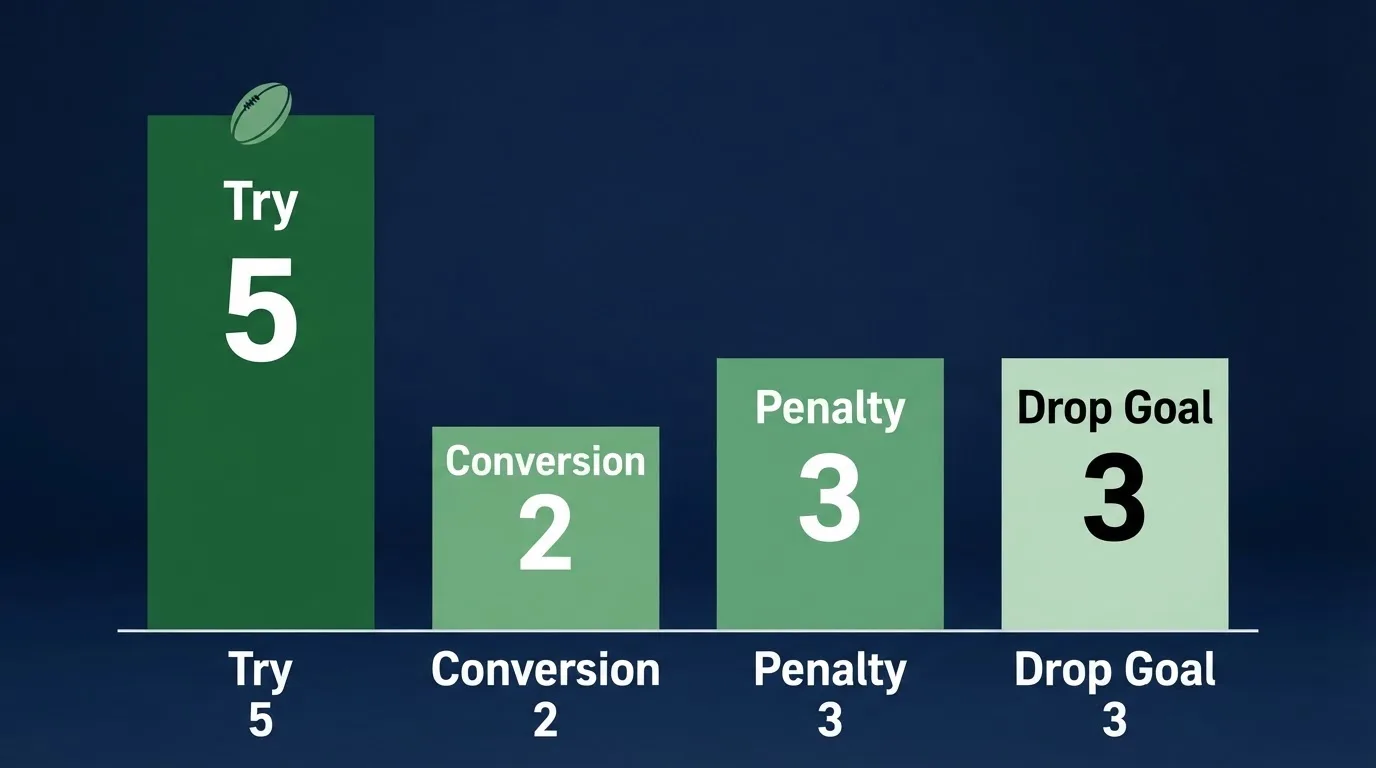
A rugby union team has 15 players on the field; a match is two 40-minute halves; stoppage time is not added on, so games typically run past 80 minutes. The shape of the game — tries, conversions, penalties, drop goals — produces a scoreboard that ticks up in 2-, 3- and 5-point moves, and the totals market prices against that distribution. The five-pointer for a try and the two-pointer for a conversion make for a natural 7-point penalty-try-and-conversion sequence, which is the most common scoring chain in a balanced Test. The punter watching a totals market should expect the line to settle around sequences of 7s and 3s more often than sequences of 5s and 2s.
Stoppages not added on means the live clock sits over 80 at the close of the second half in close to every fixture. For totals markets that settle on the 80-minute mark this is irrelevant — the line is set on the 80-minute score. For markets that settle on full-time including stoppages, the model and the price sit further apart. The bookmaker’s terms should be read on the settlement point: 80 minutes, full-time including stoppages, or full-time including extra time, each affects a totals bet differently.
The Ten Licensed Bookmakers Reviewed
Every brand below holds a Gambling Commission remote licence for Great Britain at the date of writing. Each brand runs under its own operating company through its own Gambling Commission account number; the licence number is the only thing that proves the brand on the Commission’s public register, and that register is the test of who is licensed. Reviews are not a recommendation; they are a read of each operator’s published terms and product shape, kept short by design.
| Brand | Gambling Commission licence | Operating shape |
|---|---|---|
| Tote | 054779-R-331321-008 (TDCO Limited, account 54779) | Pool-betting heritage, racing-focused, with a sportsbook bolted on. |
| Hollywoodbets | 053028-R-330019-013 (Hollywoodbets International UK Limited, account 53028) | South-African-rooted sportsbook with a stake-back welcome offer on a losing first acca. |
| Sporting Index | 027343-R-308898-011 (Sporting Index Limited, account 27343) | Hybrid fixed-odds and spread-betting sportsbook; the spread side can exceed the deposit. |
| QuinnBet | 061011-R-335683-004 (QuinnBet (Gibraltar) Limited, account 61011) | Mid-sized sportsbook with BOG on racing and a sharp in-play tennis/racing focus. |
| Betboro | 044181-R-324363-007 (Webmedia Development N.V., account 44181) | Smaller sportsbook running a matched free-bet welcome offer up to £25. |
| BetGoodwin | 002927-R-327985-008 (Goodwin Racing Limited, account 2927) | Independent racing-anchored book with a £15 free-bet welcome bundle. |
| Fitzwilliam Sports | 048760-R-335434-009 (SBKI Limited, account 48760) | Capped-membership Dublin bookmaker positioned for higher-stakes customers. |
| Betfair | 039439-R-319330-013 (PPB Counterparty Services Limited, account 39439) | The largest betting exchange in Great Britain plus a sportsbook with deep in-play and streaming. |
| Bet Ahoy | 100094-R-341742-003 (Bet Ahoy Ltd, account 100094) | Smaller sportsbook with a £10 free-bet welcome bundle. |
| Kalooki Sportsbook | 057730-R-333396-005 (Kalooki Sportsbook Limited, account 57730) | Single-purpose sportsbook on a Gambling Commission account with full GAMSTOP integration. |
The licence numbers in the table are how the reader checks the brand against the Gambling Commission’s public register; the account number is the operator’s unique identifier under that licence. None of the rows above is an endorsement, and no single brand here is the only licensed option — the Commission’s register lists the broader licensed market, and an unlicensed alternative is described in the offshore section below.
Tote
Tote runs pool betting on horse racing as its core product and offers a sportsbook alongside. The pool structure means the dividend is determined by stake distribution across the pool rather than by a bookmaker’s fixed margin, and on the racing side the value proposition looks different from a fixed-odds book. On rugby union, Tote is a thin product: match odds on the major events, fewer outrights, limited in-play. A punter looking for pool betting on racing should look at Tote; a punter looking for depth on international rugby union should look elsewhere.
Verdict: useful on the racing side, marginal on rugby union specifically; pick it for the pool-betting product rather than the sportsbook.
Hollywoodbets
Hollywoodbets is a South-African-rooted brand that licenses into Great Britain through a UK subsidiary. The welcome offer gives back up to £30 in free bets on a losing first acca (stake £10+, three or more legs, minimum odds of 4/1, settled within seven days, one per customer). In-play coverage on rugby union is built around the southern-hemisphere leagues and the internationals, and the coupon is broader than the welcome offer alone would suggest. A punter chasing the welcome should pick their first acca from a market with reasonable liquidity; a punter chasing the sportsbook should treat it as a thinner alternative to the bigger books.
Verdict: welcome offer is competitive on paper; the seven-day settlement window is the constraint a beginner underweights.
Sporting Index
Sporting Index runs a fixed-odds sportsbook and a spread-betting product under the same roof. The spread side is for experienced customers: losses on a spread bet can exceed the original deposit, which is a different risk profile from a fixed-odds wager, and the Financial Conduct Authority regulates the financial-spread product while the Gambling Commission regulates the fixed-odds side. In-play, auto cash-out and a Multi-Markets product all sit on the platform. The punter expecting a fixed-odds sportsbook exclusively is in the wrong shop; the punter willing to use both products gets a depth most fixed-odds books cannot match.
Verdict: a sharp product on the spread side; the fixed-odds sportsbook is functional rather than distinctive. Read the risk warning on the spread side before opening an account.
QuinnBet
QuinnBet runs a sportsbook anchored on racing — best odds guaranteed on UK and Irish horse racing from 10:00 daily on singles, multiples and system bets, capped at £150 per customer per race. In-play and rugby union coverage are deeper than the racing heritage suggests, and the live markets on the bigger internationals are competitive. The welcome offer is a credit-back bundle rather than a matched-deposit bonus. The punter who bets primarily on horse racing and only occasionally on rugby union gets a sharper racing product than the average; the punter who bets primarily on rugby union gets adequate coverage but no premium.
Verdict: sharp on racing and good enough on rugby union; pick it if the racing side matters at least half as much as the rugby side.
Betboro
Betboro runs a matched free-bet welcome offer of up to £25 on the first wager (£10 debit card deposit, first bet £5–£25, three selections at minimum odds of 3/5). The sportsbook is a fixed-odds book without a sportsbook-defining feature. Rugby union coverage is mainstream; in-play is functional. The punter looking at Betboro is looking at the welcome offer, and the welcome offer is competitive in shape without being standout in size. After the bonus clears, the book is one of several interchangeable options on a bigger coupon.
Verdict: the offer is worth claiming; the long-run book is interchangeable with several better-known alternatives.
BetGoodwin
BetGoodwin operates as an independent racing-anchored sportsbook under Goodwin Racing Limited. The welcome offer is a £15 free-bet bundle made up of three £5 tokens (£5 sports bet, £5 acca, £5 Sub-Cover bet). The bundle structure pushes the punter towards the higher-margin markets, which is the book’s natural shape — accas carry a wider margin than singles. In-play coverage on rugby union is adequate. The punter looking for depth on international rugby will find it shallow; the punter looking for a tidy welcome with a horse-racing book behind it will find it suitable.
Verdict: a tidy welcome and a racing-leaning book; the acca leg of the bundle is the most expensive part and the easiest to use.
Fitzwilliam Sports
Fitzwilliam Sports describes itself as a Dublin bookmaker with capped membership and a “High Stakes Welcome” subject to compliance criteria. The product set is mainstream — instant deposits, fast withdrawals, timeouts and deposit limits, with links to GambleAware, GamStop and Gamblers Anonymous. The capped-membership model keeps the customer count low, which generally means less promotional churn and tighter margins, though the brand’s sportsbook is shallow relative to the bigger books. A punter with the right profile gets a higher-stakes book; a casual punter is better served elsewhere.
Verdict: positioned for higher-stakes customers; the rugby union offering is shallow even at the right profile.
Betfair
Betfair is the largest betting exchange in Great Britain, and the sportsbook sits alongside it. On the exchange, prices are set by customers betting against each other; on the sportsbook, prices are set by Betfair. The two products run on different economics and carry different margins: exchange prices carry a commission rather than a margin, and the margin on a typical sportsbook line is wider than the typical exchange price. In-play coverage is among the deepest in the market; streaming covers UK and Irish racing and football; Bet Builder and a 90-minute payout market are layered on top. A punter disciplined enough to price-shop between the exchange and the sportsbook on the same event gets an edge a casual punter leaves on the table.
Verdict: the deepest product on the page for a punter willing to use both the exchange and the sportsbook; the sportsbook alone is good rather than great.
Bet Ahoy
Bet Ahoy is a smaller sportsbook offering a £10 free-bet welcome bundle (£5 sports bet, £5 acca). The product is mainstream; the rugby union coverage is mainstream; the in-play tab is functional. Nothing on the page marks Bet Ahoy as a destination brand, and the welcome offer is the reason to look at it once. After the bonus clears, the book sits among several interchangeable alternatives.
Verdict: a competent welcome, an interchangeable long-run book; pick it for the offer, leave it for the product.
Kalooki Sportsbook
Kalooki Sportsbook runs under Kalooki Sportsbook Limited on Gambling Commission account 57730 and is a GAMSTOP member. The product is single-purpose: a sportsbook without the racing heritage of the bigger books and without the exchange underneath. Rugby union coverage is mainstream, in-play is functional, the welcome shape is competitive. The punter looking for a focused sportsbook without a casino product on top of it finds a clean option; the punter looking for a one-stop shop finds it skinny.
Verdict: a focused sportsbook option, well-positioned for the punter who wants the sport and not the rest of the casino.
How the Margin Is Built Into Every Price
The bookmaker’s margin is the difference between what the punter would receive on a “fair” market and what the bookmaker actually pays. It sits inside every price on the coupon: the home win is shorter than fair, the draw is shorter than fair, the away win is shorter than fair, and the cumulative shortening is the margin. On a two-way market with decimal odds 1.90 / 1.90 the calculation is simple: 1 ÷ (1/1.90 + 1/1.90) = 1 ÷ (0.5263 + 0.5263) = 1 ÷ 1.0526 = 0.95. The payout share is 95p in the pound; the margin is 5%. On a three-way market the same calculation extends to three reciprocals.
Reading the Margin Off a Two-Way Line
Worked example: a rugby union Test with decimal odds 1.85 / 2.00 on a two-way line (home win / away win, no draw — a price-ladder commonly seen on handicaps or on outright head-to-head matchups). 1 ÷ (1/1.85 + 1/2.00) = 1 ÷ (0.5405 + 0.5000) = 1 ÷ 1.0405 = 0.961. The margin is 3.9%. On a Test with decimal odds 1.65 / 2.40, 1 ÷ (1/1.65 + 1/2.40) = 1 ÷ (0.6061 + 0.4167) = 1 ÷ 1.0228 = 0.978. The margin is 2.2%. Both of these are illustrative — a real-world Test with this price-ladder would carry a margin in the same band, which for international rugby is thin.
Three-Way Lines and Wide Margins
Three-way lines are the standard on rugby union match odds because draw is a real outcome. The wider the draw, the more the margin is hidden in the long price. Test match between balanced sides might sit at home 2.10, draw 21.00, away 2.40. The implied probabilities are 47.6%, 4.8%, 41.7%, summing to 94.1% — and the missing 5.9% is the margin. Move the same match to a club fixture with thinner liquidity: home 1.85, draw 19.00, away 2.55. The implied probabilities are 54.1%, 5.3%, 39.2%, summing to 98.6% — and the margin is 1.4%. Margin is what the punter pays to the bookmaker on every wager, expressed as a share of turnover.
Where the Margin Sits in the Lifecycle
The margin widens as kick-off approaches on most markets, narrows on the eve of big tournaments, and is widest on outrights opened months ahead. Outright markets opened six months ahead of the Rugby World Cup carry margins that compress as the tournament draws closer: a £10 wager on the World Cup winner in March returns less in expected value than a £10 wager on the same outcome in October. The bookmaker’s job across that window is to balance the book, and the punter’s job is to spot the markets where the balance has shifted. Outrights near the start of the tournament with thin margin are rarer than outrights opened early with wide margin.
The Legality of Rugby Union Betting in Great Britain
The Gambling Act 2005 covers Great Britain (England, Scotland and Wales); Northern Ireland runs under older legislation and is outside the Act, so the correct framing for a GB-licensed operator is that it is licensed for Great Britain, not the United Kingdom as a whole. The Gambling Commission, sponsored by the Department for Culture, Media and Sport, is the regulator and the issuer of every commercial betting licence in scope. The Commission’s public register is the test of who holds a licence.
The Licence Categories That Matter Here
Five licence categories cover what rugby union betting actually runs under. Remote general betting standard (real events) is the licence category every brand on this page holds — it permits fixed-odds betting on real sporting events to customers in Great Britain. Remote general betting standard (virtual events) is the separate licence category for computer-simulated events; it does not cover real Test matches. Remote general betting limited is a smaller equivalent of the real-events licence for operators with a constrained product. Remote pool betting covers pool products such as Tote’s racing pools. Remote betting intermediary is the licence category for betting exchanges — Betfair’s exchange operates under this category.
Since the Gambling (Licensing and Advertising) Act 2014, an operator whose remote facilities are used in Great Britain needs a Gambling Commission licence wherever it is based. A Curaçao, Maltese or Gibraltar licence is not a substitute; the Commission’s position is that the point-of-consumption test applies. None of the ten brands reviewed here are unlicensed, and the licence numbers in the table above reconcile against the Commission’s public register.
What May Be Bet On
No statutory list of permitted bets or markets exists. The LCCP and the operator’s licence conditions together determine what an operator may offer; there is no government-published schedule saying “Test match betting permitted, novelty betting not permitted.” In-play betting on real sporting events is offered by GB bookmakers; the controls are licence conditions and customer-protection duties, not a statutory framework. Spread betting on real sporting events is offered under the Gambling Commission’s general betting duty regime, while financial spread betting is regulated by the Financial Conduct Authority under a separate framework — and losses on financial spread bets can exceed the original deposit.
Credit Cards, Identity and Source-of-Funds
Credit cards have been banned for gambling in Great Britain since 14 April 2020; the ban covers credit-card-funded payments through an e-wallet, so an e-wallet top-up on a credit card falls inside the rule. Debit cards and bank-based payments are not covered by the credit-card ban. Identity verification has been mandatory before a customer can deposit or gamble since 7 May 2019, including on free bets and bonuses — name, address and date of birth are checked against public records, and the verification has to pass before the customer places a first wager. Source-of-funds checks follow at higher spend under anti-money-laundering rules.
A financial vulnerability check applies at licensed remote bookmakers under LCCP condition 3.4.4, in force since 30 August 2024. The trigger is a customer’s deposits minus withdrawals exceeding £150 in a rolling 30 days — from 28 February 2025. The check is a public-record check (bankruptcy, county court judgments, similar) and is not an income check and not a credit reference check. Financial risk assessments — the “affordability checks” of the press — are announced in a staged plan; the Commission’s article of 7 July 2026 set the framework but no start date has been fixed. The honest current read is “announced, staged, no start date”, and that is the only read the public record supports.
Bonuses, the 10x Cap and What It Costs
The 19 January 2026 bonus rules cap wagering requirements on bonuses at 10x the bonus amount and ban mixed-product promotions. The cap matters because turnover requirements on welcome bonuses used to run higher. A £10 bonus at 50x wagering needs £500 of qualifying bets; under the new cap no more than £100 of qualifying stakes is required to clear the same bonus. The cap is not the end of the clearing grind — it bounds the grind. Whether the 10x cap applies to free bets with no wagering condition is not established, and any cap on the money value of a bonus is not established; the only rule confirmed in writing is the 10x cap on bonuses and the ban on mixed-product offers.
What the Player Pays in Tax
The player pays no tax on betting winnings in Great Britain. General Betting Duty is the operator’s tax on gross profits — a 15% rate in the current regime, moving to a new structure from 1 April 2027 in which remote bets carry a 25% rate and remote bets on UK horse racing, bets on self-service betting terminals in licensed premises, pool betting and in-person betting stay at 15%. The remote rate stays at 15% until 1 April 2027. Whether operators pass duty on through odds is not established, and the honest framing is “the operator pays duty; the player does not” rather than the implied “the operator recovers duty from the player through reduced odds.”
Responsible Gambling and the Limits Around the Punter
GAMSTOP is the national multi-operator online self-exclusion scheme and a mandatory licence condition for online operators since 31 March 2020. Every GB-licensed online bookmaker — including every brand in the table above — takes part. Self-exclusion periods are six months, one year, five years, or five years with auto-renewal; after the minimum period the exclusion stays in place for a further seven years unless the customer asks GAMSTOP to remove it. The scheme covers online sites and apps; betting shops use a separate service. A punter who self-excludes through GAMSTOP cannot open a new account with any participating brand until the exclusion is lifted.
Deposit Limits and RTS 12
Deposit limits (Remote Technical Standards 12) require operators to offer a gross deposit limit on a fixed time frame. The first changes applied since 31 October 2025; a second phase was postponed to 30 September 2026; whether the second phase is live is not established. Limits are the customer’s choice — there is no state-set deposit or loss ceiling for betting. A punter who wants a deposit limit can set one; a punter who would prefer not to can decline. The terms on the operator’s responsible-gambling page set out the time frames and the changes available.
Help Beyond the Operator
GamCare runs the National Gambling Helpline; GambleAware funds treatment and prevention; the NHS runs gambling clinics for treatment; Gamblers Anonymous runs peer-support meetings. The help is independent of the bookmaker; the routes do not pass through the operator’s customer-service team and do not require the operator’s permission. A punter in difficulty has both routes — the operator’s safer-gambling tools and the external support services — and either route can lead to a useful next step.
The Offshore Edge Case
A GB-licensed operator covers the punter through the Commission’s oversight, the 10x bonus cap, the £150 vulnerability check, the GAMSTOP framework, and the approved alternative-dispute-resolution routes. An offshore brand covers none of those. The Commission’s approach to offshore is disruption: cease-and-desist notices, search-engine referrals, work with registrars, hosts and payment providers. Court-order DNS blocking powers are being prepared; ISP blocking is not in operation. The honest framing is that licensed books give the punter an enforceable complaint path and a set of safer-gambling tools, while offshore books give the punter a potentially cheaper line and no recourse if the operator withholds funds. Neither is “the safe choice” by default — both are choices, and the punter pays a different price on each.
Staking Plan, Book Size and Putting the Pieces Together
A punter’s edge is small in absolute terms because the bookmaker’s margin is small in absolute terms. A 5% margin across the punter’s book, sustained, means the punter loses 5% of turnover on average before the skill effect. A 3% margin does the same at 3%. The skill effect has to be measured against that baseline, not on its own.
Pacing the Season
The international rugby calendar runs on a roughly eight-month cycle: the Six Nations in February–March, the summer Tests in June, the Rugby Championship from August, the autumn internationals in November. Each window creates a denser betting week than the off-weeks between. A punter who treats every weekend as a betting weekend breaks the bank faster than a punter who treats the busy windows as their active weeks and the off-weeks as their review weeks.
Bankroll review is the discipline most punters skip. A weekly review of which markets produced the wins and which produced the losses tells a punter where to trim their betting and where to add to it. A punter with a positive record on handicap markets and a flat record on player props is a punter who should weight their wagering towards handicaps. The review is the part of the system nobody charges for and almost nobody does.
Multiple-Book Strategy
Carrying accounts with three to five books is the standard approach for a punter who wants price-shopping discipline. The bigger books carry the deepest markets; the smaller books carry the sharper welcome offers; the racing-anchored books carry the racing specials; the exchange carries the price-discovery layer. Routing every wager through one book is leaving money on the table; routing every wager through every book is spreading the bank too thin. The discipline is selecting which book to use on which bet, on a per-bet basis.
Tournament Windows
The Six Nations and the autumn internationals are the two windows where international rugby union gets full coverage on every book. The Rugby World Cup is the third window. Premiership and URC coverage sits in between. A punter should plan the wagering around the windows where the books are most complete, and use the off-weeks for review and bankroll management.
How a Bet Returns: The Math Underneath the Slip
A wager of £10 at decimal odds 6.00 returns £60 — the £10 stake plus £50 profit. A wager of £25 at decimal odds 3.75 returns £93.75 — the £25 stake plus £68.75 profit. The formula is the same in every case: return = stake × odds; net profit = stake × (odds − 1). A combination bet multiplies the decimal odds across the legs into one price. A four-fold at decimal legs of 1.80, 2.20, 1.65, 2.40 prices at 1.80 × 2.20 × 1.65 × 2.40 = 15.68; a £10 wager returns £156.80 — the £10 stake plus £146.80 profit, all four legs having to win for the wager to settle as a winner.
The figure that matters is the implied probability. Decimal odds 2.00 imply a 50% chance; 3.00 imply a 33.3% chance; 6.00 imply a 16.7% chance. The punter’s job is to compare the implied probability against the punter’s own estimate of the actual probability. If the punter’s estimate is meaningfully higher than the implied probability on enough wagers, the punter’s edge is real; if it is not, the bookmaker’s margin carries the day.
A Closing Note on Reading the Coupon
The margin is the number that tells a punter what they are paying to play. On a two-way line at 1.90 / 1.90 the margin is 5.0%; on the same line at 1.85 / 2.00 it is 3.9%; on 1.65 / 2.40 it is 2.2%. These are illustrative — a real-world Test will price somewhere in this band for the major markets, and the punter who reads the margin off the coupon is the punter who knows what the wager costs. The ten brands above are licensed; the offers are described from each operator’s own terms; the welcome bundle is a marketing construct, not a recommendation. The punter’s edge is small, the margin is real, and the discipline of running a fixed unit on a thin-margin market is what a long game looks like.
Frequently Asked Questions
How does rugby union betting work in the UK?
A GB-licensed bookmaker offers prices on real sporting events to customers in Great Britain under a Gambling Commission remote licence. The customer deposits, the bookmaker verifies identity, and the customer wagers against the bookmaker’s quoted prices. The bookmaker’s prices embed a margin, so over many wagers the bookmaker keeps a share of turnover. Net winnings on bets placed with a GB-licensed bookmaker are not taxed on the customer in Great Britain.
How do you bet on rugby union?
Place a wager against a bookmaker’s quoted price on a market, and the wager settles as a winner or a loser when the market closes. Match odds price home win, draw and away win; handicaps price a points start; totals price the combined match score against an over/under line; outrights price the winner of a tournament. Each market settles under its own rule, and the margin on each market varies.
How can a Gambling Commission licence be checked?
Search the Commission’s public register by business name, trading name, domain, or account number, and the register returns the licence status, the licence categories held, and the operating company. Every brand on this page reconciles against the register, and the licence numbers in the table above are the routes to do that.
How is a bet return worked out from stake and odds?
A wager of stake S at decimal odds O returns S × O; the net profit is S × (O − 1). A combination bet multiplies decimal odds across the legs into a single price. The bookmaker’s margin is the difference between 1 and the sum of reciprocals of every outcome price, so the punter’s expected value over many wagers is reduced by the margin.
What is the bookmaker’s margin and how is it visible in the odds?
The margin is the share of every pound wagered that the bookmaker keeps on average. It is visible as the gap between 100% and the sum of the implied probabilities of every outcome in the market; on a two-way line at 1.90 / 1.90 the margin is 5.0%. The wider the implied probabilities sum past 100%, the wider the margin on that market.
How do fractional odds convert to decimal odds?
Decimal odds equal fractional odds plus one. Fractional 5/1 becomes decimal 6.00; fractional 11/4 becomes decimal 3.75; evens (1/1) becomes decimal 2.00. A wager of £10 at decimal 6.00 returns £60, the same as a wager of £10 at fractional 5/1.
Rugby, cricket & Gaelic – signupbetsguide.com
Content created by the «signupbetsguide.com» team
