
What is a goliath bet, and what does it cost to play one?
 Available in US
Last updated 30 October 2026 · Licence claims checked against the Gambling Commission’s public register.
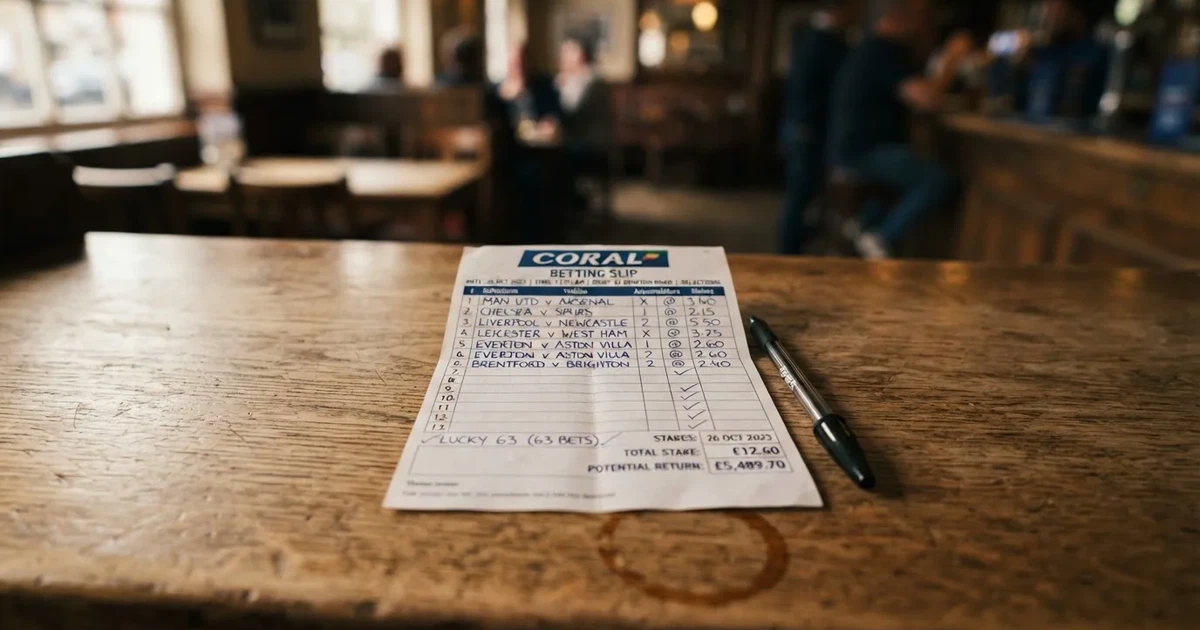
A Goliath is a single ticket that fans 247 separate bets across eight selections, and the punchline sits inside that number long before any odds do. Each of the 247 lines is paid independently, so the stake goes in 247 times over rather than once. A £1 unit stake means £247 out of pocket before a ball is kicked; a £10 unit stake means £2,470. That is the deal on its face, and the rest of this guide unpacks what those 247 bets contain, what each one costs, what a winner actually pays back and where the bookmaker’s margin hides inside the prices. The angle throughout is cost — what the wager takes from the punter — because a Goliath is sold on the romance of a long-priced winner, and the romance is the last thing a stake-holder needs to be told.
Goliath betting tips, strategy and what the stake looks like in practice
Why the Goliath exists at all
The bet is a constructed one, not an organic one. Bookmakers do not offer the Goliath because customers kept asking for 247-bet tickets; they offer it because the package price — the combined stake — inflates the operator’s take on the 8 selections while letting them advertise “one bet” to the customer. A punter who backs each of the eight selections as eight separate singles spends less for the same single-match wins; a punter who buys a Goliath pays for the privilege of also collecting on doubles, trebles, four-folds and so on up to an eight-fold that almost never lands.

The case for the bet lives at the long end of the slip. Eight selections at average odds of around 2.00 each give an eight-fold somewhere near 250.00 — the kind of headline that gets shared. The case against it is that the punter pays for all 246 lines that never hit it. Strategy material built around the Goliath typically suggests short-priced favourites for most legs and one or two longer prices to lift the eight-fold; that advice tends to treat the bet as a Lucky 15 or a Yankee with extra legs, and forgets that every additional leg shortens the odds on the long line while adding 60-odd more losing combinations.
A reasonable budget framing: a Goliath at £1 per line costs £247. The same eight selections staked as a £10 single each costs £80 and produces the same eight single-win pay-outs. The £167 difference is the price of the doubles-through-to-eight-folds. Whether that price is worth paying depends almost entirely on whether the punter believes two or more selections will win together — a forecast that is, on average, much rarer than the marketing suggests.
Bankroll, forecast and the long tail
The bankroll question for a Goliath is not “how much do I have?” but “how many of these tickets can I afford to lose in a row?” Because the bet pays only when two or more selections win, the relevant volatility is not a single game’s variance; it is the joint probability of all eight selections being correct. Eight football matches at a 55% strike rate each (a strong weekend punter’s average on singles) give a joint probability of roughly 0.55⁸ ≈ 0.0084 — less than 1%. Every line below an eight-fold is also constrained by the same correlation, and only the single lines pay out on each leg independently.

Practical forecasts that circulate in punting forums break the eight into clusters — three short-priced bankers, three mid-range, two speculative longer prices — and treat the singles and doubles as the realistic return path. That is sensible in cost terms: singles and doubles return at the average stake level across the slip and recover something close to the outlay when three or four selections win. The 1+ winning-selection outcome (which yields only single-line pay-outs) is the most common pay-out shape, and most punters see the slip end there most weekends.
Strategy pitfalls that the marketing copy skips
The marketing copy, on every operator’s landing page, leads with the eight-fold price. The arithmetic leads with what happens when four selections win: 4 singles, 6 doubles, 4 trebles and 1 four-fold pay out, and the rest of the slip is dead. A punter expecting the eight-fold has paid for an experience that almost never arrives; a punter pricing the realistic mid-range outcome gets a more honest read on what the ticket is worth.
A second pitfall is each-way. Each-way doubles the stake across every line, because each-way is two bets at equal stakes — a win part and a place part — so a £1 each-way Goliath is £494 out, not £247. Most operators do not allow each-way on the larger multi-leg lines of a full cover bet; some allow it on the singles and doubles. Whether each-way is permitted at all on the bet, and on which lines, varies by operator and is one of the terms to check before the stake is placed.
How the Goliath works, and what 247 bets actually contain
Anatomy of a full cover bet
A full cover bet is the technical name for the family of bets that takes a set of selections and constructs every possible combination of them, from singles up to the full accumulator. A Goliath sits at the top of the family tree for eight selections; smaller siblings include the Trixie (3 selections, 4 bets), Patent (3, 7), Yankee (4, 11), Lucky 15 (4, 15), Canadian or Super Yankee (5, 26), Heinz (6, 5) and Super Heinz (7, 120). The Lucky variants add singles; the non-Lucky variants do not, so a Lucky 15 on four selections is 4 singles, 6 doubles, 4 trebles and 1 four-fold = 15 bets, while a Yankee on the same four selections is 6 doubles, 4 trebles and 1 four-fold = 11 bets.
For eight selections the full cover bet has 28 doubles, 56 trebles, 70 four-folds, 56 five-folds, 28 six-folds, 8 seven-folds and 1 eight-fold, summing to the 247 lines of the Goliath. The number is not arbitrary: it is the binomial sum C(8,2) + C(8,3) + … + C(8,8), which works out to 2⁸ − 8 − 1 = 256 − 9 = 247. The 8 singletons and the 1 unit are subtracted because a full cover bet excludes singles. A Lucky 63 on the same eight selections would carry all 63 lines of a six-pick Lucky plus the four upper sizes — 8 singles plus the full Goliath set of doubles, trebles and higher multiples = 255 bets in total — at a steeper cost still.
Bet-by-bet breakdown
The 247 bets split as: 28 doubles (any 2 of the 8), 56 trebles (any 3 of the 8), 70 four-folds (any 4 of the 8), 56 five-folds (any 5 of the 8), 28 six-folds (any 6 of the 8), 8 seven-folds (any 7 of the 8) and 1 eight-fold (all 8). Every line is settled independently: a winning four-fold pays out at the combined odds of those four selections, irrespective of whether the four that did not win were also on the slip. The accumulator terms multiply into one price; for example, four selections at decimal odds 1.80, 2.10, 1.95 and 2.40 give a four-fold price of 1.80 × 2.10 × 1.95 × 2.40 = 17.68.
A unit stake is the stake per line, not per ticket. A Goliath at £2 per line costs £2 × 247 = £494. Whatever the unit stake, the maximum pay-out from any single line is unit stake × combined odds of that line. The maximum pay-out across the whole slip, on a perfect 8/8 result, is the sum across all 247 lines of unit stake × line odds — and that sum is typically capped by the operator’s maximum-pay-out rule per customer per event or per day.
How the bet settles and pays
Settlement is by individual match result and runs in the order the events conclude. As each leg is settled, the lines containing only settled legs are evaluated; lines still containing unsettled legs wait. A non-runner in any leg reduces the whole bet: the affected line drops to the next selection down (a non-runner in a four-fold makes it a treble on the remaining three), and the rule is operator-specific, so reading the house rules before staking is the only way to know how a withdrawal of a horse or the abandonment of a tennis match reshapes the slip.
Cash-out is offered by some brands on full cover bets, but with a wide qualification: cash-out is a bookmaker-conceived price on the unsettled portion of the slip, not a settlement. A brand’s cash-out price on a Goliath with three winners and five remaining legs is the bookmaker’s view of what the remaining 217 lines are worth at that moment, less their margin. Punters who want a guaranteed lock-in profit cash out only when the cash-out price exceeds the total stake paid in; cashing out early on a multi-leg bet typically yields less than letting the bet run.
Worked example: payout on a partial winner
To price what the slip actually pays, take an example. Eight football selections at decimal odds of 1.50, 2.00, 2.50, 1.80, 1.95, 2.10, 1.70 and 2.40; unit stake £10. Suppose exactly four selections win: those at 2.00, 2.50, 1.95 and 2.10.
The lines that pay are 4 singles (the four winners × £10 × odds), 6 doubles (each pair of winners), 4 trebles (each trio of winners) and 1 four-fold (all four winners). Singles: £10 × (2.00 + 2.50 + 1.95 + 2.10) = £10 × 8.55 = £85.50. Doubles: £10 × ((2.00×2.50) + (2.00×1.95) + (2.00×2.10) + (2.50×1.95) + (2.50×2.10) + (1.95×2.10)) = £10 × (5.00 + 3.90 + 4.20 + 4.875 + 5.25 + 4.095) = £10 × 27.32 = £273.20. Trebles: £10 × ((2.00×2.50×1.95) + (2.00×2.50×2.10) + (2.00×1.95×2.10) + (2.50×1.95×2.10)) = £10 × (9.75 + 10.50 + 8.19 + 10.2375) = £10 × 38.6775 = £386.78. Four-fold: £10 × (2.00×2.50×1.95×2.10) = £10 × 20.475 = £204.75.
Total return = £85.50 + £273.20 + £386.78 + £204.75 = £950.23. Total outlay was £10 × 247 = £2,470. Net position on a partial four-winner slip: −£1,519.77. A Goliath that wins only four of eight legs and pays back just over a third of stake is the modal outcome for a punters’ slip — and it is worth seeing in numbers once, because the marketing material will not show it.
What a single-decimal wagering example looks like on the accumulators
Working the same eight selections as a single accumulator (one line, eight legs) at the same £10 stake returns £10 × (1.50 × 2.00 × 2.50 × 1.80 × 1.95 × 2.10 × 1.70 × 2.40) = £10 × 1,830.06 = £18,300.60 if all eight win, with zero return otherwise. The full-cover shape distributes the same stake over 247 lines, so the punter pays £2,470 to chase a smaller upside on the eight-fold (£2,470 × 1,830.06 ÷ 247 = £18,300.60, identical on a perfect 8/8) but with running pay-outs at every shorter combination along the way. The trade is upside for resilience: a single accumulator pays 7.4× the outlay only on 8/8, while the Goliath pays out partially on any two-or-more result.
The expectation, if the implied probabilities across the eight legs are accurate, is negative for the punter on either structure; the bookmaker’s margin sits in every price. The point of the comparison is not that one structure beats the other but that both lose to a margin that, on this bookmaker’s prices, can be reconstructed from the eight quoted odds.
The 10-licensee shortlist: how the brands stack up
What the ranking is and is not
The table that follows is not a list of recommendations. It is a list of ten operators whose domains the Gambling Commission’s public register lists against a holder of a remote general betting standard (real events) licence for Great Britain, as of the register snapshot behind this guide. The register is the only test of who holds a GB betting licence; a place in this table is not an endorsement and the absence of a brand from it is not a judgement. Several groups run multiple brands under one licence (Ladbrokes and Coral, for example), and they are presented here as the registered trading names, not as separate operators.
A note on offers: every offer described below is the operator’s own terms as published, and only the structural shape — a free-bet package, a price-boost product, a fixed-odds welcome — is named. No promo code, no voucher, no sign-up link is printed, because a bonus is not the bet and a bet is not worth chasing for the bonus. The relevant question is whether the operator accepts a full cover bet of the size a Goliath requires, at stakes the punter can fund, settled under the LCCP and the operator’s own house rules.
What the columns cover
Each row carries the brand name as published, the Gambling Commission licence number and licence holder as recorded on the public register, and a brief on what the operator’s terms say about the bet type at the centre of this guide. Empty cells are rare and signal where the operator’s own page does not state a position in the consulted material; nothing is implied by the gap.
| Brand | Gambling Commission licence number and licence holder | What the operator’s own terms state on the bet |
|---|---|---|
| Fafabet | Remote licence 057385-R-333191-006 (account 57385); licence holder Taichi Tech Limited | Pays Best Odds Guaranteed on UK and Irish horse racing from 9am on race days; the relevant column for a GP football Goliath is the standard sportsbook margin, not the BOG product |
| Betway | Remote licence 039372-R-319367-029 (account 39372); licence holder Betway Limited | Welcome package of £40 in free bet tokens (4 × £10) on settlement of a first bet of at least £10 at minimum odds of 2.0; 7-day expiry; debit card deposits only |
| Bar One Racing | Remote licence 056516-R-332750-007 (account 56516); licence holder Bar-One Racing Limited | Irish independent bookmaker rebranded as BAR 1 Betting; full cover bet pricing is horse-racing-led and the racing margin drives the slip rather than the football margin |
| Unibet | Remote licence 045322-R-324275-019 (account 45322); licence holder Platinum Gaming Limited | Has operated since 1999; welcome offer of £40 in free bets on a £20 qualifying bet at minimum odds of 2.0; 7-day expiry on free bets; debit card or instant bank transfer deposits |
| DAZN Bet | Remote licence 048756-R-327274-019 (account 48756); licence holder DZBT Limited | Offers Cash Out, Bet Builder, daily bet boosts and in-play; cash out availability is not guaranteed and unsettled bets stand if it is unavailable |
| Midnite | Remote licence 101839-R-342850-001 (account 101839); licence holder Midnite Limited | Welcome offer of £25 in free bets and 50 free spins on a £5+ pre-match qualifying bet at minimum odds of 2.0 within 14 days of sign-up; 7-day validity on free bets |
| Sporting Index | Remote licence 027343-R-308898-011 (account 27343); licence holder Sporting Index Limited | Fixed-odds welcome: a £10 qualifying bet at minimum odds of 1/2 unlocks three £10 fixed-odds free bets plus spread-bet tokens; the qualifying bet cannot be placed in-play or cashed out early |
| BetMGM | Remote licence 039198-R-319450-029 (account 39198); licence holder LeoVegas Gaming PLC | Welcome offer for new UK customers: deposit £10+ and place a sports bet within 7 days to receive four £10 free bets structured as two football accumulators (4+ selections) and two sports multiples (2+); 7-day validity; minimum odds apply |
| Fitzwilliam Sports | Remote licence 048760-R-335434-009 (account 48760); licence holder SBKI Limited | Prices each selection against Oddschecker’s average; mobile apps on Apple and Google; full cover bets are settled against those average prices rather than a self-derived feed |
| Octobet | Remote licence 062545-R-337248-006 (account 62545); licence holder Octopus Game Limited | Best Odds Guaranteed on UK and Irish horse racing, capped at £150 per customer per race; the cap matters for racing-led full cover slips where one leg’s SP move can lift a line |
The pattern in the right-hand column is that the welcome offers are mostly structured as fixed-odds free bet packages rather than as cash bonuses or matched deposits. The free-bet structure carries an important property for a Goliath punter: a free bet’s stake is usually not returned with a win, so the value of a free bet on a multi-leg line is materially less than the headline figure would suggest. Staking a £10 free bet on a four-fold at 20.00 returns £200 in winnings (not £210), and the punter’s effective price is 19.00 on the free stake. Free bets on full cover bets compound this further, because each winning line keeps only the winnings, not the free-bet portion, and the gap between headline and take-home widens with every additional leg.
What the licence column actually certifies
A Gambling Commission remote licence certifies that the operator has passed the Commission’s checks on identity, finances, social responsibility code, and the LCCP’s conditions on advertising, age verification and customer interaction. It does not certify that the operator’s prices are sharper than a competitor’s, that the welcome offer is good value, or that the operator will pay out faster. It certifies a floor of conduct, not a ceiling of generosity. A punter who reads the licence number and assumes the rest is settled is reading more into the register than the register contains.
Verification is mechanical: the punter searches the public register by business name or domain, finds the licence account number, and checks that the categories listed include the kind of bet they want to place. For a Goliath on football, the relevant category is remote general betting standard (real events), which all ten brands on this list hold. A licence that covered only virtual events, or only pool betting, would not authorise a football Goliath, and the absence is visible on the register before a penny is staked.
What this shortlist does not contain
It does not contain every licensed GB bookmaker. There are several hundred on the public register; ten is a shortlist selected for the breadth of product mix on this bet, not for a ranking. It does not contain a single brand that is “the only” licensed one — there is no monopoly on GB-licensed online football betting, and any brand that holds the relevant category is allowed to compete for the slip. It does not contain any brand that lacks the licence; an unlicensed brand has no consumer protections in Great Britain, and the comparison here is among the regulated set.
The Goliath in the wider market: where it sits among full cover bets
The full cover family, by stake
The stake scaling across the family is steep, and the jump from one tier to the next is the main reason a punter steps up — or does not. A Trixie at £10 per line is £110; a Patent at £10 per line is £70; a Yankee at £10 per line is £110; a Lucky 15 at £10 per line is £150; a Canadian at £10 per line is £260; a Heinz at £10 per line is £570; a Super Heinz at £10 per line is £1,200; a Goliath at £10 per line is £2,470. Each step doubles the line count roughly; the punter pays for upper-tier multiples that, on any realistic weekend, do not pay out.
The decision between, say, a Lucky 15 (4 selections, 15 bets, includes singles) and a Goliath (8 selections, 247 bets, no singles) is not a finer or coarser version of the same bet — it is a different bet with a different shape of return. The Lucky 15 pays out from one winner up; the Goliath pays nothing on one winner because there are no singles. A punter whose selections average 2.00 will see the Lucky 15 pay out most weekends (some singles, often a double or two), while the Goliath pays nothing most weekends and pays handsomely only when four or more selections win together.
When the Goliath is the right ticket
The Goliath is the right ticket when the punter has a strong view that several of the eight selections will win and at least a few will win together. A punter working from a shortlist of eight short-priced favourites (each at around 1.30 to 1.50) expects four or five to win and a reasonable chance of two or three winning together; the doubles and trebles carry the slip on those weekends, and the upper multiples contribute rarely but generously. The bet is the wrong ticket for the punter who wants to back eight long-shots hoping for one giant eight-fold; the bet pays nothing on the eight long-shots unless at least two win, and two long-shots winning together is the rare outcome the structure is built around.
The relevant question is what the punter would do with the stake in singles. If the singles on the same eight selections would themselves cost £80 at £10 each, and the punter has £2,470 to deploy across the eight, the structure question is whether the £2,390 extra over singles is buying anything the punter genuinely values. For some, the entertainment of the long-priced combination is the value. For others, eight singles at a fraction of the cost are the more honest deployment.
The bookmaker’s margin across the family
Each line of a full cover bet carries its own margin, and the overall margin across the slip is a weighted average of the legs. A Goliath on eight selections priced at an average margin of, say, 6% per leg carries a similar margin per pound staked across all 247 lines, because the stake is identical on each line. The aggregator (the eight-fold) is the worst-priced line for the punter, because bookmaker margins compound across legs: an eight-fold at 6% per leg carries a margin closer to 40% of the price, and the punter sees this only by reconstructing it from the eight quoted odds.
A punter who wants to minimise the cost should price every selection with at least two operators, take the best price on each leg, and then build the full cover bet at the operator that prices the slip best as a package. Some operators offer a “combination bonus” on multi-leg bets — typically a 5% to 25% boost on winnings above a threshold number of legs — and that boost cuts into the compounded margin on the larger multiples. Whether the boost is worth reorganising the slip for depends on how many legs it covers and whether the qualifying legs are the ones the punter already wanted.
Legality, regulation and what a GB licence covers
The Gambling Commission and the Gambling Act 2005
The Gambling Commission (UKGC) is the regulator of the commercial gambling market in Great Britain, a non-departmental public body sponsored by the Department for Culture, Media and Sport. It operates under the Gambling Act 2005, which covers England, Scotland and Wales. Northern Ireland runs under older, separate legislation, so a GB licence does not authorise activity in Northern Ireland and an NI customer betting with a GB-licensed operator is, in strict legal terms, outside both regimes’ intended coverage. Write “GB-licensed” or “Great Britain licence” and never claim a GB licence regulates Northern Ireland.
Since the Gambling (Licensing and Advertising) Act 2014, any operator whose remote facilities are used in Great Britain needs a Commission licence regardless of where the operator is based. Sections 33 and 36 of the Gambling Act 2005 set out the offence of providing gambling facilities without the appropriate licence, with penalties of up to 51 weeks’ imprisonment, a fine up to level 5, or both in England and Wales (six months in Scotland) on summary conviction. The 2014 Act closed the previous “white-list” loophole that allowed operators based in jurisdictions such as Gibraltar, Malta or Curaçao to serve GB customers without a GB licence. A non-GB licence is no longer a substitute for a GB licence.
What the public register shows
The Commission’s public register is searchable by business name, trading name, domain or account number, and is the definitive list of who holds a licence. The register records the licence account number, the holder’s legal name, the trading names and domains covered, the licence type and categories, the issue and expiry dates, and any conditions or regulatory action. For punter purposes the check is simple: search the domain the punter is about to use, confirm the holder’s name matches the brand they expect, confirm the categories include remote general betting standard (real events) for sports, and check for open conditions.
A brand on a .com domain is no less GB-licensed than one on a .co.uk domain, and a brand on a .co.uk domain is not automatically GB-licensed — domain and licence are independent facts, and the register is the test of the second. Several brands run multiple sites (for example, a sportsbook and a casino) under one licence or under several, and the register shows the connection.
The licence categories and what they authorise
The Commission’s betting-side categories are: remote general betting standard (real events); remote general betting standard (virtual events); remote general betting limited; remote pool betting; and remote betting intermediary (the licence for betting exchanges). A Goliath on real-world football sits under remote general betting standard (real events); a Goliath on simulated events would sit under remote general betting standard (virtual events); a Goliath structured as a pool product on horse racing would require a pool-betting licence. Operators hold one or several of these; the punter’s check is whether the relevant category is on the licence.
Financial spread betting is regulated by the Financial Conduct Authority, not by the Commission. A brand that offers spread betting alongside fixed odds is doubly regulated (Spreadex, for example), and the spread-betting side carries a different consumer-protection regime and the FCA’s disclosure rules. Spread betting losses can exceed the original deposit, which is not true of fixed-odds betting, and the relevant terms are the FCA’s, not the Commission’s.
The minimum age and identity check
Minimum age for gambling in Great Britain is 18. Since 7 May 2019, name, address and date of birth are verified before a customer can deposit or gamble at a licensed operator, and the check applies equally to free bets and bonuses. Verification is typically electronic (a database check against credit-reference and public-records data) and is supplemented by document upload for higher spend. The check means there is no anonymous play at a licensed site: every deposit, every bet, every free-bet claim runs against an identified account, and a customer who fails verification cannot stake.
What may be bet on
There is no statutory list of permitted bets or markets. An operator holds a licence for a category and offers markets under its own rules and the Licence Conditions and Codes of Practice (LCCP). In-play betting is offered by GB bookmakers under their licence conditions; the controls are operator-led within the LCCP, not statutory. Esports are treated like any other event for licensing purposes; virtual events are a separate category; bets on politics, television outcomes and novelty markets are offered by GB bookmakers with no statutory prohibition. The punter’s check is the operator’s own markets list, which the LCCP requires to be transparent.
Player protection: GAMSTOP and the safer-gambling tools
GAMSTOP is the national multi-operator online self-exclusion scheme and is a mandatory licence condition for online operators since 31 March 2020. Self-exclusion periods are six months, one year, five years, or five years with auto-renewal, and after the minimum period the exclusion stays in place for a further seven years unless the customer asks GAMSTOP to remove it. GAMSTOP covers online sites and apps; betting shops use a separate service. Every GB-licensed online operator takes part.
The financial vulnerability check (LCCP condition 3.4.4, in force since 30 August 2024) applies to licensed remote betting when a customer’s deposits minus withdrawals exceed £150 in a rolling 30-day window, with the rolling window starting on 28 February 2025. The check is a public-record check (bankruptcy, county court judgments) — not an income check and not a credit reference check. Financial risk assessments (the press’s “affordability checks”) were announced in a staged plan with no start date as of the consultation behind this guide. Deposit limits under RTS 12 are the customer’s choice; the first changes applied since 31 October 2025, a second phase was postponed to 30 September 2026, and whether that phase is live is not established in the public register.
Credit cards, payments and the bonus cap
Credit cards have been banned for gambling in Great Britain since 14 April 2020 (LCCP condition 6.1.2), including credit-card-funded payments through an e-wallet. Debit cards and bank-based payments are not covered by that ban. The rule means a punter who wants to deposit at a GB-licensed operator needs a debit card or a bank-based method; the credit-card ban is one reason most welcome offers require a debit-card deposit specifically.
Bonus wagering requirements are capped at 10x by the promotion rules in force since 19 January 2026. A £10 bonus at 50x wagering would have needed £500 of qualifying bets; under the cap, no more than £100. Mixed-product promotions — an offer that requires gambling on two or more product types (betting plus casino, for example) — are banned. Whether the cap applies to free bets with no wagering condition, and any cap on the headline money value of a bonus, are not established in the consulted material.
Advertising and the ASA codes
Advertising is not licensed by the Commission. Broadcast advertising runs under the BCAP Code; non-broadcast under the CAP Code. Both are enforced by the Advertising Standards Authority (ASA), alongside the LCCP marketing conditions. CAP Code section 16: marketing must be socially responsible, must not be of strong appeal to under-18s, and no one who is or seems to be under 25 may be featured gambling or play a significant role, with an exception for marketing placed where a bet can be made directly. That rule concerns who may appear in an advertisement; it is not a rule about who may bet.
“Whistle-to-whistle” is an industry code, not law: since 1 August 2019, betting advertisements have not been shown on UK television from five minutes before a live sporting event to five minutes after it, before the 9pm watershed, with horse and greyhound racing excluded. The Premier League clubs’ voluntary withdrawal of gambling sponsorship from the front of matchday shirts from 2026/27 is a club-level commercial decision, not law.
Tax: what the punter pays, and what the operator pays
The punter pays no tax on betting winnings in Great Britain (general information, not tax advice; a professional gambler should consult HMRC or an adviser). The operator pays General Betting Duty, currently 15% on gross profits; from 1 April 2027 a remote betting rate of 25% applies within it for remote bets not on UK horse racing, while remote bets on UK horse racing, bets on self-service betting terminals in licensed premises, pool betting and in-person betting stay at 15%. Until 1 April 2027 the remote rate stays at 15%. Spread betting carries its own rates (3% financial, 10% other). Whether operators pass duty on through the odds they offer is not established in the consulted material, and the page does not claim the punter is charged duty.
The offshore option, and what is lost without a GB licence
A GB licence is compulsory at the point of consumption. An operator providing gambling facilities in Great Britain without the licence the Act requires commits an offence under section 33 of the Gambling Act 2005, with the penalties above. There is no customer-side offence established in the consulted material for merely betting with an unlicensed operator; the consequences are framed as loss of protection: no GAMSTOP coverage, no Commission complaints route, no approved dispute-resolution body, no British consumer redress if funds are withheld, and no entitlement to the bonus cap or the financial vulnerability check.
Enforcement against unlicensed operators is disruption-led: cease-and-desist notices, search-engine referrals, work with registrars, hosts and payment providers. The Commission has been given, or is about to receive, court-order DNS-blocking powers; the page does not write ISP blocking as in operation. Honest framing: licensed means checks, limits, GAMSTOP, the bonus cap and the identity regime, and also verification before the first bet; unlicensed means none of those protections and a real risk of funds being withheld. Neither is “the safe choice” by default.
Responsible gambling: where the bettor gets help
GamCare, GambleAware and the NHS
GamCare runs the National Gambling Helpline and offers one-to-one counselling across Great Britain, online and by phone. GambleAware funds treatment, research and the national prevention campaigns. NHS gambling clinics operate in several regions and offer treatment for problem gambling as a recognised health condition. Gamblers Anonymous runs peer-support meetings across the country. The four services work together; a punter who feels their betting is no longer recreational can reach any of them and be routed onward.
Self-exclusion, time-out and deposit limits
Every GB-licensed operator offers in-account self-exclusion (the punter excludes themselves from that operator’s products) and time-out (a shorter pause). GAMSTOP multi-operator self-exclusion is the strongest tool: it excludes the punter from every GB-licensed online operator for the chosen period. Deposit limits are customer-set under the operator’s safer-gambling tools; the punter can set a daily, weekly or monthly deposit cap that the operator is required to honour.
What the LCCP requires of operators
The LCCP’s social responsibility code requires operators to monitor customer behaviour, interact with customers showing signs of harm, and refuse service where the operator’s customer-interaction processes conclude the customer is at risk. The interaction is not optional: operators log it, and a customer who experiences repeated affordability or behaviour-related interactions is a customer the operator is required to manage actively. A punter who is asked intrusive questions about income or spending at a licensed operator is seeing the LCCP in action, not arbitrary questioning.
Help, plainly
If a Goliath punter feels the bet has moved from entertainment to pressure, the routes are GamCare, the National Gambling Helpline, GambleAware, NHS gambling clinics and Gamblers Anonymous. Self-exclusion via GAMSTOP removes the option at the source. Deposit limits and time-outs reduce the option in the moment. None of these is a substitute for the punter’s own decision; they are the supports for it.
How the page priced the bet
The payout calculation, plainly stated
The arithmetic the page used to price the partial-winner example takes eight decimal odds — 1.50, 2.00, 2.50, 1.80, 1.95, 2.10, 1.70 and 2.40 — multiplies the four winners’ odds to give the four-fold price of 20.475, sums the six pairwise products for the doubles, sums the four triple products for the trebles, and adds the four singles. On a £10 unit stake with four winners (2.00, 2.50, 1.95, 2.10), total return is £950.23 against total outlay of £2,470, a net position of −£1,519.77. The same eight selections staked as eight singles at £10 each returns £85.50 for the four winners, against an outlay of £80 — a net position of +£5.50. The contrast is the cost of the full cover structure on a typical weekend.
The result is a band, not a point: the four-winner case above gives a specific number for those specific odds, but the realistic range across selections priced differently is wide. A punter pricing a real slip should run the partial-winner case (typically four or five winners) before paying, using the operator’s own odds, because the operator’s margin is what makes the difference between a partial winner that returns 30% of stake and one that returns 50%. The page uses the chosen odds as an example, not as a quoted price, and a live slip at a live operator’s prices is the only number that counts.
A note on the bookmaker’s margin
The bookmaker’s margin is reconstructed from the implied probabilities of the prices offered. For a three-way football market (home / draw / away) at decimal odds of 2.10 / 3.40 / 3.60, the implied probabilities are 1 ÷ 2.10 = 0.476, 1 ÷ 3.40 = 0.294, 1 ÷ 3.60 = 0.278; the sum is 1.048, and the margin is 1.048 − 1 = 0.048, or 4.8%. A “100% market” (a margin of zero, where the implied probabilities sum to exactly 1) is the theoretical fair book; real markets carry a margin above zero, and the punter pays that margin on every pound staked, including on every line of a Goliath.
For an accumulator, the margins compound across legs. Two legs each at 5% margin do not produce a 10% margin; they produce a margin of 1 − (1 − 0.05) × (1 − 0.05) × … × (1 − 0.05) per leg, and for eight legs at 5% per leg that works out to about 34%. The compounded margin is the reason an eight-fold priced in isolation tends to be much shorter than the punter’s back-of-envelope estimate, and is also the reason a Goliath carries more margin per pound staked than eight singles on the same selections. A punter who wants to minimise the cost should take the highest available price on each leg and assemble the full cover at the operator with the sharpest combination bonus, if any.
Frequently asked questions about the Goliath bet
What is a goliath bet?
A Goliath is a single betting ticket that contains 247 separate bets on eight selections: 28 doubles, 56 trebles, 70 four-folds, 56 five-folds, 28 six-folds, 8 seven-folds and 1 eight-fold. There are no singles. The stake is multiplied by 247, so a £1 unit stake costs £247 and a £10 unit stake costs £2,470, and every line is settled independently at its own combined odds.
How many bets in a goliath?
Exactly 247. The count comes from the binomial expansion for choosing 2 or more items from 8 (C(8,2) + C(8,3) + … + C(8,8) = 256 − 8 − 1 = 247), subtracting the 8 singletons and the empty set that a full cover bet excludes. Adding singles would take the count to 255, the size of a Lucky 63 on the same eight selections.
How does a goliath bet work?
Every line pays independently. When two selections win, the 1 double containing them pays; when three win, the 3 doubles and the 1 treble pay; and so on up to the eight-fold on 8/8. A non-runner reduces affected lines to the next size down, and the rule is operator-specific, so the house rules should be checked before staking. The unit stake is the stake per line, not per ticket.
How can it be checked that a bookmaker holds a Gambling Commission licence?
The Commission’s public register at the gamblingcommission.gov.uk domain is searchable by business name, trading name, domain or account number. Searching the brand name brings up the licence holder’s legal name, the account number, the licence categories, the issue and expiry dates, and any conditions. The check is free and is the only authoritative answer to whether a brand is licensed for the bet type being placed; a brand that does not appear is not licensed for that activity.
How is the return on a bet worked out from the stake and the odds?
For a single bet, return = stake × decimal odds, and net profit = stake × (decimal odds − 1). For a combination bet (an accumulator or a multi-leg line), the legs multiply into one price first, then the same return formula applies. For example, a £10 bet at decimal odds of 2.50 returns £25 and profits £15; a £10 four-fold at combined odds of 20.475 returns £204.75 and profits £194.75. Each-way doubles the stake because it places two bets of equal size on the same selection.
What is the bookmaker’s margin and how can it be seen in the odds?
The margin is the share of every pound staked that the bookmaker expects to retain. It is reconstructed by summing the implied probabilities (1 ÷ decimal odds) of every outcome of a market; the sum exceeds 1 by the margin. A 1.05 sum is a 5% margin. On accumulators the margin compounds across legs, so an eight-fold at 5% per leg carries a margin of roughly 34% — the punter sees this when the eight-fold price is materially shorter than the product of the eight legs’ prices would suggest.
Bet types & in-play – signupbetsguide.com
Content created by the «signupbetsguide.com» team
