
Where Tether fits — and where it does not — at a UK-licensed bookmaker
 Available in US
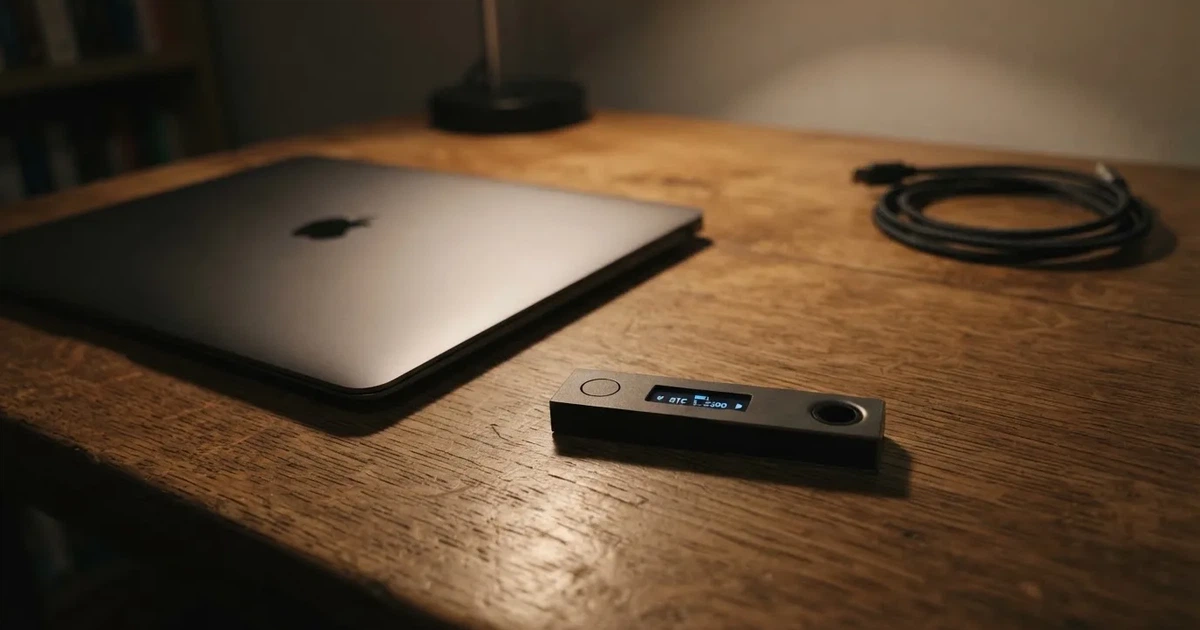
A reader who searches for “best betting sites with tether” in Great Britain is looking for one of two things. Either a bookmaker that takes USDT as a deposit, or one that lets them bet without the name-and-address drill the Gambling Commission requires. Neither of those is on offer in the same shape they expect, and the gap between what the marketing implies and what the licence enforces is the story this page tells. A hardware wallet and a closed laptop on a dim desk capture the side of Tether that reads well on a thumbnail — the wallet, the autonomy, the lack of a middleman. What they do not capture is the regulator at the other end of the deposit, and the regulator is the part that decides whether the bet exists at all.
This page was last checked against the operator domains and the Gambling Commission’s public register on 30 October 2026, with the rules and figures cross-referenced to the Gambling Commission’s own guidance, HMRC’s published position on cryptoassets, and the FCA’s announced stablecoin regime.
What Tether actually is, and what it is not
Each USDT token is intended to maintain a 1:1 peg with the US dollar. That sentence is the entire value proposition of the coin and, in fairness, the entire risk profile of the coin. Tether launched in 2014, with the first tokens issued on 6 October 2014 under the original name Realcoin; the issuer, Tether Limited, shares the same parent company as the Bitfinex cryptocurrency exchange. The coin was co-founded by Brock Pierce, Reeve Collins and Craig Sellars, and today it moves on a great number of them — Bitcoin’s Omni layer, Ethereum, Tron, Solana, Polygon and Avalanche — which is why a USDT balance can arrive at a sportsbook in a dozen different shapes that all settle to the same dollar peg on paper.

The peg is the part that has been on the wrong end of regulators more than once. In October 2021 the US Commodity Futures Trading Commission fined Tether $41.6 million for inaccurately claiming USDT was fully backed by fiat reserves at all times. In February 2021 Tether and Bitfinex reached an $18.5 million settlement with the New York Attorney General over disputed claims about USDT’s reserve backing. A token that says it is always worth a dollar, issued by a company that has been fined for saying exactly that, is not the same thing as a dollar in a current account. It is a claim about a dollar, audited unevenly and enforceable only through the issuer staying solvent.
For the bettor, the practical consequence is that USDT at a sportsbook is a deposit method with the volatility of a dollar and the counterparty risk of a private company in Hong Kong. If the peg holds, a winning bet pays out in coins that buy roughly the same basket of goods tomorrow as today. If the peg breaks, a winning bet pays out in coins that may not, and the bookmaker has no obligation to make up the difference.
The crypto and anonymity question, asked honestly
A search for the “best betting sites with tether” in Great Britain often focuses on privacy, seeking anonymity or an absence of identity checks. In Great Britain, however, a bookmaker must verify a customer’s name, address and date of birth before the customer can deposit or gamble — the rule has been in force since 7 May 2019 and applies even when the first bet is a free bet or a bonus token. The check is run by the operator against public-record and commercial databases; it is not optional, and it is not a step the customer can decline and still place a bet. The bookmaker’s own terms state this clearly at every brand reviewed below.

The Gambling Commission classes cryptoassets, including stablecoins such as Tether, as a high-risk payment method requiring enhanced customer due diligence from licensed gambling operators. Enhanced due diligence in this context means more questions, not fewer, and it normally means a source-of-funds request once a customer’s spend passes the thresholds in the Commission’s anti-money-laundering rules. A bettor who wants the anonymity a pure-crypto sportsbook promises will not find it at any operator that holds a Gambling Commission remote licence — and that is every operator reviewed below.
What this costs the reader is the speed and friction the marketing copy claims to remove. A deposit in Tether to a GB-licensed account still goes through identity verification first; the coin does not bypass the check, it sits behind it. The crypto sportsbooks that do not verify identity run outside the British licence, which means they offer no GAMSTOP coverage, no Commission complaints route, no approved dispute-resolution body and no British consumer redress if funds are withheld. The 10x bonus cap and the £150 financial vulnerability check that apply at a licensed bookmaker do not apply there, because the rules they enforce do not apply there. None of that is “the safe choice” — it is the unprotected end of the trade, dressed up as freedom from paperwork.
What the British licence frame actually requires
The Gambling Commission licenses the entire commercial market under the Gambling Act 2005, which covers Great Britain — England, Scotland and Wales. Northern Ireland runs on its own older law, so a GB licence does not regulate Northern Ireland. Since the Gambling (Licensing and Advertising) Act 2014, an operator whose remote facilities are used in Great Britain needs a Commission licence wherever it is based; a Curaçao, Maltese or Gibraltar licence is not a substitute. There is no state monopoly and no cap on the number of licences, and the Commission’s public register can be searched by business name, trading name, domain or account number — which is the whole test of whether a brand holds a licence. Star Sports, the operator reviewed below, sits on that register under account 9177.
Identity verification before the first deposit is universal at the brands reviewed on this page, and the GAMSTOP self-exclusion scheme is mandatory for every online operator. A customer can self-exclude for six months, one year, five years, or five years with auto-renewal, and after the minimum period the exclusion stays in place for a further seven years unless the customer asks GAMSTOP to remove it. GAMSTOP covers online sites and apps; betting shops use a separate service. A customer who has registered with GAMSTOP cannot open a new account at any GB-licensed operator for the period they have chosen, and a new account at an unlicensed crypto sportsbook is the standard escape route — which is why this page does not list one.
Financial vulnerability checks run at the operator’s end once deposits minus withdrawals exceed £150 in a rolling 30 days (since 28 February 2025). The check is a public-record check — for example bankruptcy or county court judgments — not an income check and not a credit reference check. Financial risk assessments, the affordability checks of the press, were announced in a staged plan on 7 July 2026 with no start date — so “announced, staged, no start date” is the honest framing. Deposit limits under RTS 12 are the customer’s choice: operators must offer a gross deposit limit on a fixed time frame, but no state-set ceiling exists. The customer sets the number, and the operator enforces it.
Advertising and bonuses are not licensed by the Commission; they run through the CAP Code (non-broadcast) and BCAP Code (broadcast), enforced by the ASA, alongside the LCCP marketing conditions. CAP Code section 16 keeps marketing socially responsible, keeps it out of strong appeal to under-18s, and stops anyone who is or seems to be under 25 from being featured gambling in an advertisement — a rule about who may appear in the ad, not who may bet. Promotion rules in force since 19 January 2026 cap wagering requirements on bonuses at 10x and ban mixed-product promotions that ask the customer to bet on two or more product types to clear an offer. Whether the cap applies to free bets with no wagering condition and any cap on the money value of a bonus are not established.
Credit cards are banned for gambling in Great Britain, including credit-card-funded payments through an e-wallet, since 14 April 2020 under LCCP condition 6.1.2. Debit cards and bank-based payments are not covered by that ban. A British named-account rule, a state list of permitted payment methods and any rule for or against cryptocurrency deposits at licensed operators are not established — the Commission’s public register does not record a position either way, so the page reports only what each operator’s own terms state.
The tax position for the player is the cleanest part of the frame: there is no tax on betting winnings in Great Britain (general information, not tax advice; a professional gambler should ask HMRC or an adviser). General Betting Duty is the operator’s tax on gross profits, currently 15% remote, and a new remote betting rate of 25% applies within it from 1 April 2027. The remote rate stays at 15% until that date. Whether operators pass duty through into odds is not established. Tether itself sits in a different frame: HMRC does not consider exchange tokens such as Tether to be currency or money for UK tax purposes, which affects their treatment across Stamp Duty, Income Tax and Corporation Tax rules. A bettor who disposes of USDT at a gain or a loss is in capital-gains territory, not in betting-winnings territory, and the gain or loss is calculated in sterling at the moment of disposal.
The FCA’s incoming cryptoasset regime adds another layer. Under that regime, firms wishing to issue stablecoins such as Tether to UK customers must obtain FCA authorisation, with applications opening on 30 September 2026 ahead of the regime’s start on 25 October 2027. Tether Limited has not been authorised by the FCA to issue USDT to UK customers as of the date of this page. A licensed British bookmaker accepting USDT is therefore accepting a token whose UK issuer status changes in 2027, and a reader who holds USDT through that period should expect the deposit and withdrawal experience at any operator to shift as the regime lands.
Where the page stops: licence, KYC, and the price of staying inside
A bookmaker on the British register does the KYC check because the licence requires it. A bookmaker off the British register does not, and that is the entire difference the marketing copy points to. The price of staying inside is identity verification at sign-up, source-of-funds questions at higher spend, GAMSTOP coverage, the bonus cap and the £150 vulnerability check. The price of stepping outside is the loss of every protection on that list plus the loss of any British route to complain if funds are withheld. The bet itself is the same product on both sides of the line. The frame around it is not.
How the licensed bookmakers reviewed here compare
The table below covers one operator from the Gambling Commission’s public register of remote betting licences. The licence account number is the test, the licence holder is the company that holds it, and the operator’s own published terms state what the brand does with crypto deposits. No single brand is “the only” licensed one — the register lists many — and a place in a comparison is not a licence. Where an operator’s own terms name no cryptocurrency payment method, the table says so plainly.
| Brand | Licence account and holder | Operator’s own terms on payment methods | Tether support |
|---|---|---|---|
| Star Sports | Account 9177, held by Star Racing Limited (remote general betting standard — real events) | Contact-led account opening via a phone line and a support inbox; standard UK debit-card and bank-based methods named on the brand’s published terms | No data on file — Star Sports’ published terms do not list cryptocurrency deposits |
Star Racing Limited, the licence holder, is the same entity behind the brand and the only company on the register against this licence. The brand’s published terms name the standard UK debit-card and bank-based rails and offer an account-opening route through a trader on the phone (08000 521 321) or via [email protected], which is unusual in this market and explains why the brand is named in the same breath as a phone-led betting shop. Star Sports’ published terms do not list a cryptocurrency deposit method, which is the honest report from the listings reviewed. A reader who wants Tether at a UK-licensed brand should treat Star Sports’ published payment page as the authoritative source rather than any affiliate page that says otherwise.
Star Sports in detail
Star Sports is the only operator this page reviews, and it sits at a precise corner of the British market. The brand takes bets by phone in a way most modern operators do not, and the published terms name a customer service line and a support email before they name a deposit method. That ordering tells the reader who the operator is for: a punter who wants to open an account by speaking to a trader rather than by filling in a form, who has questions before the first deposit, and who values the human at the other end of the line over the speed of an app.
Star Sports operates under Star Racing Limited, with a full British licence that includes mandatory GAMSTOP membership and strict identity verification before the first deposit. The published terms detail the verification flow, the available deposit methods and the routes to a trader if a customer needs support. Tether is not among the payment methods listed in the brand’s published terms, which is the authoritative record for any reader evaluating the service.
A punter looking for a Tether deposit at a GB-licensed bookmaker will not find that option at Star Sports. In fact, a British-licensed operator offering Tether is a rarity, and stepping outside the British register to find such a site carries significant risks: the loss of GAMSTOP, the absence of the Gambling Commission’s complaints route and the lack of an approved dispute-resolution body. These are substantial protections to forgo, especially for a customer waiting on a payout. A reader evaluating the options will find that staying on the British register is the only route that guarantees consumer protection.
Responsible gambling: the help that exists, and the help that does not
GamCare runs the National Gambling Helpline and is the front door for a bettor who wants to talk. GambleAware publishes guidance and signposts to treatment, including the NHS gambling clinics and Gamblers Anonymous. A bettor who wants to stop can register with GAMSTOP — six months, one year, five years, or five years with auto-renewal — and the exclusion stays in place for a further seven years after the minimum period unless the customer asks GAMSTOP to remove it. GAMSTOP covers online sites and apps; betting shops use a separate multi-operator self-exclusion scheme that the customer registers for in person at a shop.
The licensed operator sets the deposit limit. The customer can lower it at any time; raising it back up carries a cooling-off period the operator enforces. The £150 rolling-30 vulnerability check is the operator’s job, not the customer’s — the customer cannot opt out of being checked once the threshold passes. None of this is a substitute for the bettor’s own decision, but the infrastructure is in place for the decision to stick.
The unlicensed crypto sportsbook offers none of it. A customer who has registered with GAMSTOP and then opens an account at an offshore crypto book is, in practice, starting over — there is no multi-operator exclusion to honour, no Commission route to escalate a complaint to, no approved dispute-resolution body to take a withheld-payout case, and no British consumer redress if funds disappear. The frame on this page is not “licensed is safe, unlicensed is dangerous” — it is “licensed comes with checks, limits, exclusions, complaint routes and a bonus cap; unlicensed comes with none of those, and a customer who picks one is picking the absence, not the safety”.
Closing the comparison
Tether deposits at UK-licensed bookmakers remain a rarity. Licensed operators do not name USDT among their accepted payment methods in their published terms, and the British register does not record a stance on cryptocurrency deposits. Furthermore, the Gambling Commission classifies cryptoassets as high-risk, necessitating enhanced due diligence. A punter who wants to deposit in USDT while remaining on the British register will find no current, licensed option, and a sportsbook that claims otherwise without a licence is not a safe alternative.
The page’s angle is cost, and the cost is real on both sides. The licensed side costs the punter an identity check at sign-up, a source-of-funds question at higher spend, and the discipline of a deposit limit and a GAMSTOP exclusion that cannot be bypassed by opening a new account. The unlicensed side costs the punter every protection on that list, plus any realistic route to recover funds if a payout does not arrive. The licence is the bettor’s only enforcement mechanism against a withholding operator, and an offshore book has none. A reader who weighs the two honestly will, in most cases, choose the licensed side — and if Tether is the deposit method that tips the choice, the right answer is to wait until a licensed operator names it on its own terms page, not to step outside the register to find one.
Frequently asked questions about Tether at a UK betting site
Can you bet against tether?
Tether is a deposit method at a sportsbook that accepts it, not a side of a bet the customer can take. Wagers are placed against the bookmaker’s prices in the usual way, and the stake is settled in USDT if that is what was used to deposit; the bet itself has no “against tether” structure the way an exchange lay bet does.
Can you lose on tether betting?
Yes. The token’s peg to the US dollar does not protect a stake from being lost on a losing wager, and a USDT payout on a winning bet is worth whatever USDT is worth in sterling at the moment the payout arrives. The bet works like any other bet, with the same risk of a stake lost on a wrong result.
Can you use tether in betting shops?
The betting shops reviewed on this page run on the standard UK over-the-counter rails and do not list cryptocurrency deposits in their published terms. The British high-street bookmaker pays out and takes deposits in sterling through the tills; Tether is a digital token and the shop counter is not a crypto point of sale.
What does a player lose by betting on a site without a Gambling Commission licence?
The player loses GAMSTOP coverage, the Commission’s complaints route, any approved dispute-resolution body and British consumer redress if funds are withheld. The 10x bonus cap and the £150 vulnerability check do not apply either, because the rules that enforce them do not apply. The bet is the same product; the frame around it is not.
How can it be checked that a bookmaker holds a Gambling Commission licence?
Search the Commission’s public register by business name, trading name, domain or account number; the register is the whole test of whether a brand holds a licence. A licence number printed on the brand’s own terms page is a starting point, not a confirmation — the register is the confirmation.
Payments & apps – signupbetsguide.com
Content created by the «signupbetsguide.com» team
