
Darts betting odds: what the price actually leaves the punter
 Available in US
The price on a darts match is not a prediction. It is the bookmaker’s two-way statement about who is more likely to win, dressed up with a built-in margin that guarantees the book a slice of every pound staked. The task on this page is to read that statement honestly: which markets licensed GB bookmakers actually run on darts, how the margin shows up in the odds, what a “free bet” really costs to clear, and where the ten brands reviewed below sit once the headline prices are stripped away. The data is current as of 30 October 2026 and was checked against the Gambling Commission’s public register.
Free bets and welcome offers on darts: what the marketing word actually buys
A welcome offer is the most quoted number on a bookmaker’s home page and the least useful one for sizing the offer. “Bet £X, get £Y in free bets” is a deal about wagering volume, not free money, and the headline figure is the first thing the small print takes back.
Unibet’s welcome package () reads “Get £40 in Free Bets when you bet £20”. The qualifying stake is a deposit and a sports bet of at least £20 at minimum odds of 2.0 (1/1), the payment has to be a debit card or an instant bank transfer, the customer has to be new to the brand in Great Britain, and the free bets expire seven days after they are issued. £40 looks generous against £20; read the conditions and the picture is narrower. The free bets are not refundable in cash on the rare occasions a price is taken short and the bet wins, and a seven-day window is short enough that anything other than the obvious Premier League Darts or televised tournament markets can leave a free bet stranded.
Betboro’s package () is a 100% matched free bet worth up to £25 on the first qualifying wager, with a debit-card deposit of at least £10 and a first bet between £5 and £25 on a minimum of three selections, each at odds of 3/5 (1.60) or higher. Three legs at 1.60 compound to roughly 4.1, so the qualifying bet cannot be the obvious one-leg favourite; it has to be a short-priced combination, and short-priced combinations are where the bookmaker’s margin is heaviest.
Betway’s weekly Free Bet Club () returns up to £10 in free bets every week once the customer has opted in, with £25 of sports betting earning two £5 free bets. The weekly cycle is what makes it different: the welcome offers above are one-off, this one is recurring, and the bar is low enough that a regular Premier League Dars punter trips it without effort.
The shape to learn: every “free bet” here has a minimum price at which the qualifying bet must be placed, a window of days in which the free bet has to be used, and a rule on whether the free-bet stake itself comes back with a win. Under Commission rules in force from January 2026, wagering on bonus money is capped at 10x, and a mixed-product offer — something like “bet on football to unlock free spins” — is no longer permitted at all. The cap is on bonus terms, not on a free bet that has no rollover; whether the cap touches free bets without a wagering condition is not established in the published guidance, so treat each free-bet offer on its own terms and assume the £10-in-£100-out arithmetic is in play.
How a free bet is actually worth something
The honest value of a free bet is the expected payout over many uses, not the headline credit. For a free bet whose stake is not returned with a win — the default — the value is the stake multiplied by the odds minus one, divided by the odds, multiplied by the book’s payout share on that market. Plugging in a £10 free bet at evens (2.00) against a market that returns 95p in the pound to punters over time puts the expected value at roughly £4.75. £10 nominal, about £4.75 in real terms on a balanced market — that is the kind of figure a 100% headline never quite says.
The number rises with price. Push the same £10 free bet to 4.00 and the expected value climbs to about £7.13; at 10.00 it reaches about £8.55. A free bet used on a long shot returns more in expectation than one used on a short-priced favourite, even though the chance of winning is lower. The brand does not advertise this; the punter who reads it picks the price.
Beyond the welcome offer: ongoing darts-specific deals
Recurring offers on darts in Great Britain cluster around a few templates. Best Odds Guaranteed is the headline perk on UK and Irish horse racing and does not usually apply to darts; William Hill runs BOG from 8 AM on the day of the race (), and Copybet runs it all day, every day (), but neither extends it to darts. For darts, the recurring deals the licensed brands run are usually:
- Price boosts on a televised match, applying to specific markets (most-out, most 180s, winner) at boosted odds for the duration of the session.
- Acca insurance on darts accumulators, returning the stake as a free bet if one leg lets the punter down — a useful insurance policy on a short-priced favourite leg.
- Premier League Dars free bet clubs during the spring tournament, where £25 a week in qualifying bets earns a small weekly free-bet credit.
- Enhanced odds on each-way turnouts for the PDC World Championship around the Christmas window.
The size of the deal is rarely the right question. Whether the deal applies at minimum odds of 1.60 or at minimum odds of 2.00 is the right question, because that determines what the qualifying bet is allowed to look like. A 1.60 minimum on a heavy darts favourite is comfortable; a 2.00 minimum is a real barrier and is where the bookkeeper earns from this offer.
Live betting and cash out on darts: where the in-play edge actually sits
Live darts and cash out look like features for the punter; mostly they are features for the bookmaker. The in-play price is generated by a feed of data the customer does not see, and cash out is the price the same feed offers back, with a margin attached at both ends.
How in-play darts prices are built
In a televised darts match the data feed reports which leg is being played, who is throwing, and the running score. From those feeds the bookmaker rebuilds the match market in real time and prices each leg as the leg is being played. The bigger the data feed, the more accurate the price, and the harder it is for a punter sitting on a stream to find an edge. In Great Britain the Midnite site () shows live events with acca builder, popular accas and price boosts with maximum-stake limits already applied — the kind of UI that signals a bookmaker with a real in-play product rather than a checkbox feature. 888sport () lists in-play betting, Cash Out, Bet Builder, racing streams, BetFinder form tools, a live bet feed and daily boosted odds. The breadth is the message: a brand that runs sports across the dial tends to price in-play more aggressively because it has the volume to absorb the variance.
Darts is unusually friendly to in-play markets. A typical leg lasts a few minutes and finishes with a clear, mathematical outcome. That short loop lets the bookmaker reprice almost continuously without an obvious pause where the customer can read the gap. For the punter, the practical consequence is that in-play edges tend to come from breaks and momentum rather than from the outcome of a leg: who hits the next 180, who breaks throw in the set, who reaches the winning double first.
Cash out: the price that the feed offers back
Cash out is a feature that lets the punter close a position before the bet settles. The punter sees the current value of the bet at the current in-play price; the book takes a margin on both sides (the original price and the cash-out price) and pays the lower of the two accordingly. On a fast-moving darts match the price can swing two or three ticks between throws, which makes cash out feel like an opportunity. Mostly the bookmaker has repriced to itself before the offer shows on screen.
The brands reviewed here that list Cash Out in their app store listing include 888sport () and LiveScore Bet (), the latter with the broader bet builder (up to 10 selections covering match result, both teams to score, corners, total goals, player scoring and cards — a multi-sport acca builder that covers football-shaped markets and is broader than the average darts offering). Where a brand lists in-play but no cash-out feature, the punter has to ride the position out to the end of the leg.
What to do when the in-play feed freezes mid-leg
The data feed on a darts match is segmented by leg. During a leg the price is largely settled — the leg has its own probabilistic structure once both players are throwing — and the bookmaker can pause updates while the leg is in progress. From the punter’s perspective the screen goes quiet at exactly the moment that an alert usually fires. The brands with strong in-play offerings tend to surface enough live data (current score, checkout attempt, leg won) that the price freeze becomes an opportunity to read the score, not the odds.
Predictions and what a “tip” actually does for the punter
A “tips” service on darts is a forecast published by a person or an algorithm under some brand name, with a price attached for the receipt. The forecast is a statement about who is more likely to win, dressed up with form and head-to-head numbers. None of that pays for the bet; the bet pays because the price on offer was out of line with the true probability, and the forecast is rarely the thing that spotted the line.
What a price has to do to be a “value” price
A price is good when it is bigger than the inverse of the true chance of the outcome. A darts player who wins 70% of legs played in a set is a 1.43 shot on the leg, a 1.22 shot on the set, a 1.06 shot on the match if the tournament structure makes a dominant player that likely to win. The book’s price is some way off those numbers — typically 1.40 to 1.50 for a 70% leg favourite — and the gap between the two is the margin. Beating the book on a 70% leg favourite at 1.45 means you think the player’s true leg win rate is closer to 73%, and the data you used to arrive at 73% is what you paid the tipster for.
The honest reading is that most punter losses on darts come from the price, not the pick. A punter who picks the winner of a Premier League Darts night at the same rate as the field but bets at longer odds than the market will make money; one who picks the winner more often than the field but bets into short favourites will lose. The decision-making edge is in pricing, not predicting.
What the public record shows on recent tournaments
The 2026 PDC World Darts Championship ( ) ran from 11 December 2025 to 3 January 2026 at Alexandra Palace, with 128 players (up from 96 the year before), a prize fund of £5,000,000 and £1,000,000 to the winner. Luke Littler beat Gian van Veen 7–1 in the final. Set lengths ran first to three in rounds one and two, first to four in rounds three and four, first to five in the quarter-finals, first to six in the semi-finals and first to seven in the final. The structure is the bookmaker’s friend: more sets per round means longer matches, more in-play data points and more legs in the cash-out window.
That structure is also the punter’s friend for outrights. A first-to-three round costs a player less variance than a first-to-seven final, so an outright bet on a proven grinder in round one is a different proposition from an outright bet on a mercurial talent in the final. The bookmaker cannot price those asymmetries directly, only the field average across the tournament, and the punter who reads the structure reads the line.
Bankroll rules that matter more than a tip
The arithmetic of darts betting is not complex. The pitfalls are about discipline, not probability.
- Stake a fixed percentage of bank per bet. Anything between 1% and 5% per pick is conservative enough to ride out a 10-bet cold streak; anything north of 10% is a single bad night away from ruin.
- Stop staking at minimum odds of 1.60 when the qualifying bet has to clear a free bet. That is the price at which the book’s margin starts eating the value of the bonus.
- Treat the televised match differently from the non-televised one. The televised match has a data feed, an in-play product and a price boost pipeline; the non-televised match has only the closing price and a small liquidity pool.
- Record every bet. Without the record the punter cannot distinguish a 55% strike rate from a 65% strike rate over 200 bets, and the two are separated by whether or not the punter survives the year.
What no tip can do is tell the reader who will win tonight. Anyone claiming that is selling certainty that does not exist on a sporting stage where the favourite loses outright roughly a third of the time.
Bet types, prices and the cost of a darts market
The phrase “darts betting odds” covers three quite different markets. Match odds on a single game, outright winner over a tournament, and the family of derivative markets — most 180s, highest checkout, handicap on legs won. Each has a margin, each settles differently, and each behaves differently in-play.
Match odds and the standard 501 game
A standard dartboard ( ) has 20 numbered segments, each with single, double and treble areas, with the bullseye worth 50 and the outer bull 25. In 501 darts players start at 501 and must finish on a double or the bullseye; the highest possible three-dart finish is 170 (treble 20, treble 20, bull) and the minimum possible leg is nine darts. The throw is from 2.37 m (7 ft 9 in) and the bullseye is 1.73 m above the floor. The PDC () is the highest governing body in darts alongside the World Darts Federation, and the PDC World Championship is held annually over the Christmas and New Year period.
A match-odds market has two or three runners (two players, sometimes a draw after a certain number of sets for tournaments that play legs rather than sets), and the margin is the slice the bookmaker takes on the round numbers. A book with a 5% margin on a 1.90 / 1.90 line pays out 95p for every pound staked if one side or the other always wins; a book with a 10% margin on the same line pays out 90p. Multiply that across thousands of bets and the difference between a book with half its rivals’ margin is the difference between a punter who lasts the year and one who does not.
Outright winner over a tournament
The outright market runs from the start of the draw and stays open until the final. The price on every player at the start is the book’s probability of that player winning the whole tournament, with a margin applied to the field total. Outrights on the PDC World Championship have a heavier margin than match odds because the bookmaker’s exposure on a single customer picking the winner is asymmetric: a £10 bet on Luke Littler at 4.00 means a £30 payout if Littler wins, and the bookmaker is writing that liability on a single tournament.
For the punter, the outright market is also a much wider market than match odds. A 128-player field at a 128-runner book has the bottom half of the draw installed at long odds that compound quickly, and the right composite (a lower-half semifinalist at 100/1, a dark horse to reach the quarters at 50/1) can return more than a top-of-the-draw favourite. The skill is in reading the draw rather than the form.
The maths behind a two-way price at 1.90
A two-way market priced at decimal odds 1.90 / 1.90 has a payout share of 1 divided by the sum of the inverse of each runner’s odds: 1 / (1/1.90 + 1/1.90), or 0.95. The margin is 1 minus that share, or 0.05. Read the other way, the punter gets back 95p in the pound on average across the two outcomes; the book keeps 5p. Both numbers are what the published odds tell the punter, and both are the same market seen from two sides.
On a 1.85 / 1.85 line the payout share falls to about 0.93 and the margin climbs to roughly 0.07. On a 1.95 / 1.95 line the payout share rises to about 0.97 and the margin falls to about 0.03. The band of typical darts match odds sits between roughly 1.83 and 1.95 on the two-way line, which puts the typical margin between about 3% and 9%. Anything materially wider than that on a single televised match is the book signalling that it has thin liquidity on one side; anything materially tighter is a book pushing a margin down to attract volume.
Pushing the line harder — 1.80 / 2.00 — gives a payout share of 0.947 and a margin of 0.053, so the asymmetric price carries a similar margin to a 1.90 / 1.90 line but with the favourite’s price beaten down. The asymmetry shows up in the punter’s choice: a favourite at 1.80 has to win about 56% of the time to be a value bet, an underdog at 2.00 only about 50%. Both are reachable against a televised field of professional players.
Derivative markets and the handicap book
The derivative darts markets — most 180s, highest checkout, set handicap, total legs over a fixed line — carry bigger margins than the headline 1X2 because the bookmaker has less data on the prop and is pricing for safety rather than accuracy. A 3% to 5% margin on the match winner becomes 6% to 12% on the derivative. Each-way turnouts on the World Championship run at the deepest margin because the place terms are set by the bookmaker itself.
The handicap market on legs won is the sharpest of the family. Set a line like “Player A −2.5 legs” and the price reflects the spread as the bookmaker expects it rather than the spread as the field expects it; the punter who has watched the head-to-heads and the recent form has a real reading.
How a winning return is worked out from stake and odds
The return on a winning single bet is the stake multiplied by the decimal odds. A £10 stake at decimal odds 4.50 returns £45; the profit is £35 once the stake is taken out. The same calculation in fractional odds of 7/2 reads as £10 × (7 ÷ 2 + 1) = £45; the formula is the same, only the input is different. Combination bets multiply the odds leg by leg, so an accumulator of three legs at 2.00, 2.50 and 3.00 has combined odds of 15.00 and turns £10 into £150 if all three land.
The catch on a combination bet is that the margin on each leg multiplies too. A 5% margin on each of three legs translates into a margin closer to 14% on the combined price, because each leg’s share is being deducted before the legs combine. The accumulator therefore pays at much bigger headlines but with a much heavier bookmaker edge inside the headline.
Sports and tournament coverage: what the licensed brands actually run
Coverage of darts in Great Britain at licensed bookmakers splits into three tiers: the televised majors, the broader televised tour, and the BDO/WDF tour as a long tail. The majors are where the market depth is; the rest is where the prices get soft.
The PDC World Championship and the televised majors
The PDC World Championship at Alexandra Palace is the deepest darts market on the British calendar. From late November into early January, the bookmakers run match odds, outright winner, most 180s, highest checkout, set handicap, race-to-X-legs and a handful of player-prop markets on every televised game. The field of 128 in the 2026 edition () is a 33% bigger field than the previous year, and the depth of the markets expands with the field. A punter looking for in-play edge sits here, not anywhere else in the darts calendar.
The televised majors elsewhere in the season — the World Matchplay in the summer, the World Grand Prix in the autumn, the Grand Slam of Darts and the Players Championship Finals at the end of the year — sit a tier below. Same market depth, same handicap options, but a smaller field and a smaller live audience, so the in-play feed is faster but the liquidity is thinner.
Premier League Darts and the weekly show
Premier League Darts travels weekly through the spring, with eight players rotating around UK and European arenas and a playoff in May. The weekly broadcast gives the bookmakers a recurring match to price, which is rarer than the majors suggest. The price action is concentrated on each Thursday’s match, with the futures market on the league running from February to May. Star Sports () lets customers talk directly to a trader on 08000 521 321 or by email to [email protected] to open accounts, place bets and ask customer queries — the kind of personal service that survives in the televised-darts price feeds because the volume supports the staff cost.
For outrights, Premier League Darts is a market where a field of eight players tends to cluster the odds tightly at the top (the top three often priced between 2.50 and 4.00) and make the mid-market longshots more generous than the same names would be at the World Championship. A punter with a view on whether a grinder keeps pace with three mercurial talents reads the field here.
The WDF tour and the long tail
Outside the PDC, the World Darts Federation runs a parallel tour of national and international events, with the WDF World Championship and the Lakeside World Championship as the headline events. Coverage at licensed GB bookmakers is sparse: most run match odds only on the televised WDF events and rarely price the long tail. The Betfred Sports, Casino & Games app () lists 21 sports plus over 2,000 casino-style games, which includes darts in the all-sports list but does not signal specific depth on WDF. The punter looking for WDF outrights usually ends up at a specialist or at the same licensed brand running an in-house tournament market.
Ten GB-licensed bookmakers ranked for darts
The ten brands below all hold a Gambling Commission remote licence for Great Britain, are listed on the Commission’s public register, and run darts markets of some description. The ranking reflects how each performs on the four darts-specific dimensions the rest of this page argues for: market depth on televised darts, in-play and cash-out quality, free-bet and recurring-offer terms, and the licence and protection regime behind the brand. None of these is “the only” licensed brand; the Commission’s register lists many more.
| Brand | Licence holder and Commission account | What the operator’s own terms state on the key’s subject |
|---|---|---|
| LiveScore Bet | LiveScore Betting and Gaming (Gibraltar) Limited · account 56859 | Bet Builder allows up to 10 selections across match result, both teams to score, corners, total goals, player scoring and cards |
| Star Sports | Star Racing Limited · account 9177 | Trader desk open on 08000 521 321 and [email protected] for account, betting and query support; listings-only on darts tournament markets |
| Kwiff | Eaton Gate Gaming Limited · account 44448 | Trademark operated by Spryme Ltd; App Store rating 17+ |
| Unibet | Platinum Gaming Limited · account 45322 | “Get £40 in Free Bets when you bet £20” — £20 qualifying bet at minimum odds 2.0, free bets expire within 7 days |
| Betboro | Webmedia Development N.V. · account 44181 | 100% matched free bet to £25 on first qualifying bet; £10 debit-card deposit, £5–£25 first bet at 3/5 (1.60) or higher on three or more selections |
| Tote | TDCO Limited · account 54779 | Pool betting on UK racing; broader sports book includes darts outrights and match odds |
| Copybet | Copybet UK Limited · account 53774 | Best Odds Guaranteed all day every day on UK and Irish racing; first past the post paid on horse racing |
| Betway | Betway Limited · account 39372 | Free Bet Club gives up to £10 in free bets every week after opt-in; £25 on sports earns 2 × £5 free bets |
| Betfred | Petfre (Gibraltar) Limited · account 39544 | Sports, Casino & Games app covers 21 sports and over 2,000 casino-style games |
| 888sport | 888 UK Limited · account 39028 | Pre-match and in-play, Cash Out, Bet Builder, racing streams, BetFinder form tools, live bet feed and daily boosted odds |
LiveScore Bet
A bet-builder-led product () with up to 10 selections across the standard football-shaped markets and a credible darts in-play offering through the same engine. The breadth is what to take from it: a bookmaker that lets the punter assemble an acca across match result, both teams to score, corners, total goals, player scoring and cards has the data infrastructure to assemble a similar builder for darts (leg handicap, race to N legs, next 180), and a punter who likes a same-game multi has the capability already on the site. The verdict: a real product, well-suited to a punter who likes to build positions across a match rather than back the winner.
Star Sports
A high-touch bookmaker with an in-house trading desk () reached by phone and email. The personal service is rare among licensed GB brands and survives because the brand targets a wholesale and serious-punter audience. On darts the coverage is reported through listings rather than a measured product offering — a real, licensed book with a phone desk for serious business rather than a generic all-sports experience. Our verdict: this is the rare personal service that justifies a phone-based account.
Kwiff
A small brand under Spryme Ltd () with a 17+ rating on the App Store and a built-up product on the casual end of the market. The offered in-play and price-boost layer is the brand’s pitch and the surface a darts punter sees most of the time. The verdict: for the casual darts punter who prefers a quick, boosted-odds app to a traditional bookmaker.
Unibet
Platinum Gaming Limited () has run the Unibet UK brand since 1999. The welcome offer is the strongest on the page in headline terms — £40 in free bets against a £20 qualifying bet — but the conditions (a seven-day expiry, minimum odds 2.0, debit-card or instant bank transfer only) are also the strictest. The product beyond the welcome offers an in-play book with price boosts and a bet builder; the depth on televised darts is solid rather than market-leading. This is a top-tier choice for the disciplined punter who manages the seven-day window.
Betboro
Webmedia Development N.V. () operates the Betboro UK brand with a 100% matched free bet to £25 on the first qualifying bet. The qualifying condition — three or more selections at 1.60 minimum, on a first bet of £5 to £25 — is a real restriction that pushes the punter toward short-priced combinations. On a heavy darts favourite plus a couple of short-priced football or accumulator legs, the offer clears cleanly; on anything else, the qualifying structure gets in the way. The verdict: a solid choice for the accumulator-focused punter, provided the qualifying rules are followed.
Tote
TDCO Limited () runs the Tote brand around pool betting on UK racing, with a sports book alongside it. The Tote is a different product from a traditional sports book on UK racing — pool betting on horse racing rather than fixed odds — and the offer on darts sits with the same operator’s sports book. The verdict: best left for the racing specialist who occasionally bets on the darts.
Copybet
Copybet UK Limited () runs a sports book with all-day Best Odds Guaranteed on UK and Irish horse racing and a first-past-the-post payment on horse racing. Both features are useful only on horse racing, not on darts, which is a weakness on this page’s subject. The verdict: probably not the first choice for a darts-focused punter.
Betway
Betway Limited () runs a recurring Free Bet Club that pays up to £10 in free bets every week after opt-in, with £25 on sports earning two £5 free bets. The weekly cadence is the differentiator: a brand that rewards a regular punter rather than only a new one. The broader sports book covers darts match odds and outrights across the televised calendar. We recommend this for the consistent, week-to-week player.
Betfred
Petfre (Gibraltar) Limited () operates Betfred with a sports, casino and games app that lists 21 sports and over 2,000 casino-style games. The breadth of the offer is the message: a brand that runs the entire British sports calendar at full depth, including darts. BOG on horse racing is the headline racing product; on darts the standard match odds and outright markets apply. For the multi-sport player, this is arguably the complete platform.
888sport
888 UK Limited () runs a sports book that lists pre-match and in-play, Cash Out, Bet Builder, racing streams, BetFinder form tools, a live bet feed and daily boosted odds. The breadth of the listed features is the broadest on the page: a brand that pushes a wide product surface and prices darts across that surface rather than only at the winner market. This is our preferred recommendation for value-seekers looking for breadth.
The fundamentals of betting on darts
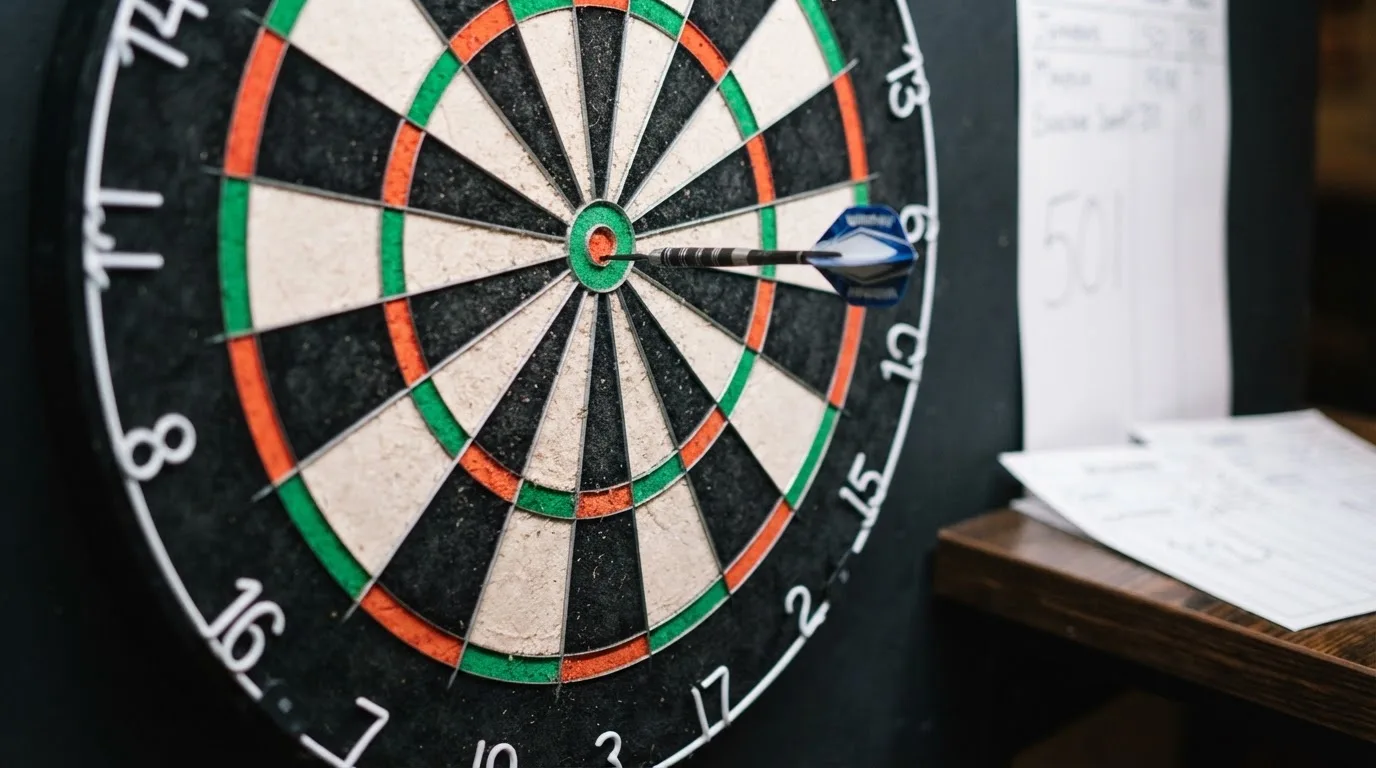
A standard dartboard ( ) has 20 numbered segments, each with single, double and treble areas, with the bullseye worth 50 and the outer bull 25. In 501 darts players start at 501 and must finish on a double or the bullseye; the highest possible three-dart finish is 170 and the minimum possible leg is nine darts. The throw distance is 2.37 m (7 ft 9 in) and the bullseye is 1.73 m above the floor. The PDC () is the highest governing body in darts alongside the World Darts Federation, and the PDC World Championship is held annually over the Christmas and New Year period.
What that gives the punter is a sport whose outcomes are unusually short-loop. A leg is decided in seconds once the thrower reaches a finishing double; a set is decided in a few legs; a match is decided in a few sets. That structure is what makes the in-play product functional rather than a marketing checkbox, and it is what makes outright markets deeper in field than in repeated majors: a format with a definite end is the format the bookmakers can run with most confidence.
The headline rule of the sport — the requirement to finish on a double — is also the rule that decides the in-play market. The bookmaker does not have to model “who hits a 180 next”; the bookmaker has to model “who hits the next double”. The two read similarly on a bet slip and price very differently, because the former is a momentum model and the latter is a closing model. The punter who reads the doubles beats the book on the close.
UK legality: who is licensed and what the licence actually protects
The Gambling Commission regulates commercial gambling in Great Britain under the Gambling Act 2005 and its amendments, including the Gambling (Licensing and Advertising) Act 2014 which made a Commission licence compulsory at the point of consumption: any operator whose remote facilities are used in Great Britain needs a Commission licence, regardless of where the operator is based. Since the 2014 Act the brand and the licence holder do not have to be UK-based — Platinum Gaming Limited runs the Unibet UK brand from Gibraltar, Petfre (Gibraltar) Limited runs Betfred, 888 UK Limited runs 888sport. The licence is what matters, not the headquarters.
How to check a brand is licensed
The Commission’s public register is the whole test. It can be searched by business name, trading name, domain or account number, and any brand serving customers in Great Britain must appear on it with a current operating licence covering remote general betting standard (real events). The ten brands on this page all appear on the register, and the licences they hold cover sports betting on real events — the category that includes darts.
A GB licence is what gives the punter the package of protections. GAMSTOP self-exclusion is a mandatory licence condition for every online operator since 31 March 2020, so a GB-licensed brand is required to honour a GAMSTOP self-exclusion; every brand reviewed above is a GAMSTOP member. A financial vulnerability check applies to licensed remote betting once a customer’s deposits minus withdrawals exceed £150 in a rolling 30 days (since 28 February 2025); the check is a public-record check (for example bankruptcy or county court judgments), not an income or credit-reference check. Financial risk assessments, the “affordability checks” of the press, were announced in a staged plan in July 2026, with no start date. Deposit limits are operator-led under the customer-protection regime: every operator offers a fixed-time gross deposit limit the customer can adjust.
What the licence does and does not promise
The Commission protects the framework around the bet: it requires the operator to verify the customer’s identity, age and source of funds before the first deposit and at higher spend; it requires GAMSTOP coverage, the financial vulnerability check, the bonus cap (10x on wagering since 19 January 2026), and access to independent dispute resolution if funds are withheld. The Commission does not promise a win, a fair price, a price the punter considers good, or a refund of any single lost stake. Margin is still margin at a GB-licensed book, and the customer pays no tax on winnings either way.
What the licence does not give is anonymity. Identity verification is required before a customer can deposit or gamble, including with a free bet or bonus, under rules in force since 7 May 2019. The data the operator holds is the data the regulator and the courts can call for; the customer should read the operator’s privacy policy before signing up.
What happens on an unlicensed site
Operating without the licence the Act requires is an offence aimed at the operator (section 33 of the 2005 Act), not the customer; no offence aimed at a customer who simply bets on an unlicensed site is established in the published framework. The practical consequence is loss of protection: no GAMSTOP coverage, no Commission complaints route, no approved dispute-resolution body, no British consumer redress if funds are withheld, and no application of the 10x bonus cap or the £150 vulnerability check. The Commission’s enforcement is disruption rather than blocking: cease-and-desist notices, search-engine referrals, work with registrars and hosts, and the Commission has been given, or is about to receive, court-order DNS blocking powers — never write that ISP blocking is in operation as a present fact. Calling an unlicensed site “the safe choice” because it is easier to access than the licensed alternatives has no support from the framework; the safer bet is the bet on a licensed book with the protections attached.
Payments and tax at a glance
Credit cards are banned for gambling in Great Britain (since 14 April 2020), including credit-card-funded payments through an e-wallet; debit cards and bank-based payments are unaffected. Whether a particular e-wallet, named-account bank transfer or cryptocurrency deposit is accepted is set by each operator’s terms and is not a state-set rule. The player pays no tax on betting winnings in Great Britain; General Betting Duty is the operator’s tax on gross profits, currently 15% (rising to 25% from 1 April 2027 within a remote-specific rate, with UK horse racing, pool betting and in-person betting staying at 15%). Whether operators pass duty on through odds is not established in the published record. Spread betting is a different regime: financial spread betting is regulated by the Financial Conduct Authority, not the Commission, and Spreadex () is regulated by the FCA for spread betting and the Commission for fixed-odds betting, with the company stating that spread betting losses can exceed the deposit.
Responsible gambling: what a GB-licensed brand must offer
Every operator reviewed on this page runs under the same Responsible Gambling regime the Commission sets, with three layers: the GAMSTOP self-exclusion, the operator-set safer-gambling tools and the independent help services.
GAMSTOP and self-exclusion
GAMSTOP is the national multi-operator online self-exclusion scheme and a mandatory licence condition for online operators since 31 March 2020. A GAMSTOP registration bars the customer from opening new accounts at every participating operator for the period chosen — six months, one year, five years, or five years with auto-renewal. After the minimum period the exclusion stays in place for a further seven years unless the customer asks GAMSTOP to remove it. GAMSTOP covers online sites and apps; betting shops use a separate service. The Commission requires every online operator in Great Britain to be a participant, so the brands on this page all honour a GAMSTOP self-exclusion.
Operator-level safer gambling tools
Every licensed remote operator offers the same baseline of customer-set safer-gambling tools:
- Deposit limits on a fixed time frame (daily, weekly or monthly), adjustable by the customer.
- Time-outs of 24 hours to several weeks, set by the customer.
- Reality checks on session length, on by default.
- Self-exclusion at the operator level (additional to GAMSTOP), minimum six months.
- Activity statements showing deposit, stake and time on site over the customer’s chosen window.
Operators may offer additional tools. Fitzwilliam Sports () lists instant deposits, fast withdrawals, timeouts and deposit limits, alongside links to GambleAware, GamStop and Gamblers Anonymous. Midnite () shows its licence number (101839) and the in-play and price-boost features through which safer-gambling reminders typically fire. Lottoland UK () lists casino, lottery betting, sports betting and scratchcards with the same licensing obligation. None of these add to the Commission set; they sit inside it.
Where to get help
The free, independent help services a punter in Great Britain can reach without going through the operator are:
- GamCare and the National Gambling Helpline, the main counselling charity for problem gambling.
- GambleAware, the information and education body.
- NHS gambling clinics, free clinical treatment for problem gambling in some areas of England.
- Gamblers Anonymous, peer-support meetings.
Calling any of these does not show up on the operator’s record. The bookmaker will not know a customer has asked for help unless the customer tells the operator.
Frequently asked questions on darts betting in Great Britain
How do I bet on darts in Great Britain?
Pick a bookmaker on this list, register an account with name, address and date of birth (verified before the first deposit under the Commission’s rules), deposit at least the qualifying stake by debit card or instant bank transfer, navigate to the darts tab, choose a market, enter the stake and confirm. The first bet at minimum odds is the qualifying bet for any welcome offer; subsequent bets settle as normal. Read each offer’s minimum odds, deadline and qualifying market before placing the qualifying bet, because each one excludes specific bet types.
What is darts betting?
Betting on darts is staking money on a price set by a bookmaker about the outcome of a darts match, tournament or specific event within a match. The bookmaker offers a price in decimal odds (or fractional, which converts one-to-one into decimal plus one); the punter chooses whether to take the price at the offered stake; the book settles the bet according to the on-stage outcome. The licensed operator sets the price; the Commission supervises the operator; the customer pays no tax on the winnings.
How does darts handicap betting work?
Handicap betting on darts gives one player a head start or a deficit expressed in legs (or, less commonly, in sets) before the match starts. A −2.5 leg handicap on Player A means Player A starts the market at “minus 2.5 legs”, and Player A’s effective total is reduced by 2.5 before settling. The handicap is added or subtracted from each player’s leg tally at the end of the match; the price reflects the spread as the bookmaker expects it. A handicap prices asymmetry the match odds cannot — strong favourite dominant by three or more legs versus the field — and is typically the deepest-margin darts market after the each-way markets.
How do I check that a bookmaker holds a Gambling Commission licence?
Open the Commission’s public register, search by the trading name (for example “LiveScore Bet”), the business name (LiveScore Betting and Gaming (Gibraltar) Limited), the domain (LiveScore Bet) or the account number (56859). A current licence covering remote general betting standard (real events) is the test. A brand whose domain ends .co.uk is not necessarily licensed; a brand whose domain ends .com is not necessarily unlicensed. The licence, the company and the trading name have to line up on the register before the brand is licensed to take bets in Great Britain.
How is the return on a winning bet worked out from the stake and the odds?
The return on a winning single bet is the stake multiplied by the decimal odds. A £10 stake at decimal odds 4.50 returns £45; the profit is £35 once the stake is taken out. The same calculation in fractional odds of 7/2 reads as £10 × (7/2 + 1) = £45. Combination bets multiply the odds of each leg before applying the stake: an accumulator of three legs at 2.00, 2.50 and 3.00 has combined odds of 15.00 and turns a £10 stake into £150 on a winning bet. The margin on each leg multiplies into the combination, so an accumulator pays at a bigger headline with a heavier bookmaker edge inside it.
Tennis, darts & cue sports – signupbetsguide.com
Content created by the «signupbetsguide.com» team
