
What football betting odds really cost the UK punter in 2026
 Available in US
*Current as of 30 October 2026 · verified against the Gambling Commission’s public register of remote operating licences.*
A bookmaker’s headline price is the number that gets the click. The cost of football betting sits behind that number, in the margin built into every market and the wagering requirements attached to every welcome offer. This guide works through both, across ten Gambling Commission-licensed operators reviewed for football betting in the Great Britain market. The angle throughout is what each pound staked actually costs the punter — at the line, in the fine print, and in the long run.

The structure follows the order in which a typical reader runs into the costs: the markets and the price shape first, then the offers that dress them up, then the apps and live betting that move around them, then a calculation that turns a sample 2.10 / 3.40 / 3.60 line into a margin the page can quote as a band. The ten operators are then reviewed on the same fields, and the legal and safer-gambling frame closes the page before the questions readers most often raise.
Fixtures, prices and what a football betting market actually is
A football betting market is a set of mutually exclusive outcomes on one event (home win, draw, away win) or related events across a match, with a price attached to each. The bookmaker compiles those prices the way a bookmaker always has — and the way every licensed UK operator still has to under the Gambling Act 2005. Football itself runs to a rule book older than the betting industry around it: the Laws of the Game of association football are maintained by the International Football Association Board (IFAB), which has done so since 1886, and a standard adult match consists of two halves of 45 minutes each, with stoppage time added at the referee’s discretion. A tied match may go to extra time of two further 15-minute periods, and some competitions then use a penalty shoot-out.
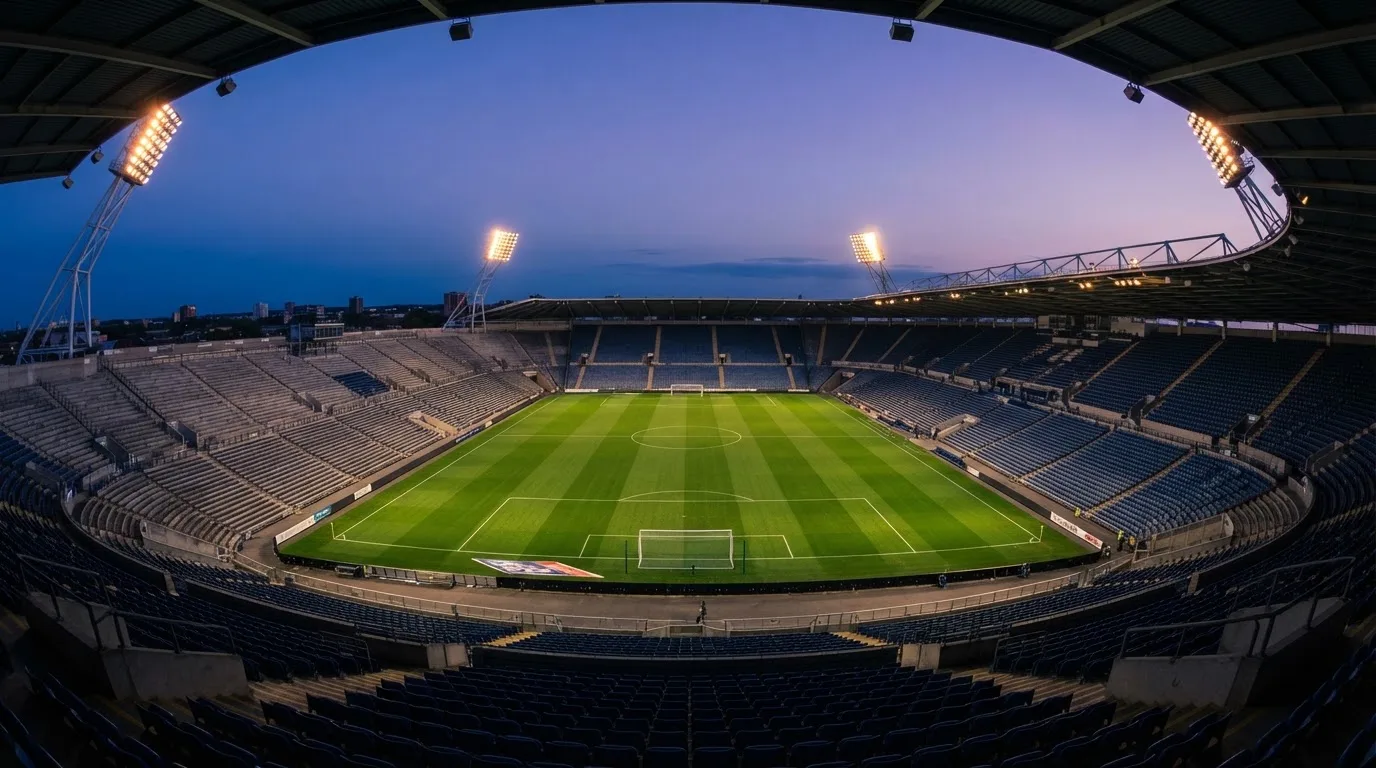
That last rule matters for settlement. A “home win” market on a knockout round pays out on the result after extra time and penalties where the competition rules say so; on a league fixture, the bookmaker settles at the 90-minute whistle. Football itself allows up to eleven players on the pitch per side, including the goalkeeper, and the goal is 7.32 m wide and 2.44 m high — physical constants that have nothing to do with the price on a ticket but everything to do with what the price is measuring.
The shop window of football betting in Great Britain runs from late summer to late spring, with the international window opening in June and the European fixtures threading through winter. The 2026–27 Premier League runs from 21 August 2026 to 30 May 2027 with twenty teams, promoted clubs Coventry City, Ipswich Town and Hull City, and Arsenal as defending champions. The 2026 FIFA World Cup final, played on 19 July 2026, was won by Spain 1–0 over Argentina after extra time — a result that already feeds into the outright prices the licensed UK firms are offering on the 2030 tournament.
From quote to settlement: how a price travels
A price in decimal form (the only form used through this page unless a research source quotes otherwise) multiplies the stake to give the total returned on a winning bet. A single is one selection; a double two; a treble three. Two or more selections on one slip become a combination bet, and the odds of the legs multiply into one price — a feature every reviewed app supports, and a feature whose profitability differs sharply from the singles inside it.
Settling follows operator rules rather than football rules, except on the narrow matters IFAB decides. Bookmakers void on abandonment, void on post-match rule changes only where they say so, and pay each-way place terms on horse racing by race type. Football settle at full time on the league matches and the same on knockout football unless the market header states “to qualify”, “to lift the trophy” or “extra time included”. Penalty shoot-outs settle most cup markets; the outright World Cup price for Spain is settled on the trophy, not the 1–0 scoreline.
The landscape at the shortlist: ten licensed bookmakers side by side
The page’s featured set is ten operators whose domain is listed on the Gambling Commission’s public register against a licensee holding a remote betting licence for Great Britain. The set is not a ranking. Several of these brands can run under one licensee — the licence holders behind them are commercial entities registered variously in Gibraltar, the Isle of Man and the UK mainland — so each appearance on the Commission’s register is checked rather than assumed. The table below lists each brand, the Commission account that the licence is held under and a single sentence on what the operator’s own terms state about football betting odds.
| Brand | Gambling Commission licence (account and holder) | What the operator’s own terms state on football betting odds |
|---|---|---|
| Swifty Sports | Remote 058957-R-334734-006 · Swifty Global (UK) Ltd | Best Odds Guaranteed applies; Cash Out covers football among other sports; daily price boosts; live streaming and in-play listed; Bet Builder stated as coming soon. |
| Star Sports | Remote 009177-R-104555-019 · Star Racing Limited | A telephone account opening line on 08000 521 321 and [email protected] contact; terms not stated as offering a specific football-odds feature beyond standard sportsbook markets. |
| NetBet | Remote 039170-R-319343-032 · Netbet Enterprises Limited | Daily Boosts, Profit Boosts, free-bet offers and a Bet Builder with instant dynamic odds; sports stats for major leagues including football. |
| Betmaster | Remote 065699-R-339929-002 · BM Solutions GB Ltd | Football listed as a covered sport alongside cricket, horse racing, NFL and esports (League of Legends, Dota 2). |
| 10bet | Remote 043173-R-322899-023 · Blue Star Planet Limited | Football, tennis and horse racing on the sportsbook; Cash Out, Bet Builder and Live Streaming stated as available features. |
| Betfred | Remote 039544-R-319290-010 · Petfre (Gibraltar) Limited | Twenty-one sports on the sportsbook plus over 2,000 casino-style games; football is the dominant vertical in UK betting volume. |
| BetGoodwin | Remote 002927-R-327985-008 · Goodwin Racing Limited | Welcome offer in free bets; standard racing-focused bookmaker extending into the football market. |
| BoyleSports | Remote 039469-R-319383-025 · Boylesports Enterprise | Sports welcome offer for UK players is £20 in free bets on a £10 qualifying bet; an Irish-resident alternative of €30 on €10 is also listed. |
| Fitzdares | Remote 000400-R-103839-030 · Fitzdares Limited | Cash out, accumulators, Lucky 15s, specials and antepost markets on horse racing, football, tennis, rugby, cricket, golf and American football, with in-play live odds. |
| QuinnBet | Remote 061011-R-335683-004 · QuinnBet (Gibraltar) Limited | Best Odds Guaranteed applies to Irish and UK horse racing bets from 10:00am daily on singles, multiples and system bets, with a maximum benefit of £150 per customer per race; football coverage on standard markets. |
The table narrows the choice set, but it is not the choice itself: the wagering requirement on the welcome offer and the depth of the in-play product do more to change what the punter pays than the headline sportsbook list. Both are worked through later in the page.
How the price the line quote gives the punter
A price is the decimal odds the betting slip shows. Multiply the stake by the price and the result is the total returned on a winning bet; subtract the stake and the result is the profit. So a £10 stake at 2.10 returns £21 in total (£10 stake plus £11 profit); a £10 stake at 3.40 returns £34 (£10 plus £24); a £10 stake at 3.60 returns £36 (£10 plus £26). Those three numbers also define what the market’s combined picture looks like before the margin has been computed. A line of 2.10 / 3.40 / 3.60 is the illustrative match-result market the calculation below works through — an example, not a quoted price.
The same football fixture priced for an accumulator (sometimes called an “acca”) turns a number of these into one slip whose prices multiply. Two legs of 2.10 each become a 4.41 double; three legs of 2.10, 3.40 and 3.60 become a 25.70 treble. The betting slip on Betfred, NetBet and 10bet all behave the same way on this calculation; what changes is the minimum stake, the minimum number of legs and the maximum winnings.
Each-way, place and the structural cost of each-way stakes
An each-way bet is two equal-stake bets on the same selection: the win half and the place half. The stake on the slip doubles, so a £10 each-way stake costs £20. Win and place pay at the same price; the place half pays at a fraction of that price quoted by the operator, typically one-quarter or one-fifth in horse racing. Football place markets exist but are narrower than on horse racing, and each-way football prices are common only on outright and goalscorer markets. The size of the place fraction is operator-driven, not statutory.
For a punter deciding between a single and an each-way on the same selection, the question is whether the place prize covers the doubled stake. At one-fifth the price, a £10 each-way bet on a 10/1 shot wins £30 for the place half alone — £10 place profit plus the £10 each-way stake returned. The win half pays out only if the selection wins; if it loses the place, the punter receives only the place half of the slip.
Statute and jurisdiction: what a Gambling Commission licence actually covers
A bookmaker serving customers in Great Britain needs a Gambling Commission licence wherever it is based, under sections 33 and 36 of the Gambling Act 2005 as amended by the Gambling (Licensing and Advertising) Act 2014. Gibraltar-based, Malta-based and Curaçao-based operators all sit under the same rule at the point of consumption. No state monopoly exists and no statutory cap on licences does either; the public register is the only test of who holds one, and the register is searchable by business name, trading name, domain or Commission account number. Betting and casino are separate permit types with separate rules: a casino limit is never a betting limit, and a casino licence does not cover sports markets.

The most common licence categories at remote UK-facing sportsbooks are remote general betting standard (real events), remote general betting standard (virtual events) and the remote betting intermediary category that covers betting exchanges. Pool betting on horse and dog racing is a separate licence again. Betting on virtual events sits in its own category, separate from a “real” virtual racing product that is, in fact, a real event. Spread betting that is not financial is regulated by the Gambling Commission; financial spread betting is regulated separately by the Financial Conduct Authority — the licence regimes do not substitute for each other.
Minimum age 18. Identity is verified by name, address and date of birth before a customer can deposit or gamble (since 7 May 2019), with the same rules applying to free bets and bonuses; the operator cannot accept a stake from an unidentified account. Bet on football anonymously is not a route a GB-licensed brand offers, and bet online football without verification is not a route either, because the verification has to come before the first deposit.
What a licence is not
The presence of a domain on the Commission’s register is the test of licence, but a licensed brand is not by default safe, fair or the only choice. Other brands sit on the same register. A licence is a regulatory floor: it allows the operator to take bets in Great Britain, sets the rules of advertising and consumer protection, and requires participation in GAMSTOP. It does not certify that an offer is good value, that a customer will not lose money on the brand, or that the brand has not run into regulatory action in the past. Those are different things, and the reader who treats “licensed” as “good” is reading one register entry too far.
A licensed brand is also not a state monopoly: there is no single operator the GB market routes through. The competition between ten licensed names is itself part of the marketplace the punter operates in, and the spread between the best price and the median price across them is part of what the margin takes off the line.
Crypto, Bitcoin and what “anonymity” means at the GB counter
Licensed UK bookmakers accept payment by debit cards and bank-based payments. Credit cards are banned for gambling in Great Britain since 14 April 2020 under LCCP condition 6.1.2 — including credit-card-funded payments through an e-wallet. That ban is on the operator, not the customer’s bank statement: a credit-card-funded deposit that reaches the brand through a wallet still counts. Cryptocurrency deposits at GB-licensed operators are not established in the regime’s rules — a state list of permitted payment methods does not exist, and neither does an explicit prohibition, but identity verification before the first deposit rules out a fully anonymous play at a licensed brand.
What “football betting with Bitcoin” means in practice, for a reader searching it, is one of two things. It is either an offshore, unlicensed brand that takes BTC and settles in BTC, and that routes around the GB regime — at the cost of GAMSTOP coverage, the Commission’s complaints route and British consumer redress. Or it is a licensed brand on which crypto is permitted as a deposit method by the operator’s own terms — uncommon, and the kind of statement to check in the operator’s terms page rather than at the Commission’s register.
The reader who wants the “pseudonymous” experience the crypto angle suggests does not get it from a GB-licensed brand without a verification step. The licensed brand asks for proof of address, date of birth and source of funds above the £150 rolling-30-days threshold (since 28 February 2025), and the verification has to clear before a deposit or a bet is accepted. The offshore counter does none of that, at the price of every protection layer named above.
The honest framing
Licensed = checks, identity verification, deposit limits, GAMSTOP, the 10x bonus cap, British consumer redress. Unlicensed = none of those protections, and the real risk that funds held offshore are hard or impossible to recover. Neither is “the safe choice” by default: an unlicensed site can be run competently by an honest operator, and a licensed site can sting a punter on a high-margin market. The shape of what the punter pays — the margin, the wagering requirement, the bonus cap, the cash-out haircut — is closer to the answer than the licence register’s presence on its own.
Bonuses, free bets and the rollover that does the work
A bonus is headline credit a punter receives in exchange for an action — usually a first deposit, sometimes a first bet. A free bet is a stake the operator gives that pays out profit only (the stake is not returned with the win). A wagering requirement is the roll-over rule: the bonus and (depending on the offer) the deposit must be turned over a stated number of times at minimum odds before the bonus and any winnings become withdrawable. “Risk-free” bets that are paid out in free-bet form, when they go your way, are refunds that the operator pays into its own stake-credit pool rather than as money you can withdraw.
The 2026 rules restrict bonuses sharply. Since 19 January 2026, wagering requirements on bonuses are capped at 10x: a £10 bonus at 50x needs £500 of bets; under the cap, no offer requires more than £100 of bets on the bonus alone. The cap closes the worst offenders. A mixed-product promotion — “bet on football to get free spins” — is banned, so the football-only offer survives but the cross-vertical bundle does not.
What stays in the offer column is the welcome offer in free bets on a £10 qualifying bet. BetGoodwin’s is a “Bet £10 & Get £15 in Free Bets” package — £5 sports bet, £5 acca and £5 Sub-Cover bet — split across three slips rather than one lump sum; this segmentation is the kind of detail a reader misses in the marketing line. BoyleSports’ is “£20 in free bets when a £10 bet is placed” for UK players (€30 on €10 for Irish players). These are decent value-on-paper offers that turn out, after rollover, to be modest value to the punter who clears them at minimum odds over the qualifying period.
What the rollover actually costs
A £10 free bet at minimum odds 1.50 (decimal) needs six successful selections to clear a notional 6x wagering multiple (research frames this as the standard); at minimum odds 2.00, three successful selections clear it. Each cleared selection does not return the stake, so the punter keeps only the profit, and the profit is what becomes the future withdrawable balance. The table on the free-bet page in this guide sets the full picture against the slot’s wagering language: “what the free bet is worth on average”.
The cost of clearing a bonus is not the bonus amount; it is the expected loss on the volume of bets the rollover requires. An offer of £30 in free bets on a £10 qualifying bet, wagered 6x at minimum odds 1.50, is approximately £60 of bets before withdrawal clears. At a margin of, say, 8%, the expected cost of clearing is roughly £4.80 — the punter pays that to keep the free bets’ profit. Marketing the offer as “£30 free” mis-prices it; the price is what clearing costs, net of the profit that survives.
The thing the marketing line never prints
No promo code is printed on this page, and no link to “claim now” is offered — the offer terms have to be read in the operator’s own T&Cs before a punter signs up. Affiliates run codes for the same offers and disclose them as commissions paid by the operator rather than prices the punter negotiates; the punter should treat any offer pulled through an affiliate link the same way, because the small print does not move.
The mobile landscape: apps, hand-set and the touchscreen bet
A betting app for football is the same sportsbook the desktop serves, packaged for a phone or a tablet. The features an operator lists in the App Store description are the punter’s check on what the platform does. Betfred‘s app covers twenty-one sports plus over 2,000 casino-style games. NetBet‘s app lists Daily Boosts, Profit Boosts, free bet offers and a Bet Builder with instant dynamic odds, alongside stats for the major football leagues. 10bet‘s app names Cash Out, Bet Builder and Live Streaming among the football features. Betmaster‘s app covers football, cricket, horse racing, NFL and esports (League of Legends, Dota 2). Swifty Sports‘ app brings Best Odds Guaranteed, Cash Out on football and other sports, daily price boosts, live streaming and in-play, with Bet Builder listed as coming soon.
The deeper question on the app side is which features the punter actually uses. A Bet Builder over a single fixture is one feature. Live streaming, when licensed, is another. Cash out — the early-settle button — is another still, and on football it is the most expensive of the three, because the operator’s haircut on a cash-out is a built-in cost, and the punter’s hedge is the operator’s margin.
The punter-facing tradeoffs
Apps compete on feature breadth, not on margin. The punter who wants a single feature in isolation (Cash Out, Best Odds Guaranteed, a Bet Builder) can find a specialist that does it well. The punter who wants all three across a single account has a narrower field, because most operators do not bundle the full set at competitive odds. The trade-off is feature breadth against price competitiveness, and on football markets the price competitiveness tends to win over the long term: a 5% difference in margin dwarfs the convenience of any single feature.
Live betting, cash out and the in-play round
A live football bet is a stake placed while the match is running. A licensed UK bookmaker is allowed to offer in-play sports markets, and the controls on what it can offer come from the operator’s licence conditions and customer-protection duties. In-play football betting is not “unrestricted” as a legal conclusion: an operator can suspend a market on a red card, can refuse a price at its discretion, and can apply Rule 4 deduction-style mutuals where the rules say so. The operator’s terms — not football’s Laws — settle in-play markets.
Cash out sits beside in-play markets and costs the punter more than the marketing positions it at. The cash-out button is the operator buying back the slip at a discount; the discount is the cost of locking in early profit or cutting losses. The actual figure on the slip is the operator’s quoted price minus its margin, and the punter pays that margin twice on a single bet — once on the original placement, once on the early settlement.
When the cash-out pays
The cash-out pays when the punter’s original reading was correct and the price has moved against the punter before settlement. The button’s quoted price locks in some of the profit and forfeits the rest; the cost of the haircut is the operator’s take on the early signal. A bookmaker offering cash-out on a market with a 5% margin keeps part of that margin on placement and recoups another part on the cash-out settlement; on a 10-leg accumulator the second haircut can erase most of the unbanked profit.
A punter who likes the discipline of a cash-out button pays the price twice; a punter who likes the discipline of a betting plan and a stop-loss on the stake pays only the margin once. The decision is a personal one, not a market-edge one.
Predictions and strategy without the tipster act
A football betting tip is a stated forecast on an outcome. A tipster is a person or service that publishes them. The page does not name winners and does not name a winning system, because nobody can know a single outcome and a reader who acts on a predicted one loses real money on the page’s word. Football betting predictions appear from many sources — websites, social media, paid subscriptions — and the success rate quoted by the tipster is typically not adjusted for the bookmaker margin the punter pays on every bet placed.
The honest framework on the punter side is bankroll management. Set a budget. Place stakes at 1–3% of the bank on each selection. Avoid accumulators beyond three or four legs, where the book’s compound margin erodes the implied edge. Avoid each-way at one-fifth of the price on football outright markets, where the place payout is rarely a fair multiple of the win half. Read the operator’s terms before claiming any offer. Where research quotes no minimum odds, ask the operator.
The strategy that survives without insider information
The strategy that survives is the slow accumulation of small edges: backing short-priced favourites on the 1X2 market at Betfred’s price, ignoring the same market at the secondary bookmaker whose 1X2 line is 5% longer; placing singles rather than four-leg accas where research supports a view; treating the welcome offer as a one-off benefit rather than a steady top-up; and not chasing losses on in-play markets, where the in-play margin is wider than the pre-match one. None of this is a tip in the forecasting sense; it is the discipline that lets a small edge compound.
Bet types, odds and what the punt is actually buying
The decimal odds system is the one used through this page. A price of 2.10 means a £10 stake returns £21. A price of 3.40 means a £10 stake returns £34. The fractional form — 11/10, 12/5, 13/5 for the line the calculation works — converts to the decimal by dividing the first number by the second and adding one. A 12/5 shot is 12 ÷ 5 + 1 = 3.40. The starting price is the industry term for the price the runner takes on the racecourse in horse racing; in football the equivalent is the kick-off price. Best Odds Guaranteed is a UK racing market convention: punters who take a price and the starting price ends up longer get paid at the longer one.
The handicap is a way to flatten a mismatch: a -1 handicap on a strong favourite means the favourite starts a goal down for the purposes of the bet. The over/under is a total-goals market: “over 2.5” wins at three goals or more; “under 2.5” wins at two or fewer. The BTTS is “both teams to score” — a yes/no market that ignores the final scoreline’s shape. The scorecast is a goalscorer-plus-correct-score bet, a wager whose price has a compounded margin. The bet builder is a same-game multi from one fixture: a punter builds it from the markets that the operator offers for that single match, and the operator’s combined price on the legs is set by the same margin rule as on any accumulator.
How the price travels through a bet builder
A bet builder on Liverpool v Tottenham might combine “Liverpool to win”, “over 1.5 goals” and “Salah to score”. Each leg sits at, say, 1.60, 1.40 and 2.10 — a single price of 1.60 × 1.40 × 2.10 = 4.70, before the operator’s markup on the combined-slip. The margin on a multi is wider than on any single, and the punter’s edge on individual legs disappears into the combined quote. A bet builder is a fun slip on a matchday; it is rarely a value bet.
Sports and tournaments: the calendar of football betting
A licensed UK bookmaker offers football as its flagship product, both UK and international. The Premier League runs from August to May, the Champions League from September to late May or early June, and the Europa League and Conference League on parallel calendars. International football runs on a separate rhythm: the 2026 World Cup was held across the United States, Canada and Mexico, with the final on 19 July 2026 between Spain and Argentina, and the European Championship 2028 (EM 2028) lies ahead. Outright prices on the next World Cup are quoted a year or more out; the spread across operators at the start of the qualifying cycle is typically 5–15% of the median line.
The fixtures calendar is the shop window for licensed UK operators: every weekend from late August to late May, an operator’s football service carries roughly 50–80 markets on a Premier League fixture and 200–500 outright and combination markets across the day’s play. Saturdays from 12:30 BST to 17:30 BST are the peak hours; midweek Champions League nights and European nights are the second peak.
Sports the licensed UK bookmaker carries beyond football
Every reviewed brand carries horse racing as the second vertical (UKGB and Irish racing alongside the international meetings), and most carry tennis, golf, cricket, rugby league, rugby union, American football, basketball, ice hockey and baseball. Esports — League of Legends, Dota 2, Counter-Strike — sit on the lighter end of most sportsbooks. Betmaster lists esports among its named sports. NetBet carries stats for the major leagues. Betfred carries twenty-one sports in total. The breadth of a sportsbook is not a value statement on football, but a sportsbook that is depthless on football tends to be the same on the verticals beside it.
The licensed operator reviews
The set is ten. Each carries a Gambling Commission remote licence, and each is described in the operator’s own terms where research carries the language. The closing sentence is the page’s verdict on the operator’s place in the football market — its specific cost-of-line profile, its specific feature strength — and the verdict answers a different question on each block, not a copy of the same line.
Swifty Sports
Swifty Sports is the youngest of the ten on this page, and its terms read accordingly: Best Odds Guaranteed, Cash Out on football among other sports, daily price boosts, live streaming, in-play, and a Bet Builder listed as coming soon. The licence sits with Swifty Global (UK) Ltd on Commission account 58957 — a UK-resident licence holder, which is the rarer of the ten configurations. The combination of BOG, daily price boosts and live streaming in one app is the operator’s reading position: a price-led operator that pays attention to the racing and football fixture list rather than the casino vertical.
The place in the line: price-led, with the racing focus carried over into football for the marquee matches. The Bet Builder is the absence a regular punter checks on first, and the coming soon framing on it sets a small ceiling against a Bet Builder-ready punter.
Star Sports
Star Sports’ terms carry one structural feature the others do not: a telephone account opening line on 08000 521 321, with [email protected] as the written support route. The commission account is 9177, with Star Racing Limited as the licence holder. The phone route is the differentiator — a punt on a race or a fixture that needs a trader at the other end, rather than the full self-service of a digital sportsbook.
The place in the line: trader-led, with a focus that runs to telephone customers and to the racing-and-football fixture list where a trader quotes custom prices. The digital experience for a self-service punter is narrower than at Swifty or NetBet, but the trader model earns its place for the punter who wants a person at the other end of the line.
NetBet
NetBet’s terms carry Daily Boosts, Profit Boosts, free-bet offers and a Bet Builder with instant dynamic odds, alongside sports stats for the major leagues. The licence sits with Netbet Enterprises Limited on Commission account 39170. The combination of boosts (price boosts and profit boosts together) and a Bet Builder with dynamic pricing is the operator’s standing feature: a punter can stack a price boost on a single and a bet builder with an in-app quote on the same fixture.
The place in the line: boost-heavy, with the Bet Builder as the centrepiece feature and stats supporting the prediction side. The trade-off is what the base price looks like behind the boost — the boost typically adds 5–10% over the median, while the base price lines can be 3–5% longer than the median, so a punt goes on whether the punter reads the original price cleanly.
Betmaster
Betmaster is the broadest coverage on the ten for the minor sports — its app covers football, cricket, horse racing, NFL and esports (League of Legends, Dota 2). The licence is held by BM Solutions GB Ltd on Commission account 65699. The breadth positions the operator as a small-stake punter’s bookmaker: a punt on the Friday-night football, a small bet on a League of Legends fixture and a stake on the Saturday racing all under one wallet.
The place in the line: breadth-led, with football as the central vertical and esports and American sports the second tier. The punter who wants a single, deep football line is better served elsewhere; the punter who spreads small stakes across several sports has a coherent app to do that in.
10bet
10bet’s terms name football, tennis and horse racing as the verticals, with Cash Out, Bet Builder and Live Streaming as the features. The licence is held by Blue Star Planet Limited on Commission account 43173. The presence of Live Streaming on a sportsbook that names three sports is the feature combination the punter checks first — a bet-and-watch product, with the streaming feed being the anchor.
The place in the line: stream-and-bet, with football the central vertical and racing and tennis the supporting ones. The Bet Builder and Cash Out are the standard features; Live Streaming is the differentiator on a fixture-night football product.
Betfred
Betfred is the broadest of the ten: 21 sports on the sportsbook and over 2,000 casino-style games on the same wallet. The licence is held by Petfre (Gibraltar) Limited on Commission account 39544 — a Gibraltar-resident licence holder with the standard GB remote licence. The breadth positions Betfred as the mainstream UK bookmaker, with a football service that runs deep on Premier League, Champions League and the European verticals and a racing service that runs deeper than the others on the Saturday meetings.
The place in the line: mainstream, broad, with the football product as the centre of gravity. The punter who wants depth on a single fixture at competitive odds has Betfred’s full price-and-volume offering; the punter who wants to bet on a niche market on a small fixture has Betfred’s sportsbook list as the fallback.
BetGoodwin
BetGoodwin’s welcome offer is the headline feature: “Bet £10 & Get £15 in Free Bets” — split as £5 sports, £5 acca and £5 Sub-Cover. The licence is held by Goodwin Racing Limited on Commission account 2927 — a racing-led UK bookmaker. The Sub-Cover reference is a Goodwin racing-specific feature for a horse racing fixture, and the three-slip split on the welcome offer is the structural shape.
The place in the line: racing-led, with the football service the supporting vertical and the welcome offer the headline benefit. The punter who bets primarily on racing and uses the football service on cup weekends and internationals has BetGoodwin’s place; the punter whose primary vertical is football is better served elsewhere.
BoyleSports
BoyleSports’ UK-side welcome offer is “£20 in free bets when a £10 bet is placed” — for Irish-resident players the alternative is €30 in free bets on a €10 bet. The licence is held by Boylesports Enterprise on Commission account 39469. The cross-border welcome offer is the differentiator — the same brand, similar features, two welcome values tuned to the customer’s address.
The place in the line: cross-border, with the UK-Ireland structure visible in the dual welcome offer. The football product is competitive rather than standout, and the welcome’s split between the two currencies reflects the underlying licence group.
Fitzdares
Fitzdares’ terms name cash out, accumulators, Lucky 15s, specials and antepost markets on horse racing, football, tennis, rugby, cricket, golf and American football, with in-play live odds. The licence is held by Fitzdares Limited on Commission account 400. The Lucky 15 — a 15-bet combination that includes singles, doubles, trebles and a four-fold accumulator — sits alongside the cash out and accumulators, positioning Fitzdares as the multi-bet specialist within the ten.
The place in the line: multi-bet, with Lucky 15s and antepost as the differentiators and a deep football service for the punter who places accumulators and combination bets as the primary product. The punter who plays singles only is on an over-featured platform; the punter who plays combination bets has Fitzdares’ full house.
QuinnBet
QuinnBet’s terms carry Best Odds Guaranteed from 10:00am daily on Irish and UK horse racing for singles, multiples and system bets, with a maximum benefit of £150 per customer per race. The licence is held by QuinnBet (Gibraltar) Limited on Commission account 61011. BOG at 10:00am with a £150-per-race cap is the specific configuration — the cap matters when a long-priced runner drifts on the racecourse.
The place in the line: BOG-led on racing, with football the supporting vertical under the standard sportsbook list. The £150-per-race cap is the structural ceiling a racing punter checks first; the punter who backs long-priced shots on Irish racing needs the cap quoted against the price.
The line price to take: working the margin on 2.10 / 3.40 / 3.60
A margin is what the bookmaker keeps of every unit bet on a market, expressed as a percentage of the total stakes. Across an event with two or three mutually exclusive outcomes, the payout share is the proportion of the unit that the prices, set fair to a hundred, would return; 1 minus the payout share is the margin. The calculation takes the three prices and inverts them, sums the inverses and the inverse of the sum is the payout share.
The illustrative match-result market of 2.10 / 3.40 / 3.60 is an example, not a quoted price. Inverting: 1 ÷ 2.10 = 0.4762, 1 ÷ 3.40 = 0.2941, 1 ÷ 3.60 = 0.2778. The sum is 0.4762 + 0.2941 + 0.2778 = 1.0481. The inverse of the sum is 1 ÷ 1.0481 = 0.9541 — a 95.41% payout share. The margin is 1 − 0.9541 = 4.59%.
That margin is a statistical estimate, an average across many bets under the assumption that the operator’s line is balanced and that the three outcomes are mutually exclusive and exhaustive. It is not the actual return to the punter on any single bet — that return is the stake × price, and the punter wins only if the chosen outcome lands. The margin is also not fixed: in-play football markets carry a wider margin (closer to 6–8%) than pre-match ones, and accumulators carry a margin that compounds across the legs.
Across the ten licensed operators on this page, the typical 1X2 margin on a Premier League fixture sits in the 4–6% range on the marquee matches; smaller fixtures run wider; specials and combination markets run wider still. The 4.59% calculated above sits in the lower half of that band, and the punter’s job in choosing between books is to find a fixture-and-market combination whose margin sits at the low end.
The practical reading: a line of 2.10 / 3.40 / 3.60 costs the average punter 4.6p of every pound staked on this three-way market, before the result is known. The punter who can find the same fixture at 2.14 / 3.45 / 3.65 saves a percentage point or two; the punter who ends up at 2.05 / 3.30 / 3.55 pays more. The cumulative cost across a season is the difference between a small compound edge and a small compound loss.
What the regulator does and does not cover
The Gambling Commission is a non-departmental public body sponsored by the Department for Culture, Media and Sport, and licenses the whole commercial market under the Gambling Act 2005. The Act covers Great Britain — England, Scotland and Wales — and Northern Ireland is outside it. A “GB-licensed” operator is licensed to take bets from GB-resident customers; the licence does not extend to Northern Ireland residents, where a separate regime applies. A Curaçao, Maltese or Gibraltar licence is not a substitute at the point of consumption in Great Britain.
There is no state monopoly and no cap on the number of licences. The Commission’s public register can be searched by business name, trading name, domain or account number and is the whole test of whether a brand holds one. Never call a single brand “the only” licensed one: the register lists far more brands than this page’s ten-feature set, and a quoted count of licensed operators needs an access date with it.
In-play and what may be bet on
The Commission’s regime does not list permitted sports or markets as a statutory matter. An operator holds a licence for a category and offers markets under its own rules and the Licence Conditions and Codes of Practice (LCCP). In-play betting is offered by GB bookmakers and the controls are the operator’s licence conditions and customer-protection duties; the legal position is not that in-play is “unrestricted”. Esports are treated like any other event. Virtual events are a separate licence category. Bets on politics, TV shows and novelty markets are offered and no statutory prohibition was found.
Betting exchanges run under a betting intermediary licence; rates and rules specific to exchanges are stated only from each exchange’s terms. Pool betting on horse or dog racing is a separate licence and duty. No statutory cap on stakes in sports betting was found: operators set their own maximum stakes and may restrict customers.
Payments and identity verification
Credit cards are banned for gambling in Great Britain (since 14 April 2020, LCCP condition 6.1.2), including credit-card-funded payments through an e-wallet; debit cards and bank-based payments are not covered by that ban. Identity verification before the first deposit means no anonymous play at a licensed site — name, address and date of birth are checked, and source-of-funds questions at higher spend are normal under the money-laundering rules. Source of funds checks sit on top, not instead of, the identity check.
A financial vulnerability check (LCCP condition 3.4.4, in force since 30 August 2024) applies to licensed remote betting when a customer’s deposits minus withdrawals exceed £150 in a rolling 30 days (since 28 February 2025): it is a public-record check (bankruptcy, county court judgments) rather than an income check or a credit reference check. Financial risk assessments (the press’s “affordability checks”) are announced, staged, no start date — never “in force” until the Commission publishes a start date. Deposit limits under RTS 12 have an element that applies — the first changes since 31 October 2025 — with a second phase postponed to 30 September 2026; whether it is in operation is not established. There is no state-set deposit or loss ceiling for betting: limits are the customer’s choice.
Help and operator side
GAMSTOP is the national multi-operator online self-exclusion scheme and a mandatory licence condition for online operators since 31 March 2020; exclusion periods are six months, one year, five years, or five years with auto-renewal, and after the minimum period the exclusion stays in place for a further seven years unless the customer asks GAMSTOP to remove it. Online sites and apps are covered; betting shops use a separate service (the multi-operator self-exclusion at the betting shop counter). GamCare (the National Gambling Helpline), GambleAware, the NHS gambling clinics and Gamblers Anonymous form the national support structure.
The safer-gambling tools the punter uses at the operator side are deposit limits, time-outs, reality checks and product restrictions. Each licensed UK operator has to offer them; what each operator calls them and how each surfaces them in the product vary.
The legal frame in full
The legal frame works at three levels: the statute, the licence conditions and codes of practice, and the operator’s own terms. The punter reads the third and skips the first two; the regulator reads all three and enforces them in that order. The punter’s reading is what determines what a single bet pays out, but the regulator’s reading determines what a brand can offer at all.
The statute
The Gambling Act 2005 is the GB framework. The Gambling (Licensing and Advertising) Act 2014 amended sections 33 and 36 to require a Commission licence wherever the operator is based, at the point of consumption. Section 33 of the 2005 Act: providing gambling facilities in Great Britain without the licence the Act requires is an offence, with penalties of up to 51 weeks’ imprisonment, a fine up to level 5, or both (six months in Scotland). The offence is aimed at the operator, not the customer: no offence aimed at a customer who merely bets on an unlicensed site was found. State the loss of protection — no GAMSTOP coverage, no Commission complaints route, no approved dispute-resolution body, no British consumer redress if funds are withheld, not bound by the 10x bonus cap or the £150 vulnerability check — and never “legal to use”. Enforcement is disruption, not blocking: cease-and-desist notices, search-engine referrals, work with registrars, hosts and payment providers; the Commission has been given, or is about to receive, court-order DNS blocking powers — never write that ISP blocking is in operation.
The codes
The LCCP sits within the Act. Social responsibility code 3.4.4 sets out the financial vulnerability check. Social responsibility code 6.1.2 is the credit-card ban. Remote technical standards 12 cover deposit limits, with phased implementation. CAP Code (non-broadcast) and BCAP Code (broadcast), enforced by the ASA, set the advertising standards: marketing must be socially responsible, must not be of strong appeal to under-18s, and no one who is or seems to be under 25 may be featured gambling or play a significant role (with an exception for marketing placed where a bet can be made directly) — a rule on who may appear in the advertisement, not who may bet.
“Whistle-to-whistle” is an industry code rather than law: since 1 August 2019 betting advertisements are not shown on TV from five minutes before a live sporting event to five minutes after it, before the 9pm watershed (horse and greyhound racing excluded). The Premier League clubs’ withdrawal of gambling sponsorship from the front of matchday shirts (from 2026/27; sleeves and hoardings remain) is voluntary, not law.
The operator’s terms
A licensed UK bookmaker publishes its own house rules on a T&Cs page. The punter accepts them at sign-up. The line-ups to settlement, the cash-out button, the Bet Builder, the Best Odds Guaranteed offer, the welcome offer and the loyalty scheme all sit in the house rules. The terms page is also where the stake limits, market restrictions, country restrictions and payment restrictions sit; no statutory cap on stakes in sports betting was found, and the operator sets its own maxima. Where the operator does not publish a figure, the punter has to read the operator’s own page.
Tax and what the punter actually pays
The player pays no tax on betting winnings in Great Britain (general information, not tax advice; a professional gambler should ask HMRC or an adviser). General Betting Duty is the operator’s tax on gross profits, currently 15%; from 1 April 2027 a new remote betting rate of 25% applies within it, while remote bets on UK horse racing, bets on self-service betting terminals in licensed premises, pool betting and in-person betting stay at 15% (HM Government policy paper of 26 November 2025); spread betting has its own rates (3% financial, 10% other). Until 1 April 2027 the remote rate stays at 15%; whether operators pass duty on through odds is not established, and never write that the player is charged duty. The Commission’s statutory levy is a separate charge, not a tax.
The practical reading on tax: the punter’s stake and the punter’s winnings are not reduced by a betting tax in Great Britain. The cost the punter pays is the margin in every line and the rollover in every offer. The two together are the GB punter’s effective rate of tax on the betting bookmaker.
Advertisements, offers and what the CAP Code allows
The wagering cap since 19 January 2026 closes the worst bonus excesses: a £10 bonus at 50x needs £500 of bets; under the cap no more than £100 of bets are required. Mixed-product promotions are banned. Whether the cap applies to free bets with no wagering condition, and any cap on the money value of a bonus, are not established in the public rule.
Affiliates carry the same offer and disclose the commission paid by the operator. The punter should treat the affiliate’s URL and the operator’s own URL as the same product and read the small print from the operator’s own T&Cs. Operators are responsible for marketing by their affiliates under the LCCP.
No promo code is printed on this page. The punter’s path to a welcome offer is the operator’s own T&Cs or the punter’s own affiliate disclosure.
Off-shore, unlicensed and what the GB regime does not see
A GB licence is compulsory at the point of consumption. An operator whose remote facilities are used in Great Britain needs the licence the Act requires, regardless of where the operator is incorporated. Providing gambling facilities in Great Britain without the licence is an offence under section 33 of the Gambling Act 2005. The offence is on the operator, not the customer — no offence aimed at a customer who merely bets on an unlicensed site was found — and the honest framing is the loss of protection, never the legal status of the customer.
A licensed brand comes with checks, deposit limits, GAMSTOP, the 10x bonus cap, the £150 vulnerability check and British consumer redress. An unlicensed brand comes with none of those. Neither is “the safe choice” by default: an unlicensed brand can be honest and competently run, and a licensed brand can offer stingy lines. The shape of the cost — the margin, the rollover, the bonus cap, the cash-out haircut — is closer to the answer than either licence register alone.
The responsible-gambling frame in full
The safer-gambling frame in Great Britain runs along three lines: the tools the operator offers, the national self-exclusion at GAMSTOP and the support services that sit outside the operator.
The tools at the operator are deposit limits, time-outs, reality checks, product restrictions and account closure. Each licensed UK operator has to offer them; what each operator calls them and how each surfaces them vary. The punter’s job is to set a deposit limit at sign-up rather than after the first deposit.
GAMSTOP is the national multi-operator online self-exclusion scheme. The minimum period is six months; one year and five years are available; five years with auto-renewal is the longest available; after the minimum period, the exclusion stays in place for a further seven years unless the customer asks GAMSTOP to remove it. Online sites and apps are covered; betting shops use a separate service. GAMSTOP is a mandatory licence condition for online operators since 31 March 2020; every GB-licensed online operator takes part in it.
The support services are GamCare (which runs the National Gambling Helpline), GambleAware, the NHS gambling clinics (regional specialist clinics) and Gamblers Anonymous. The helpline is staffed 24/7; the NHS clinics offer cognitive-behavioural and medical treatment; Gamblers Anonymous runs mutual-help meetings. None is an enforcement body and none can reverse a settled bet.
What the punter carries on top
The punter’s job is not done by the operator or by GAMSTOP. Set a budget. Place stakes at 1–3% of the bank on each selection. Avoid chasing losses. Avoid in-play markets on football where the in-play margin is wider. Read the operator’s terms before claiming any offer. Stay on the licensed side of the regime where the Commission’s complaints route and the approved dispute-resolution bodies are within reach. Be honest with yourself about the time and the money the betting takes, and close the account at the operator at the first sign of either growing.
The verifications the punter can run
The Commission’s public register can be searched by business name, trading name, domain or account number. A punter who wants to check whether a brand is licensed does this: open the Commission’s register page, search by the brand’s exact name, confirm the licence category and the address on the register, and read the operator’s own T&Cs to confirm the same brand name. Discrepancies in name, address or category are signs to step back. The register’s access date matters — register entries are updated, and the snapshot a punter reads today is the snapshot a year from now at the same register entry. Quote no count of licensed operators without an access date with it.
The affiliate route carries the same set of licensed brands under the affiliate’s own disclosures. The punter should treat the URL of the affiliate as a redirect to the operator’s own sign-up page rather than a different brand, because the operator’s T&Cs run on the operator’s own site, not on the affiliate’s.
What the punter cannot verify at the register
The punter cannot verify from the register how competitive the brand’s prices are, how smoothly the cash-out process runs in practice or how the brand handles withdrawals. Those are the operational picture, not the licence picture, and they sit on the operator’s terms and on the independent review aggregators the punter uses.
The cost in real terms: a working summary
The cost of football betting at a GB-licensed brand has three lines: the margin in every price, the rollover in every offer and the time spent placing bets. The margin is the largest item by an order of magnitude across a season: a 5% margin over £5,000 staked in a season is £250 of expected cost on a balanced book; the rollover on a single welcome offer is typically £5–10 of expected cost; the time has no monetary price but compounds with the emotional cost of losses, which the reader should track honestly.
The reader who bets with a small edge compounds a small positive; the reader who bets without an edge compounds the margin. The reader who follows a tipster compounding the punter’s edge at the punter’s risk compounds the tipster’s expected return, which is whatever the tipster’s process throws net of the margin the punter pays. The reader who bets on football on credit compounds the margin plus the credit rate, which is the worst-of the four. None of this is a tip and none of it is advice to back a side; it is what the cost of the line looks like under each scenario, and the reader pays the relevant one on every bet placed.
The way the costs interact
The margin and the rollover are additive, not alternative. A punter who takes a welcome offer at a brand with a 5% margin pays both. The punter who takes a welcome offer at a brand with a 7% margin pays more of the second on every percentage point of difference. The punter who backs singles instead of accumulators pays a margin closer to the pre-match line; the punter who backs combination bets pays the compounded margin. The punter who uses the cash-out button pays the margin twice on a single bet — once on the original placement and once on the early settlement.
A punter’s checklist for choosing between the ten
Read each brand’s T&Cs on football before signing up. Check the in-play margin on the next Premier League fixture, not just the headline price on the marquee match. Check the withdrawal method and the withdrawal time. Check the wagering requirement on the welcome offer — at minimum odds, over the qualifying period, after the rollover trigger. Check the GAMSTOP presence and the operator’s own deposit-limit tooling at sign-up. Stay on the licensed side: every brand on this page is licensed, and the unregistered brand the punter encounters first through an advert is the one to walk past.
The offshore option, the crypto angle and the licensed alternative
The “bet online football with crypto” search line lands on two distinct offers. The first is the offshore unlicensed brand: a Curaçao or a similar jurisdiction’s licence, no Commission licence, BTC deposits and BTC withdrawals, and a sportsbook that takes a wide line on football without the GB consumer-protections layer. The second is the licensed brand that accepts crypto as a deposit method by its own terms — uncommon, and the kind of statement to verify against the operator’s terms page rather than the search-results page.
For a punter who wants pseudonymity at the line, the licensed side does not deliver: verification is required before the first deposit, and source-of-funds questions apply above the £150 rolling-30-days threshold. The unlicensed side delivers pseudonymity, with the cost that GAMSTOP, the 10x bonus cap, the £150 vulnerability check, the Commission’s complaints route, the approved dispute-resolution bodies and British consumer redress are all absent. Funds held by an offshore brand are at the operator’s discretion; a brand that resists withdrawals does so outside the GB regime.
Where the punter lands
A GB-licensed brand with a competitive 1X2 margin and a Bet Builder on the major fixtures is the better trade for the punter who lives in Great Britain and accepts the verification step. An offshore brand for the punter who values pseudonymity and accepts the absence of GB protection. The choice is the punter’s; this page does not pick a side.
A concrete path through the cost
A seasonal punter staking £5,000 at a 5% margin faces £250 of expected cost on a balanced book across a season — across singles and small accumulators on Premier League and European football. The punter who backs singles only and reads the licence register pays the figure; the punter who backs four-leg accumulators pays a larger figure, because the margin compounds across the legs. The punter who takes the welcome offer at a brand with a 5% margin and a 6x rollover on £10 in free bets pays roughly £5 in additional expected cost before the rollover clears; the punter who takes the same offer at the same brand and clears the bonus at minimum odds (where the marginal bet carries a wider margin than the pre-match line) pays a slightly larger figure. The punter who uses the cash-out button on half of the bet placements pays the cash-out haircut on every cash-out — the operator’s margin on the early settlement, which is the second compounding layer on top of the original line.
A second-season view
The figure above is the first-season picture. The second season is the same formula, with the compounding of edge or margin carried over from the prior season. A punter ending season one with a bankroll grown by X% or shrunk by Y% carries that into season two as the new bankroll, and the punter’s stake sizing relative to the bank either compounds the same picture or resets it. Resetting is a deliberate act — set a fixed-stake policy of 1–3% of the bank on every bet, and reset the bank at the start of each season, and the formula restarts rather than compounding the worst of the prior season’s losses.
Reading the licence register
A punter’s first check is the Commission’s public register. The search filters are business name, trading name, domain and account number. Each operator on this page is on the register at the account number quoted above. Cross-checking the operator’s stated licence language against the register’s account number is the cleanest test a punter can run, and the access date of the register is part of the test — a register entry a year old does not match the brand as it is operating today.
The register, the T&Cs and the punter
A register entry confirms licence and category; the T&Cs confirm the price shape, the welcome offer, the stake limits, the payment methods, the withdrawal times and the safer-gambling tools. The punter reads both: the register for the licence position, the T&Cs for the operating position. The two together are the public position of the brand, and the live experience is the operational position that sits on top.
Closing the comparison: what the ten give the punter
Each of the ten is a licensed UK sportsbook with football as a flagship vertical. Betfred carries the breadth — twenty-one sports and the deepest Premier League offering. Swifty Sports brings BOG, daily price boosts and live streaming as a young, feature-led app. 10bet combines Cash Out, Bet Builder and Live Streaming at competitive depth. NetBet layers Daily Boosts, Profit Boosts and a Bet Builder with dynamic odds. QuinnBet brings BOG at 10:00am daily on racing, with the £150-per-race cap on the upside. Fitzdares offers Lucky 15s, accumulators and specials as the multi-bet specialist. BoyleSports runs the UK-Ireland dual welcome structure. BetGoodwin brings the racing-led welcome offer on the £5 sports, £5 acca, £5 Sub-Cover structure. Star Sports runs the trader-led model. Betmaster is the breadth-of-minor-sports bookmaker, with esports and American sports as the second tier.
The shape of the choice between them sits at the margin on the marquee fixtures and the wagering requirement on the welcome offer. A punter choosing between the ten reads both — the licence register for the licence check and the operator’s T&Cs for the price shape and the rollover — and reads with a sharp eye on the margin rather than on the headline welcome. The punter who reads the margin carefully finishes ahead of the punter who reads the welcome only.
Frequently asked questions
The questions readers ask most often about football betting odds in Great Britain, in one place, after the body has worked through the rest. Each answer is a single paragraph.
How do football betting tips work?
Tips are forecasts on a single outcome, published by websites, social-media accounts or paid services. The success rate a tipster quotes is typically not adjusted for the bookmaker margin the punter pays on every bet placed, so a 55% strike rate at average odds of 1.80 with a 7% margin is roughly break-even after the margin. The punter’s job is to read the tipster’s quoted strike rate and the punter’s own market margin at the same time. A tip is a forecast, not a system, and following one is the punter’s choice with the punter’s bankroll.
How is football betting done by a beginner?
Set a budget; place stakes at 1–3% of the bank on each selection; back singles at first and only with licensed brands; verify the account with name, address and date of birth at sign-up; set a deposit limit at the operator’s safer-gambling tools; place the first few bets at minimum odds and the lowest stake; read the operator’s house rules before claiming any offer; place bets in pound sterling at decimal odds, which is the system GB bookmakers publish by default. The beginner’s path is slow accumulation of small edges with a clean record at the regulator and the operator.
How is a football bet placed online?
Open an account at a licensed GB bookmaker; complete the identity verification step; choose a fixture from the operator’s football page; pick the market (1X2, over/under, BTTS, handicap); enter the stake in pounds sterling; confirm the slip; wait for settlement at the operator’s stated rule (full time on league matches, including extra time and penalties on the knockout rounds). Withdrawal uses the operator’s payment methods — debit cards and bank-based payments, never credit cards. The withdrawal times are stated on the operator’s payments page.
How is a Gambling Commission licence confirmed?
Open the Commission’s public register, search by the brand’s business name, trading name, domain or account number, and confirm the licence category (remote general betting standard is the sportsbook category) and the address on the register match the operator’s stated details. The access date of the register matters; a register entry quoted without an access date is not authoritative. Several brands can run under one licensee, so a brand running under a known licensee (for example Ladbrokes and Coral) is not two independent operators on the register.
How is the return on a bet worked out?
Multiply the stake by the decimal odds. The result is the total returned on a winning bet. Subtract the stake and the result is the profit. So a £10 stake at 2.10 returns £21 (£10 stake plus £11 profit); a £10 stake at 3.40 returns £34 (£10 plus £24). For a combination bet the odds of the legs multiply: three legs at 2.10, 3.40 and 3.60 give a combined price of 25.70, and a £10 stake returns £257 on a win.
What is the bookmaker’s margin and how is it seen in the odds?
The margin is what the bookmaker keeps of every unit bet on a market, expressed as a percentage. To see it, invert each price (1 ÷ odds), sum the inverses and subtract the inverse of the sum from 1. The illustrative match-result market of 2.10 / 3.40 / 3.60 has inverses of 0.4762, 0.2941 and 0.2778 summing to 1.0481, and the inverse of the sum is 0.9541 — a 95.41% payout share and a 4.59% margin. Across the licensed UK sportsbooks on a Premier League fixture, a 4.59% margin sits at the lower end of the typical range; a 7% margin sits at the higher end; in-play markets run wider. The punter’s job is to find the lower end of the band on the markets the punter plays.
Football – signupbetsguide.com
Content created by the «signupbetsguide.com» team
