
The True Cost Behind Horse Racing Betting Odds
 Available in US
Horse racing draws a deeper crowd of bettors than almost any other sport in Great Britain, and the prices on offer look straightforward until the bets start landing — and the small print starts costing. A fractional quote of 5/1 looks the same on the betting slip as a decimal 6.00, but what those numbers mean for the punter’s wallet, and what the bookmaker skims off the top of every race, is a different story for every operator and every market. This guide maps what licensed UK bookmakers charge for the privilege of betting on horses, where the real costs hide, and which ten sites earn their place in the shortlist for horse racing in particular.
Data current as of 30 October 2026 and verified against the Gambling Commission’s public register of remote operating licences.
How Bookmakers Build a Horse Racing Price
A horse racing price is not a prediction. It is a two-sided bargain dressed as one. The bookmaker offers odds on every runner in a race, lays a book — that is, balances the book — across the field, and keeps a slice of every pound staked regardless of the result. That slice is called the overround, or margin, and it is why a “fair” race on paper never pays exactly what probability suggests it should.
The margin hiding in plain sight
Take an illustrative two-way race priced at decimal odds of 1.90 on each runner. Implied probability on a fair view would be 1 ÷ 1.90, or about 52.63% for each horse. Add the two implied probabilities and you get roughly 105.26% — the extra 5.26 percentage points are the bookmaker’s margin, the cut kept by the house on every unit bet on this market. The payout share to bettors is therefore about 94.74%, meaning a £1 stake returns roughly £1.90 if the bet wins but the field collectively loses about five pence in the pound to the margin on every race.
Markets with more runners — twelve-horse handicaps, twenty-runner maidens — carry fatter overrounds. A twelve-runner race priced at a typical book of around 110% implied probability gives the bookmaker closer to a 9-10% take, and that is before place terms, Rule 4 deductions and non-runner adjustments begin trimming payouts.

What moves a price during the day
Prices change because money does. From the moment a race is opened, the book rebalances each time a backer piles on one runner or lays another off through an exchange. Best Odds Guaranteed (BOG), a promotion most major bookmakers offer on UK and Irish racing, refunds the difference when the starting price (SP) is bigger than the price taken — but only if the book beats the original quote at the off, not the other way around. The clock matters: at William Hill, for example, BOG applies from 8 AM on the day of the race, and only to single and multiple bets, not ante-post, tote or pari-mutuel wagers.
The price shown at the off is not the price taken when the bet was placed. A 10/1 shot backed on Tuesday may go off at 8/1 if the money comes for it, or at 12/1 if the well runs dry — and BOG only helps in the first direction.
Each-Way Bets: Two Bets in a Trench Coat
Each-way betting is the staple of British horse racing and the single most common source of surprise losses for casual punters. An each-way bet is not one bet with extra coverage. It is two bets of equal stake: a win bet and a place bet. A £5 each-way wager costs £10, returns the win portion if the horse finishes first, returns the place portion if it finishes in the places — and returns nothing meaningful if it finishes anywhere else.
Place terms vary by race and field size
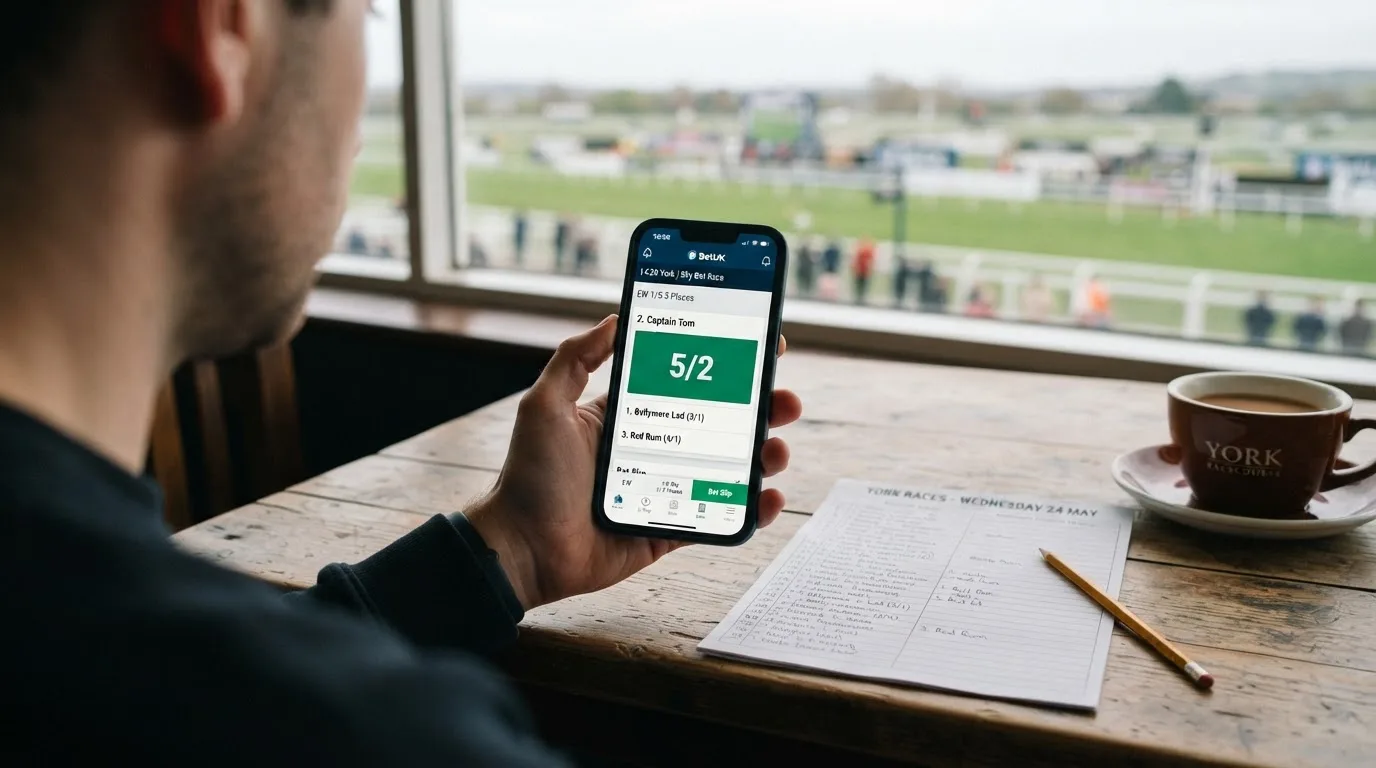
UK each-way place terms are not uniform. Handicaps with more than fifteen runners pay one-quarter of the win odds for four places; fields of twelve to fifteen runners pay one-quarter for three places; other races with more than seven runners pay one-fifth for three places; five-to-seven-runner races pay one-quarter for two places; fields of fewer than five runners go win-only, with no place payout at all. A £10 each-way bet on a 10/1 horse at one-quarter place terms for three places costs £20, returns £110 on the win part and £35 on the place part — £145 in total — if it wins.
That sounds generous, until you realise the place part pays at one-quarter of the win odds, not at the implied probability of placing. A 10/1 horse at one-quarter place terms pays 5/2 (decimal 3.50) on the place part, regardless of where in the frame it finishes, and the bookmaker’s margin sits inside both halves of the bet.
Where each-way costs the punter
The trap is the place-only bet on a non-handicap. A novice flat race with eight runners pays one-fifth odds for three places — meaning a 10/1 shot returns 2/1 (decimal 3.00) on the place part, not 5/2. Two-horse non-handicap each-way bets have no place value at all, because the field is below five runners and the operator goes win-only. Picking the wrong race shape for an each-way stake is the commonest way the bet costs more than the bettor expected.
Handicaps, Conditions and What Different Races Demand
Not every horse race is a level playing field. The two dominant formats in British racing — flat and jump — carry different distances, different weight structures and different betting conventions.
Flat versus National Hunt
Flat races are run directly between two points around a straight or oval track, without obstacles. Jump racing, called steeplechasing over fences and hurdling over smaller obstacles, is referred to as National Hunt racing in Great Britain and Ireland. The two formats share the betting infrastructure but not always the field sizes or the place terms — National Hunt handicaps tend to run smaller fields than summer flat handicaps, which limits place coverage.
Flat distances range from 440 yards (5 furlongs of downhill sprinting) to more than four miles (the marathon stayers’ events), with five to twelve furlongs the most common span on the betting page. Jump racing is dominated by distances of two to three miles, with the Cheltenham Gold Cup, the Grand National and the Champion Hurdle sitting at the upper end of that range.
Handicap versus conditions
In handicap races, each horse is assigned a different weight to carry based on its assessed ability — the better the horse, the more weight it shoulders, in theory levelling the field. In conditions races, horses carry the same weight with allowances for younger horses and for fillies and mares against colts. Handicaps dominate the daily betting card because the weights aim to make every runner competitive on paper; conditions races tend to attract fewer runners but sharper form, because the weights do not flatten the picture.
The betting consequence: handicaps routinely run twelve to twenty runners and offer four-place each-way terms, while conditions races run smaller fields and offer three places at one-fifth odds, sometimes two places at one-quarter. A bettor who picks the right race type for their each-way stake gets a meaningfully better payout on the place portion.
The Best Odds Guaranteed Question
Best Odds Guaranteed (BOG) is the most heavily advertised concession in British horse racing, and understanding what it does — and what it does not do — is the difference between treating it as a free upgrade and treating it as a partial refund.
What BOG actually covers
BOG guarantees that if the starting price of a horse is greater than the price taken at the time of betting, the bookmaker pays at the higher SP rather than the original quote. The original stake is settled at the SP, the winnings are calculated from the SP, and the only thing the punter receives is the difference between the two prices. A £10 bet at 5/1 that returns 8/1 at the off settles at the SP: £80 in winnings, £90 returned, rather than the £50 / £60 from the original price.
Most major bookmakers apply BOG to UK and Irish horse racing only, from a fixed time on race day (typically 8 AM or 10 AM) to the off. William Hill, for one, confines BOG to single and multiple bets — ante-post, tote and pari-mutuel wagers are excluded. Some bookmakers further restrict BOG to customers in Great Britain and Ireland.
What BOG does not do
BOG does not enhance the price on bets placed after the cut-off. It does not apply to greyhound racing, football, golf or any sport other than the named horse racing jurisdictions. It does not stack with other promotions in most cases. It does not pay out when the price shortens — only when it drifts — so a 5/1 shot that goes off at 3/1 is settled at 3/1, with no compensation for the lost ground. BOG is asymmetric by design: it pays the punter only on the upside.
The cost to the bookmaker is real but small, because most BOG-triggered horses shorten rather than drift, and the asymmetric structure means most of the time the bookmaker keeps its margin intact. To the bettor it is worth having on, but it is not the price advantage a casual reading of the marketing suggests.
Promotions, Free Bets and What They Cost to Clear
Free bets on horse racing are not free. They are credit on the betting account that pays out the winnings but withholds the stake, and they arrive with conditions attached: a minimum odds requirement, a wagering multiplier, an expiry window, and a market restriction that limits how and where the free bet can be staked.
The shape of the typical free bet offer
A representative sports welcome offer might state: bet £10, get £10 in free bets. The free bet credits land after the qualifying bet settles, expire within seven days, and pay only the winnings portion if the free bet wins — meaning a winning £10 free bet at 3/1 returns £30, not £40. The minimum odds on the qualifying bet tend to sit around evens (1/1, decimal 2.00) or higher, and the qualifying bet is excluded from most other promotions.
Free bets whose stake is not returned have a calculable average value. For a free bet whose stake is not returned, value equals the free-bet amount times (odds minus one) divided by odds, multiplied by the payout share of that market. On a market with roughly 95% payout share (a 5% margin), a £10 free bet at decimal odds of 3.00 returns an expected value of about £10 times 2 divided by 3 times 0.95, or roughly £6.33. The headline “£10 free” is therefore worth closer to £6 on average — not a windfall, but not a loss either, provided the punter has the time and discipline to clear the wagering requirement.
Wagering requirements and the cap
Bonus wagering requirements are capped at ten times the bonus value across UK-licensed operators as of 19 January 2026. A £10 bonus at ten times requires £100 of qualifying bets before the bonus converts to withdrawable cash; under the old regime, wagering requirements of thirty to fifty times were common on casino products. The horse racing punt, however, falls under sportsbook rules, where wagering multipliers tend to sit lower (often no wagering at all on free bets) and where stake-by-stake settlement is the norm.
Mixed-product promotions — an offer that requires gambling on two or more product types, such as “bet on football to get free spins” — are banned. The cap and the mixed-product ban apply only to GB-licensed operators; offshore brands running on their own house rules are not bound by either.
Crypto, Spread Betting and the Offshore Question
A recurring thread in horse racing betting searches concerns non-GamStop sites, crypto-funded betting and brands licensed outside Great Britain. Each of these leads to the same bottom line: the punter trades British consumer protections for something else, and what they trade is not always obvious.
Licensed versus unlicensed in practice
A GB licence is compulsory at the point of consumption: an operator whose remote facilities are used in Great Britain needs a Gambling Commission licence wherever it is based, whether the operator is registered in Malta, Gibraltar, Curaçao or the Isle of Man. The Commission’s public register can be searched by business name, trading name, domain or account number, and is the whole test of who holds one. A Curaçao or Maltese licence is not a substitute.
What a GB licence buys: identity verification before the first deposit (no anonymous play), GAMSTOP coverage and operator self-exclusion, a ten-times cap on bonus wagering, the £150 financial vulnerability check, Commission complaints routes, an approved dispute-resolution body, and the protection of British consumer law if funds are withheld. What an offshore brand offers: looser entry, faster sign-up, sometimes crypto deposits, occasionally higher advertised bonuses — but no GAMSTOP coverage, no Commission complaints route, no British consumer redress and no obligation to honour the bonus cap.
Spread betting complicates the picture further. Spreadex, for instance, is regulated by the Financial Conduct Authority for spread betting and by the Gambling Commission for fixed-odds betting — a dual structure that reflects the dual product. Spread betting losses can exceed the deposit, which is a structural feature, not a marketing claim, and it sits behind a different regulatory door from fixed-odds wagering.
Crypto deposits and what the Commission says
Cryptocurrency deposits at GB-licensed operators are not explicitly forbidden and not explicitly endorsed. The lack of a stated rule, combined with identity verification before the first deposit, means in practice that crypto-funded accounts at licensed operators function like any other verified account: no anonymity, no circumvention of the source-of-funds check, no escape from the GAMSTOP registration. A licensed operator accepting crypto is not an unlicensed operator offering anonymity — it is a licensed operator with a payment-method preference.
The genuinely anonymous route lies with offshore brands, and that is where the protections fall away.
Best Horse Racing Betting Apps
The best horse racing betting app is the one that opens fast, shows every race on the day’s card, prices up early enough for BOG and settles bets quickly after the result. The GB App Store lists several sports betting apps aimed directly at horse racing, and they differ in ways that matter to the punter.
The features that matter
A horse racing app earns its place by carrying the daily card — including evening meetings, AW all-weather fixtures and the Irish jumps — and pricing up early enough for BOG to take effect. The next layer is in-play horse racing markets, where prices update as the race unfolds and cash out becomes available before the finish.
Bet Builder functions are largely irrelevant to pure horse racing (they sit on football and tennis more than on racing), but enhanced odds on selected races, acca insurance on multiple bets and price boosts on featured runners are common across major apps. Live streaming of racing from British and Irish tracks is bundled into some apps at no extra cost, on condition the punter has placed a qualifying bet on the race.
The native-app versus mobile-site distinction
Native apps give push notifications for price drops, race reminders and BOG triggers. Mobile sites give the same betting functionality without the download. Both routes satisfy the Gambling Commission’s technical standards for remote betting; neither route bypasses identity verification, deposit limits or GAMSTOP self-exclusion. The choice is one of interface preference, not regulatory escape.
Live Betting and Cash Out on Horse Racing
Live horse racing betting, sometimes called in-running or in-play, lets the punter back or lay a horse after the stalls open or after the tape rises. The prices swing sharply from the start, and the bettor’s edge depends on reading the early furlongs better than the bookmaker’s algorithm.
How in-running horse racing works
A bookmaker’s in-play horse racing feed updates prices several times a second as positions change. The leader after two furlongs shortens sharply; the horse at the back drifts. The bookmaker charges a wider margin in-play than pre-race, because the price moves are harder to model and the liability harder to hedge. For the punter, in-play offers more value on information asymmetry — knowing a horse hates soft ground before the rain comes, recognising a trainer’s patient ride pattern — and less value on simple form reading, which the algorithm already prices in.
In-play horse racing is offered by most major UK bookmakers. There is no statutory prohibition on in-play betting on horse racing, and the controls are the operator’s licence conditions and customer-protection duties.
Cash out, partial cash out and the haircut
Cash out lets the punter close a bet before the result, taking a payout based on the bet’s current theoretical value. Partial cash out lets the punter take a slice of the current value and leave the rest running. The catch is the cash-out haircut: the payout offered is below the bet’s true expected value, as the operator must account for future price moves. No deposit or payout guarantee exists for a gambling account; your protection relies on the operator’s Gambling Commission licence, which ensures oversight, regulated deposit limits, and a local legal venue for disputes.
For an each-way bet, cash out typically closes the win and place parts separately — the punter can cash out the win portion while leaving the place portion to settle on the result, or vice versa. For an accumulator or a multiple bet, cash out covers the whole bet. The cash-out value updates in real time as the race unfolds.
Todays Horse Racing Betting and the Information Problem
A large share of horse racing searches each day ask the same question: what is worth backing today? The honest answer is that nobody can know for certain — and any source that claims certainty about a horse race is selling something that does not exist.
What tipsters, tipster sites and price movers actually offer
Tipsters — paid or free — sell opinions. Some opinions are better calibrated than others, and a long track record at publicly reported prices is the only honest test of a tipster’s edge. Tipster sites that publish verified returns to a set staking plan, with audited prices and a defined sample size, give the punter something to assess. Tipster sites that publish only winners, only on the days they got it right, are selling hope.
Price movers — services that flag steam moves, drifters and significant money on the exchanges — give the punter an indirect view of where the sharp money is going. The information is real, the lag between move and price update at mainstream bookmakers is short, and the bettor using price-mover data is essentially renting the sharp bettors’ research.
Neither route produces a winning system. What it produces, at best, is a marginal edge on a subset of races — and at the cost of subscription fees, time spent reading form and the discipline to walk away when the data stops making sense.
Form study, sectional times and the data a punter can read for free
Racing form is publicly available: the Racing Post, the BHA database and a handful of free sites carry every runner’s last six starts, going, distance suitability, course record and head-to-head results. Sectional times — pace data broken down by furlong — are published for major meetings and give a read on how a horse actually ran, not just where it finished. Going reports describe the ground: firm, good to firm, good, good to soft, soft, heavy — and a horse’s record on each going is a sharper filter than form figures alone.
None of this guarantees a winner. What it does is allow the punter to dismiss a price that looks too short, to back a horse whose profile fits the conditions and to walk away from a race where the data says nothing useful. Discipline at the betting slip is the only edge a recreational punter can manufacture, and a disciplined day ends more often than not without a bet placed.
Punters Tools and Bet Calculators
A bet calculator is the punter’s spreadsheet: it tells you what a winning bet returns before the result comes in, which lets you size stakes, compare each-way options and check the maths of a multiple without doing the arithmetic on the back of a betting slip.
What a calculator handles
A horse racing calculator takes the stake, the odds (fractional or decimal), the each-way flag and the place terms, and outputs the total returned for a win, for a place and for the each-way outcome. It also calculates accumulators: a four-leg acca at 3/1, 4/1, 5/1 and 6/1 returns the stake times the product of the decimal odds, minus the stake, with the qualifying bet settled at the bigger of the taken price or the SP if BOG applies.
Multi-leg bet permutations — the Trixie, Patent, Yankee, Lucky 15, Super Yankee / Canadian, Heinz and Goliath — get their own calculators. A Lucky 15 is fifteen bets across four selections: four singles, six doubles, four trebles and one four-fold accumulator. A £1 Lucky 15 costs £15; a winning £1 Lucky 15 with all four selections winning at 3/1, 4/1, 5/1 and 6/1 pays out a five-figure sum. The variance is enormous and the cost is fixed.
Why the calculator matters more than the tipster
The calculator tells the punter what the bet costs and what the bet returns under each outcome. That information is mechanical; it does not depend on whether the horse wins; and it sets the staking plan before the bet is placed. A punter using a calculator walks into a race knowing the maximum downside and the maximum upside. A punter not using a calculator discovers the downside only after the result has cost them money.
The Top 10 Horse Racing Bookmakers Worth a Shortlist
Ten brands operate under a Gambling Commission remote betting licence, accept customers in Great Britain and put a horse racing card on the page. The list is not a ranking — no single brand is “the only” licensed one, and a place in the comparison is not a licence. What follows is what each brand’s own terms state about horse racing, alongside the Commission’s public register data.
1. Tote
Licensed under Commission account 54779, with remote general betting standard (real events) as the registered category. Tote is the pool-betting brand of British racing — bets are settled into the Tote pool rather than against the book, and prices are driven by stake-weight across the entire field rather than by individual bookmaker quotes. Tote bets sit outside Best Odds Guaranteed in most cases because there is no traditional SP to beat.
The Tote’s appeal is the placepot, the jackpot and the scoop6 — pool-based bets that pay out from the combined pool across all participating customers, with a small take for the operator. The drawback is variability: pool payouts move up and down with the day’s stake, and a popular winner can halve the payout compared with a shock result.
2. BetGoodwin
Licensed under Commission account 2927, with remote general betting standard (real events). BetGoodwin’s sports welcome structure, as stated by the App Store listing, combines a £5 sports single, a £5 acca and a £5 Sub-Cover bet — three separate free bets, each with its own terms and minimum odds requirements. Sub-Cover is BetGoodwin’s signature product: a free bet that pays out if a chosen selection is beaten by a close-margin loss, in effect a refund on a near-miss.
For horse racing specifically, BetGoodwin offers standard win and each-way markets alongside the Sub-Cover line. The value sits in the Sub-Cover refund mechanic, not in headline price — a near-miss horse that loses by a short head triggers a payout that traditional BOG does not.
3. Geoff Banks
Licensed under Commission account 54095, with remote general betting standard (real events). The Geoff Banks app is published by GB Sports Advisors Limited and offers live in-play prices alongside ante-post markets on future events. The brand pitches itself at the racing specialist rather than the all-rounder, and the app focuses on form, market movers and race-by-race coverage rather than casino games.
Ante-post pricing is the standout: bets placed days or weeks ahead of a major festival carry much bigger prices than bets on the day, but every selection carries the non-runner risk — if the horse is declared a non-runner, ante-post stakes are returned minus a deduction in some cases.
4. VBet
Licensed under Commission account 44662, with remote general betting standard (real events). VBet’s sports welcome offer, as stated by the App Store listing, is a £10 free bet credited if a new, verified customer stakes £10 or more on a first-ever bet that loses. The qualifying bet excludes cashed-out wagers in most cases, and the free bet credits expire within seven days. The VBet pricing on Premier League football is competitive; horse racing pricing tends to track the major bookmakers rather than undercut them.
The draw for horse racing punters is the breadth of the racing card — UK, Irish and selected international meetings, plus ante-post on the major festivals — and the in-play feed on selected evening meetings.
5. Sporting Index
Licensed under Commission account 27343, with remote general betting standard (real events). Sporting Index runs a hybrid spread-betting and fixed-odds product. Customers can switch between fixed odds and spread bets on the same selection, and the app layers in-play betting, Bet Builder for football, auto cash-out and Multi-Markets on selected events.
Spread betting on horse racing markets — finish position, winning distances, the field’s total winning margin — is where Sporting Index differs from the rest of the shortlist. The product is FCA-regulated for the financial side and Commission-regulated for fixed odds, and losses on the spread book can exceed the stake. It is not the starting point for a recreational punter, but it is the only licensed route to spread betting on racing for UK customers.
6. Kalooki Sportsbook
Licensed under Commission account 57730, with remote general betting standard (real events). Kalooki is operated by Kalooki Sports Book Ltd (company number 12938274), holds a Gambling Commission licence in its own name and is a GAMSTOP member — the verification, deposit limit, self-exclusion and affordability-check regime applies in full.
The brand’s racing card covers UK and Irish meetings with standard win, place and each-way markets. Pricing tracks the major firms, and the draw is the explicit, single-brand licence statement — the operator states its licence number on its own homepage rather than the punter having to dig for it.
7. LiveScore Bet
Licensed under Commission account 56859, with remote general betting standard (real events). The LiveScore Bet app is built around the live scores product the parent brand runs across football and a dozen other sports, and the betting app inherits those feeds for in-play markets. The brand’s Bet Builder allows up to ten selections and covers match result, both teams to score, corners, total goals, player scoring and card markets.
For horse racing, the edge is the live scores integration: race-by-race times, sectional splits and finishing positions feed into the betting experience, and the punter watching the meeting can place in-play bets without leaving the scores interface. Horse racing-specific tools are more limited than at racing-first brands.
8. Dabble
Licensed under Commission account 65677, with remote general betting standard (real events). Dabble’s welcome offer, as stated by the App Store listing, is a £10 free bet on a first deposit for new customers, with minimum odds applying, a seven-day free bet expiry and the stake not returned. The qualifying bet is a single, at minimum odds typically around 4/6 or 5/6, and the free bet credits land once the qualifying bet settles.
Dabble’s racing card covers UK and Irish meetings with competitive place terms, and the app layers a social feed where customers can comment on selections and follow other punters. The social layer is the brand’s distinctive feature; the betting product is straightforward.
9. 10bet
Licensed under Commission account 43173, with remote general betting standard (real events). The 10bet app covers football, tennis and horse racing, with cash out, Bet Builder and live streaming on selected events. The racing card carries UK, Irish and selected international meetings with standard markets.
The draw is the cross-sport coverage and the live streaming on selected racing fixtures. Pricing on horse racing tracks the major firms, and the edge over single-sport racing apps is the broader catalogue rather than sharper prices.
10. Betfred
Licensed under Commission account 39544, with remote general betting standard (real events). The Betfred Sports, Casino and Games app is published by Done Brothers (Cash Betting) Ltd for the retail betting shop side, and by Petfre (Gibraltar) Limited for the remote betting side under the same Commission account. The app covers twenty-one sports plus over two thousand casino-style games.
Betfred’s horse racing heritage runs deep — the brand sponsors major races and offers Best Odds Guaranteed on UK and Irish racing from the morning of the race. The racing card is comprehensive, the in-play feed covers evening meetings, and the bonus structures tied to specific races feature frequently.
What a Top 10 Comparison Looks Like Side by Side
The table below sets out the Commission’s register data and what each operator’s own terms state on the key horse racing subjects. The licence number and licence holder are the Commission’s records; the horse racing offer is each brand’s own stated product. Cells where research does not state a figure leave the column for that brand.
| Brand | Gambling Commission remote licence number and licence holder | What the operator’s own terms state on horse racing |
|---|---|---|
| Tote | 054779-R-331321-008 (TDCO Limited, account 54779) | Pool betting on UK racing via the Tote; placepot, jackpot and Scoop6 pools |
| BetGoodwin | 002927-R-327985-008 (Goodwin Racing Limited, account 2927) | Welcome offer of a £5 single, a £5 acca and a £5 Sub-Cover free bet; Sub-Cover refund on near-miss losses |
| Geoff Banks | 054095-R-330366-010 (GB Sports Advisors Limited, account 54095) | Live in-play and ante-post prices; racing-specialist product |
| VBet | 044662-R-324273-022 (SCGO Limited, account 44662) | £10 free bet on a first bet that loses for new, verified customers; seven-day expiry; stake not returned |
| Sporting Index | 027343-R-308898-011 (Sporting Index Limited, account 27343) | Dual spread and fixed-odds product; FCA-regulated for spread, Commission-regulated for fixed odds; spread losses can exceed deposit |
| Kalooki Sportsbook | 057730-R-333396-005 (Kalooki Sportsbook Limited, account 57730) | Standard UK and Irish racing markets; explicit Commission licence statement on homepage; GAMSTOP member |
| LiveScore Bet | 056859-R-332720-005 (LiveScore Betting and Gaming (Gibraltar) Limited, account 56859) | Racing integrated into live scores feed; in-play markets available |
| Dabble | 065677-R-340363-005 (Dabble Sports UK Ltd, account 65677) | £10 free bet on first deposit for new customers; minimum odds qualifying bet; seven-day expiry; stake not returned |
| 10bet | 043173-R-322899-023 (Blue Star Planet Limited, account 43173) | UK, Irish and selected international racing; cash out, Bet Builder and live streaming on selected events |
| Betfred | 039544-R-319290-010 (Petfre (Gibraltar) Limited, account 39544) | Comprehensive racing card, Best Odds Guaranteed on UK and Irish racing, race-specific bonus structures |
The picture the table paints: every brand on the shortlist is a real betting operator with a real licence behind it, and the variation lives in what each does with that licence. Tote runs a pool product that no other shortlist brand runs. Sporting Index runs a spread product that no other shortlist brand runs. BetGoodwin and VBet front the free-bet race with different mechanics — refund on a near-miss versus refund on a loss. The others compete on coverage, in-play depth, mobile speed and the size of their own racing card.
What Every UK Horse Racing Bettor Should Know Before Placing a Bet
The mechanical facts sit behind every bet, and they make the difference between a bettor who knows what they are doing and a bettor who does not.
Identity verification, deposits and the no-anonymity rule
GB-licensed operators verify name, address and date of birth before a customer can deposit or gamble — and that has been the rule since 7 May 2019, including for accounts claiming a free bet or bonus. The verification uses public records and third-party data providers; it is not optional and not stretchy on the operator side. Cryptocurrency deposits at licensed operators do not bypass the rule, because the operator still needs a verified identity before the first deposit clears.
There is no anonymous play at a licensed site. The closest a punter gets is a verified account with a long-standing deposit history, and even that is bound by the financial vulnerability check, the deposit limit and the GAMSTOP exclusion.
Bonuses, free bets and the wagering cap
Wagering requirements on bonuses are capped at ten times the bonus value across GB-licensed operators, as of 19 January 2026. A £10 bonus at the cap needs £100 of qualifying bets before the bonus converts; at the formerly common fifty-times multiplier, the same £10 bonus would have needed £500. Free bets with no wagering condition are not always covered by the cap, and the question is unsettled.
Mixed-product promotions — offers that require gambling on two or more product types, such as “bet on football to get free spins” — are banned at licensed operators. The ban closes the most aggressive cross-sell route the industry previously used.
Taxes: the punter pays nothing, the operator pays plenty
UK betting winnings are tax-free for the customer — General Betting Duty is the operator’s tax on gross profits, currently 15%. From 1 April 2027 a new remote betting rate of 25% applies within General Betting Duty, while remote bets on UK horse racing, bets on self-service betting terminals in licensed premises, pool betting and in-person betting stay at 15%. Until that date the remote rate holds at 15%; the question of whether operators pass duty on through odds is not established.
A professional gambler — someone whose betting activity crosses HMRC’s threshold for trading income — should ask HMRC or a tax adviser for a ruling. The tax-free treatment is the general rule and not a guarantee for every punter.
Spread betting: a different product with a different regulator
Financial spread betting on horseracing markets is regulated by the Financial Conduct Authority, not the Gambling Commission, and the FCA’s regime permits losses to exceed the original stake. Spread products are offered alongside fixed-odds products at dual-regulated firms such as Spreadex and Sporting Index, and the punter choosing the spread side of the book is opting into a different risk profile from the fixed-odds side.
The spread markets most commonly offered on horse racing are finish position, winning distances and field aggregates — markets where a small swing in the actual result produces a much bigger swing in the payout. A winning-margin bet at a stated spread of, say, two lengths pays out if the actual winning distance is bigger than two lengths, costs the stake if it is smaller, and is settled against the difference in either case. The product is not a substitute for fixed-odds betting; it is a different mechanic with its own maths.
The Licence Question and Why It Matters
Every brand on this shortlist holds a Gambling Commission remote betting licence — the same kind of licence, in the same category, with the same set of licence conditions and codes of practice applying to each. The Commission’s public register can be searched by business name, trading name, domain or account number, and is the whole test of who holds one.
How to verify a licence
Open the Commission’s public register. Search by the operator’s business name, trading name, domain or the Commission account number carried on the operator’s own site. Confirm that the licence category listed matches the product the operator offers — “remote general betting standard (real events)” covers horse racing; “remote general betting limited” covers more restricted products and does not cover the full racing card. Confirm that the licence is currently active, not surrendered, lapsed or under review. Confirm that the trading name on the register matches the brand the punter is about to deposit with.
A Curaçao, Maltese or Gibraltar licence is not a substitute for a Commission licence for customers in Great Britain. Providing gambling facilities in Great Britain without the licence the Act requires is an offence under section 33 of the Gambling Act 2005 — aimed at the operator, not the customer.
What a licence buys and what it does not
A licence buys: identity verification before the first deposit, GAMSTOP coverage, the £150 financial vulnerability check on a rolling 30-day basis, the deposit limit framework, the ten-times bonus wagering cap, the ban on mixed-product promotions, the Commission’s complaints route, an approved dispute-resolution body, and British consumer redress if funds are withheld. A licence does not buy guaranteed winnings, profitable betting, a refund on losses or any insurance against picking the wrong horse.
A licence also does not cover the punter at an unlicensed site. The list of risks at an unlicensed site is real: no GAMSTOP coverage, no Commission complaints route, no British consumer redress, no obligation to honour the bonus cap, no financial vulnerability check, no source-of-funds obligation, and the possibility — backed by enforcement actions — that funds held by an unlicensed operator can become unreachable.
Where British Racing Lives in the Calendar
The British racing calendar stretches across the year, with a handful of festivals dominating the betting headlines and the daily all-weather and evening meetings filling the gaps.
The majors
The British Triple Crown consists of the 2000 Guineas, the Derby and the St Leger — three Classics for three-year-olds, with the Guineas run over the row mile at Newmarket in late April or early May, the Derby over a mile and a half at Epsom in early June and the St Leger over a mile and six furlongs at Doncaster in mid-September. A horse that wins all three becomes a Triple Crown winner, and the betting interest is enormous.
Jump racing has its own centre of gravity at Cheltenham in March, with the Cheltenham Festival a four-day meeting that includes the Champion Hurdle, the Champion Chase, the Stayers’ Hurdle and the Cheltenham Gold Cup. The Grand National at Aintree in April and the Champion Hurdle, the Queen Mother Champion Chase and the Gold Cup define the early spring. Royal Ascot in June anchors the flat summer. The bettor chasing value on the headline races needs to factor the form, the going and the market position before the off — the popular short-priced favourite has historically won fewer of these Classics than the betting market suggests, because short pricing collapses the value.
The every day
Between the festivals, the daily card carries flat, all-weather and jump racing from tracks across England, Scotland, Wales and Ireland. Field sizes matter for place terms, going reports matter for horse selection, draw biases matter at certain courses and the quality of the meeting matters for the depth of the betting market. The recreational punter backing one race a day should be selective: form study on twenty races is impossible, and a single carefully selected race beats four randomly backed runners.
Responsible Gambling and the Costs Beyond the Bet Slip
Betting sits inside a regulatory frame designed to limit the harm it can do, and the limits matter because the underlying product — risking money on an uncertain outcome — carries the risk of compounding losses.
The safety net at licensed operators
GAMSTOP is the national multi-operator online self-exclusion scheme and a mandatory licence condition for online operators since 31 March 2020. A punter who registers with GAMSTOP excludes themselves from every GB-licensed online operator for six months, one year, five years, or five years with auto-renewal, and the exclusion stays in place for a further seven years after the minimum period unless the punter asks GAMSTOP to remove it. GAMSTOP covers online sites and apps; betting shops use a separate self-exclusion service.
The financial vulnerability check applies to licensed remote betting when a customer’s deposits minus withdrawals exceed £150 in a rolling 30-day period — a public-record check (bankruptcy, county court judgments) rather than an income check or a credit reference check. Financial risk assessments — the so-called affordability checks — have been announced in a staged plan, with no start date confirmed as of writing.
Deposit limits are the punter’s choice: operators must offer a gross deposit limit on a fixed time frame, and the limit can be tightened instantly. There is no state-set deposit or loss ceiling for betting — limits are the customer’s choice, applied through the operator’s responsible-gambling tools.
The help that does not sell a product
GamCare runs the National Gambling Helpline and offers confidential support for punters and their families. GambleAware funds research, treatment and prevention. NHS gambling clinics offer free cognitive-behavioural treatment for problem gambling. Gamblers Anonymous runs peer-support meetings across the country. None of these is part of a betting operator’s product; none of them asks the punter to place a bet.
A punter who is chasing losses, betting money they cannot afford to lose, hiding their betting from family, or finding that betting is no longer fun has crossed the line between recreation and problem. The earlier the conversation starts — with GamCare, with a GP, with the operator’s own self-exclusion tools — the less it costs in the long run.
A Note on the Costs Not Yet in View
The £10 stake, the £1 place payout, the £30 acca return — every figure in this guide is a guess about a future the punter cannot see. The bettor who walks away with money is rarer than the marketing suggests; the bettor who walks away having enjoyed the day without losing the household budget is the realistic target.
The licensed operators on the shortlist will verify identity, run GAMSTOP, apply the £150 check and let the punter set a deposit limit. None of them will refuse a bet because the punter is in financial difficulty, beyond the public-record check; the discipline is the punter’s. Set the deposit limit before the first deposit. Use the calculator before the first stake. Read the terms before the first bonus. And if any of those steps feels like a chore, take it as the signal it is.
Frequently Asked Questions on Horse Racing Betting Odds
How do you bet on horse racing?
Pick a licensed UK bookmaker, register an account, verify your name, address and date of birth, deposit using a debit card or bank transfer, and place a bet from the day’s race card. Choose the race, the horse, the stake and the bet type — win, place or each-way — and confirm. The bet settles after the race: a win bet returns the stake plus winnings at the taken price or the SP under BOG, a place bet returns the place portion at the stated place odds, and an each-way bet covers both.
How do you work out a horse racing bet return?
Take the stake, multiply by the decimal odds to get the gross return, subtract the stake to get the profit. A £10 bet at decimal odds of 6.00 returns £60 and profits £50. For a fractional price of 5/1, the decimal equivalent is 6.00 — the math is the same. For an each-way bet, the calculation runs twice: a £10 each-way bet at 5/1 costs £20 and returns £120 plus a place payout if the horse finishes in the places.
How do betting odds work in horse racing?
Odds express the implied probability of a horse winning against the book’s margin. Decimal odds of 4.00 mean a £1 stake returns £4 if the horse wins, with a £3 profit; fractional odds of 3/1 mean the same. The bookmaker’s margin sits in the implied probabilities: if every runner in a six-horse race is priced at 5/1, the implied probabilities add up to 120% and the bookmaker’s margin is 20%. The shorter the field and the more efficient the market, the closer the implied probabilities sum to 100%.
How can a bookmaker’s Gambling Commission licence be verified?
Open the Commission’s public register and search by the operator’s business name, trading name, domain or account number. Confirm that the licence category covers the product — “remote general betting standard (real events)” for horse racing — and that the licence is currently active. A Curaçao, Maltese or Gibraltar licence is not a substitute for a Commission licence for customers in Great Britain; section 33 of the Gambling Act 2005 requires a Commission licence wherever the operator is based.
How is the return on a bet calculated from the stake and the odds?
Return equals stake times decimal odds. A £25 stake at decimal odds of 3.75 returns £93.75, with a profit of £68.75. For an each-way bet at one-quarter place terms with three places on an eight-runner race, the place odds are the win odds divided by four plus one: a 10/1 horse at one-quarter place terms pays 5/2 (decimal 3.50) on the place part, with the full win payout if it finishes first.
What is the bookmaker’s margin and how does it appear in the odds?
The margin is the share of every pound staked that the bookmaker keeps on average, and it sits inside the implied probabilities of every runner. For a two-way race priced at decimal 1.90 on each runner, the implied probabilities add to about 105.3%, giving a margin of about 5.3% and a payout share of roughly 94.7%. For a twelve-runner handicap priced at a typical book of about 110%, the margin sits closer to 9-10%. The wider the field and the less efficient the market, the bigger the margin — and the lower the punter’s expected return for any given level of skill.
Horse racing & greyhounds – signupbetsguide.com
Content created by the «signupbetsguide.com» team
