
Online badminton betting in 2026: which sites cover it, what the odds cost, and what an offer is really worth
 Available in US
Badminton sits in an odd corner of the British sportsbook. It is one of the longest-running Olympic disciplines, the BWF tour runs almost year-round, and a regular weekend of fixtures stretches from the All England Open through to a stack of BWF World Tour stops in Asia and Europe. Yet few casual punters realise how thin the betting menu actually is until they go looking. Most major British bookmakers carry a working match odds market on the marquee events; far fewer cover the smaller tour stops or the lower-ranked doubles disciplines. The shape of the offer is the part of the page.

What follows is a working reader’s map to online badminton betting in Great Britain: the structure of a typical bonus, the way live markets behave, the bet types that actually settle, the tournaments worth knowing, the ten bookmakers on the British register that carry a real badminton product, and the legality and safer-gambling rules that frame all of it. The angle through every section is the same: what does this cost the punter, and what does the marketing leave out.
Current as of 30 October 2026 · data checked against the Gambling Commission’s public register and each operator’s own published terms.
Bonuses and free bets on badminton: what the welcome offer really asks of you
The welcome offer is the loudest part of any bookmaker’s badminton pitch and, almost without exception, the part that costs the punter the most. The marketing line is the easy half: stake £10, get £30 in free bets. The harder half sits in the small print, and on badminton that small print is unusually unforgiving. Three structural features recur across the British market and they are worth understanding before any bonus is claimed, because the same three features decide whether a promotional offer ends up as a small loss, a small gain, or the kind of grinding turnover that eats a bankroll without ever producing a withdrawal.

The first is the qualifying bet. A welcome offer rarely credits on a deposit alone; it credits on a settled bet, and that bet has conditions. BetMGM’s sports welcome, for example, is a £10 minimum deposit followed by a sports bet placed within seven days, and the four £10 free bets that follow are split between two football accumulators of four or more selections and two sports multiples of two or more, valid for a further seven days. The football accumulator condition is the part that bites badminton: the four £10 free bets are not generic. Two of them have to be used on football accas. That is not a badminton punter’s free bet. Betboro’s first-bet offer is a matched free bet of up to £25, with a debit card deposit of at least £10 and a first bet between £5 and £25 of three or more selections, each at 3/5 (1.60) or higher. VBet’s offer is the cleanest of the three: stake £10 or more on a first bet that loses, and the book credits a £10 free bet. No accumulator condition, no sport restriction, no minimum price beyond the basic 1.50 floor on most free bets.
The second is the wagering requirement, and this is where British law has just stepped in. From 19 January 2026 the Gambling Commission’s promotion rules cap wagering requirements on bonuses at 10x. A £10 bonus at 50x — the kind of figure that was routine through 2024 and 2025 — is now barred; under the cap the same £10 bonus can require at most £100 of qualifying bets before the bonus and any winnings become withdrawable. Free bets with no wagering condition sit in a less settled area: the Commission’s published position stops at the cap, not at a blanket ban, so a free-bet token that pays out in cash with no further turnover is still the cleanest structure to look for. What is also barred under the same rules is a mixed-product promotion — an offer that asks the punter to bet on football to unlock free spins in a casino, for instance. That structure has been closed off for the British market from 2026 onward.
The third is the free bet itself and how it pays out. Sky Bet’s free-bet terms, taken straight from the operator’s help pages, are explicit: a free bet expires thirty days after it is credited, can be used only on single or each-way markets (multiples excluded), cannot be used on virtuals, is non-withdrawable in its own right, and does not return the stake when the bet wins. The non-returned stake is the part that readers most often miss. A £10 free bet at decimal odds of 4.00 returns £40, not £50: the £10 stake is the operator’s money and stays the operator’s money. A winning cash bet at the same odds would have returned £50. The £10 difference is the cost of the free bet, and on a heavily odds-on line — a 1.40 favourite — the cost is closer to two-thirds of the offered face value of the token. On longer-priced outsiders, the cost narrows. The market’s expected value of a free bet at 1.60 sits somewhere in the £4 region for a £10 token; at 4.00, closer to £7.50. Both are positive numbers, but neither is anything close to the face value of the free bet itself, and the punter who thinks otherwise is the punter the offer is built to attract.
There is a fourth point that sits behind the other three and matters more than any of them for badminton: most of the welcome offers published on a British bookmaker’s badminton page are not badminton-specific. They are general sports offers, and the free-bet currency is generic across the sportsbook, which means the punter can usually use a free bet on whatever sport they like once the qualifying bet is settled. That is the good news. The bad news is the converse: a free bet that is restricted to a particular sport is rare, but a free bet restricted to a particular market (an accumulator, a build-your-own bet) is not. The punter who wants to use a free bet on a BWF World Tour match winner market should read the per-bet rules before staking the token, and should not assume that an “any sport” line in the marketing copy actually means any market.
A worked picture helps. Take a £10 free bet on a match winner at 2.50. A winning bet returns £25, of which £15 is profit and £10 is the operator’s stake the punter never sees again. A losing bet returns nothing. The market’s payout share on a 1.50/2.50 two-way line is roughly 88.9 per cent, so the implied probability of the favourite is about 60 per cent and the underdog about 40 per cent. The expected value of the free bet is therefore about 60 per cent of the time it wins £15, plus 40 per cent of the time it returns nothing, which comes out at £9 from a £10 token. The punter pays about £1 of “edge” for the chance to win a £15 profit. That is the kind of calculation a smart punter runs before they claim any free bet, on badminton or any other sport.
Live betting and cash out on badminton: thin markets, narrow windows
Live betting is the second cluster the marketing leans on, and on badminton it is also the one that disappoints soonest. The structural reason is straightforward. A badminton match is fast. The longest games at the top of the men’s game go past twenty-five minutes, but the median game is twelve to fifteen minutes and a three-game men’s singles match rarely runs past an hour. A women’s singles match at the top of the game is shorter still. The in-play market, by contrast, is built around the assumption of meaningful time between price changes — a minute or two of trading on a new game, ten or fifteen minutes on a new set in tennis, half a period on a football match. Badminton gives the trader almost no time at all. The ball is in play from first serve to match point, and the in-play feed at a bookmaker is updating point by point in real time.
What that does to the market is compress the margin and lengthen the wait. The bookmaker’s margin on a pre-match match winner market on a major BWF event sits in the 5–8 per cent band; the margin on the same game’s in-play version, once the match is two or three points in, can climb above 10 per cent because the trader is uncertain where the swing has come from. The punter who has watched the first three points and seen the underdog take a 2-1 lead is not getting the underdog at the same price they got in the pre-match market. They are getting it at a price the trader has shaved by three or four points. The mid-game overround is a hidden tax on impulse.
A second feature of live badminton is the suspension pattern. Bookmakers do not let the punter bet on the next point — that would be match-fixing territory, and the British bookmakers do not offer it. The market is suspended point by point, with prices reissued every two or three points, sometimes every game. The punter who clicks “accept” on a price update is betting on the next game or the next significant scoring passage, not on the next point. The window is therefore not the live feed’s update speed but the gap between suspensions, which is usually one game. A men’s singles match that goes to three games offers the in-play bettor three windows. A women’s singles match that ends in two offers two. That is the entire live menu, and it is much smaller than the in-play product looks from a marketing screenshot.
Cash out, the third leg of the live product, has its own behaviour on badminton. Most British bookmakers offer cash out on the pre-match match winner market and on the outright tournament winner, both of which settle at a single point in time and give the trader a clean book to cash out against. The point-by-point in-play market, by contrast, is rarely cashed out in mid-game: the trader does not want to take a position on a match that is moving point by point, and the offer is usually “cash out at the next game break” rather than “cash out now”. The punter who wants a clean cash-out experience on a badminton match should treat the pre-match market and the outright tournament market as the cash-out markets, and treat the live point-by-point feed as an information feed rather than a cash-out feed. The data on it is real; the trading on it is thin.
The four operators from the British register that explicitly mention in-play or live functionality in the public materials are Sporting Index, which combines fixed-odds and spread betting with a full in-play product and an auto cash-out feature on football, and BetVictor, which adds enhanced live race streaming and a BetFinder feature alongside Smart Stats. Spread betting — Sporting Index’s other line — is a different product altogether, regulated by the Financial Conduct Authority rather than the Gambling Commission, and the spread bettor can lose more than their deposit. The point for badminton is narrower: the in-play market is real, but it is also narrow, and the punter who treats it as the centrepiece of a badminton strategy is going to be working with a much thinner product than the marketing suggests.
Predictions, tips and strategy: what the data does and does not say
Search traffic around badminton betting carries a heavy “tips” and “predictions” tail. “Badminton betting tips”, “badminton betting predictions”, “badminton betting tips today” and the broader “betting tips badminton” all sit in the same cluster, and a reader who lands on this page is often expecting a tipster’s verdict on the next round of matches. The honest answer is that the same data the tipster uses is publicly available, and the structure of badminton means the tipster’s edge is smaller than it looks on football, horse racing or tennis.
Three structural features of the sport compress the tipster’s edge. The first is the dominance pattern. Across the modern BWF tour, the same names — Viktor Axelsen, Kento Momota in the men’s game, Tai Tzu-ying, An Se-young in the women’s — win a disproportionate share of the titles they enter. The result is that the favourites are usually short, and the value, where it exists, is almost always on the outsider rather than the favourite. A tipster who picks the favourite wins more often than they lose, but they do not make money after margin. The punter who follows the tipster into the favourite’s price is paying the bookmaker’s margin on a market that already has a heavy favourite, and the bookmaker’s margin is the bigger number. A 1.25 favourite with a 5 per cent overround is offering the punter 76 per cent of the true value of the bet; the punter needs the favourite to win 80 per cent of the time to break even, and at the top of the men’s game, no one wins 80 per cent of the time over a calendar year.
The second is the surface. Badminton is played indoors on a uniform surface, on a uniform shuttle, with a uniform net height, and the conditions in which a match is played vary only with the air conditioning of the venue. The same is true of the equipment, which is standardised. There is no home advantage of the kind that matters in football, no weather, no pitch type. The bookmaker’s margin is therefore not compensating for any environmental uncertainty; the punter’s edge from “reading the conditions” is structurally zero. What varies between events is form and injury status, and both are hard to read at the speed the BWF tour runs at. A player who is fit on a Wednesday can be carrying a calf strain by Friday.
The third is the form-data gap. The professional tours publish a draw, recent results, head-to-heads and a world ranking, and beyond that the data is thin. There is no comprehensive public database of service percentages, return points won, or rally lengths by surface. The punter who wants the equivalent of a Smart Stats feed or an Opta feed on badminton is going to be disappointed, and the data they do find will be inconsistent across events. A tipster offering “stat-backed predictions” is usually working from the same three or four publicly available inputs, and the analytic edge of one tipster over another is small.
The practical strategy that follows from these three features is conservative. The punter who wants to bet on badminton regularly should treat the match winner market as a price-sensitive market, look for the rare line that is mispriced relative to a straightforward world ranking, accept that singles markets are more efficient than doubles, and treat any tipster service as a small overlay on their own reading rather than a substitute for it. They should also accept that badminton is a low-margin sport on the punter’s side: the typical bookmaker’s margin on a major event sits in the 5–7 per cent range, which is comparable to football’s 1X2 but with smaller markets and a much less developed derivatives product. The bet builder markets that are common on Premier League football are largely absent on badminton; the outright tournament market is a single line; the handicap and total games markets exist but trade at wider margins. The bettor is paying a higher price for less product.
There is one more reason to be cautious about tipster services on badminton. The smaller tour stops, particularly the BWF International Challenge and International Series events, are the events that bookmakers’ automated risk systems tend to suspend most often because the liquidity is thinnest. A tipster recommending a bet on a Tuesday afternoon International Series match in a third-tier venue is, in many cases, recommending a bet on a market the bookmaker is not running, or on a market that is being run with a 12–15 per cent overround. The punter who follows that recommendation is paying a heavy price for a thin product. The right test for any badminton tip is whether the tipster is naming the bookmaker, the market, the price, and the snapshot date, and whether that bookmaker actually has the market live at the named price. If any of the four is missing, the tip is not a tip; it is a screenshot.
Bet types and odds on badminton: what the menu looks like
The British bookmaker’s badminton menu runs from narrow to narrower. The most common markets, in roughly the order they appear in a sportsbook, are match winner, handicap, total games, set winner, outright tournament winner, and (at the larger bookmakers) a small set of player props. There is no meaningful derivatives market on badminton, no same-game multi, and no player prop market on serve percentages or rally lengths. The product is closer to a snooker product than a tennis product, with smaller outright markets and fewer prop lines.
Match winner is the centrepiece market. On a top-of-tour BWF event it is a straightforward two-way line with both players priced, a margin in the 5–7 per cent range, and a stake ceiling that scales with the liquidity of the event. The smaller the event, the wider the margin, and the lower the stake ceiling. A typical Tuesday International Series match might have a £50 maximum stake on the match winner market and a margin north of 9 per cent. The major BWF World Tour Super 1000 events run with margins closer to 5 per cent and stake ceilings in the low four figures on the match winner.
Handicap on badminton is a game handicap, not a point handicap. A player is set at -1.5 games or +1.5 games, which means the punter is betting on whether the favourite wins in straight games or the underdog takes a game. The handicap market trades at a wider margin than the match winner — typically 8–10 per cent — because the bookmaker is taking a position on a binary outcome that does not always reflect form. The handicap punter on badminton is usually a punter who wants a longer price on the favourite, and the price they get is a price that the bookmaker has hedged with a wider overround to compensate for the lower liquidity.
Total games is the third leg of the standard menu. A line of over/under 2.5 games reflects the best-of-three structure: most matches at the top of the game end in two, most matches between closer-ranked players go to three. The over/under 2.5 market trades at a margin in the 7–9 per cent range, and the punter who has a view on the competitiveness of the match has a real line to work with. The market is also the one that responds best to late team news: a withdrawal or a late fitness concern on the favourite moves the over line more than the match winner line, because the under bettor is a punter who is buying length.
Set winner — a market on who wins the first game, or who wins the second game conditional on the match being live — is the least consistent market on the British menu. Some bookmakers run it point by point in play, others only as a pre-match line on the first game, and the in-play version, where it exists, is suspended at almost every significant scoring passage. The punter looking for set winner liquidity should treat it as an in-running product, not a pre-match product, and should expect a margin in the 9–12 per cent band.
Outright tournament winner is the longest-running market on badminton. The All England, the BWF World Championships, the Thomas Cup and Uber Cup, the Sudirman Cup, and the Olympic tournament are all priced as outright markets at most major bookmakers from the moment the draw is released. The outright market on a major event trades at a 20–30 per cent overround because the bookmaker is pricing twenty or thirty named players, each with their own probability of winning the title, against a margin that is calculated on the full field. The punter who plays the outright market is paying for the privilege of betting on a tournament weeks before it starts, and the price they get is a price that already includes the bookmaker’s view of the field’s correlation. A 12/1 shot on a strong favourite in a sixteen-player draw is a worse bet than the same 12/1 shot on a rank outsider in a thirty-two-player draw, even before the form is read.
The best-odds side of badminton is the area where the punter has the most leverage. Best Odds Guaranteed is a horse-racing promotion that pays the punter the starting price if it is higher than the price they took — and it does not exist on badminton. There is no equivalent concession on the BWF tour. The best-odds guarantee on British horse racing from 8 a.m. on race day, which William Hill runs on UK and Irish racing on both single and multiple bets (and which does not apply to ante-post, tote or pari-mutuel bets), is a horse-racing feature, and the punter who carries the expectation over to badminton is going to be disappointed. The equivalent of best odds guaranteed on badminton is the simple discipline of taking the best available price across the sportsbooks. The bettor who checks three or four books on a major BWF match winner will find a meaningful price spread on the smaller events, and a much narrower one on the marquee matches.
The shape of the odds, finally, is the part of badminton the British punter is least likely to be familiar with. British bookmakers price in fractions by default — 4/6, 5/4, 11/8 — and present the decimal equivalent alongside. The conversion is a straight one: 4/6 is 1.67 in decimal, 5/4 is 2.25, 11/8 is 2.375. The evens line is 1/1, or 2.00 in decimal. The conversion is mechanical and adds no information, but the punter who reads only the fraction is paying the fraction in their head. The punter who reads the decimal is paying a single number. The 4/6 favourite is paying 67 pence for every pound bet, and the decimal price of 1.67 says exactly that. The punter who is reading both at once is doing a small piece of mental arithmetic on every bet they place, and on a multi-event accumulator that arithmetic adds up.
Sports, tournaments and the calendar: what is actually on the calendar
Badminton’s calendar runs year-round, with the BWF World Tour as the spine. The tour splits the year into four Super 1000, six Super 750, ten Super 500, and a longer tail of Super 300 and Super 100 events across Asia, Europe and (more thinly) the Americas and Africa. The four Super 1000 stops are the All England Open in March, the Indonesia Open in June, the China Open in July, and the Denmark Open in October; these are the events at which the British sportsbook takes the most liquidity and the outright market is the deepest. The Super 750 events — the Malaysia Open, the Japan Open, the French Open among them — carry a similar product but with narrower outright markets and slightly wider match-winner margins. Below the Super tier sits the International Challenge and International Series tier, which is where the British sportsbook’s coverage thins out: a match might be priced at one bookmaker and not at three others, and the maximum stakes are lower.
The team events add a different layer. The Thomas Cup is the men’s team championship, the Uber Cup is the women’s, and the Sudirman Cup is the mixed team event; all three are held every two years, with the Sudirman Cup dating from 1989. The team markets at the major bookmakers are usually match-winner on ties and outright tournament winner, and the in-running market is rarely developed. The Olympic tournament, held every four years since 1992 and with mixed doubles added in 1996, runs the same menu: match winner, handicap, outright. The Asian Games and the Commonwealth Games carry badminton but the British bookmaker’s coverage is uneven.
The discipline breakdown is part of why the menu is thin. Badminton has five disciplines — men’s singles, women’s singles, men’s doubles, women’s doubles and mixed doubles — and most British bookmakers price only men’s singles and women’s singles at full depth. Men’s doubles is usually priced at the major events. Women’s doubles is less consistent. Mixed doubles is the most thinly priced of the five, and on smaller events is often missing altogether. The punter who has a view on a mixed-doubles match at an International Series stop is, in many cases, going to find that no bookmaker on the British register is running a market on that match.
The Olympic cycle adds a separate subcalendar. From the moment the Olympic qualifying period opens, the outright market on the Olympic tournament becomes the most active outright market in the sport, and the British bookmakers price it at a tighter margin than the equivalent World Championships market because the field is smaller. The 2024 Paris Olympics is the most recent Games, and the next is Brisbane 2032; the LA 2028 cycle is the live one for the British punter in 2026 — and it is also the cycle on which the British bookmaker’s outright market is deepest, because the field is known and the qualifying picture is stable enough to model. The punter who wants the deepest outright market on badminton in 2026 is going to find it on the LA 2028 Olympic cycle, not on the running BWF tour.
Two pieces of sport context are worth carrying into any badminton betting decision. The first is the format. Each game is played to 21 points with rally point scoring, the match is the best of three games, at 20–20 play continues until one side leads by two, and at 29–29 the next point wins. A men’s singles match is therefore between one and three games, with the median around two. A women’s singles match is shorter, and the typical match sits between thirty-five and fifty-five minutes including the intermissions. The format is the reason the total games market works as a product: the median is known, the variance is real, and a model based on the world ranking and the recent head-to-head has a reasonable chance of being right. The format is also the reason handicap is a game handicap rather than a point handicap: the game is the right granularity for a binary line.
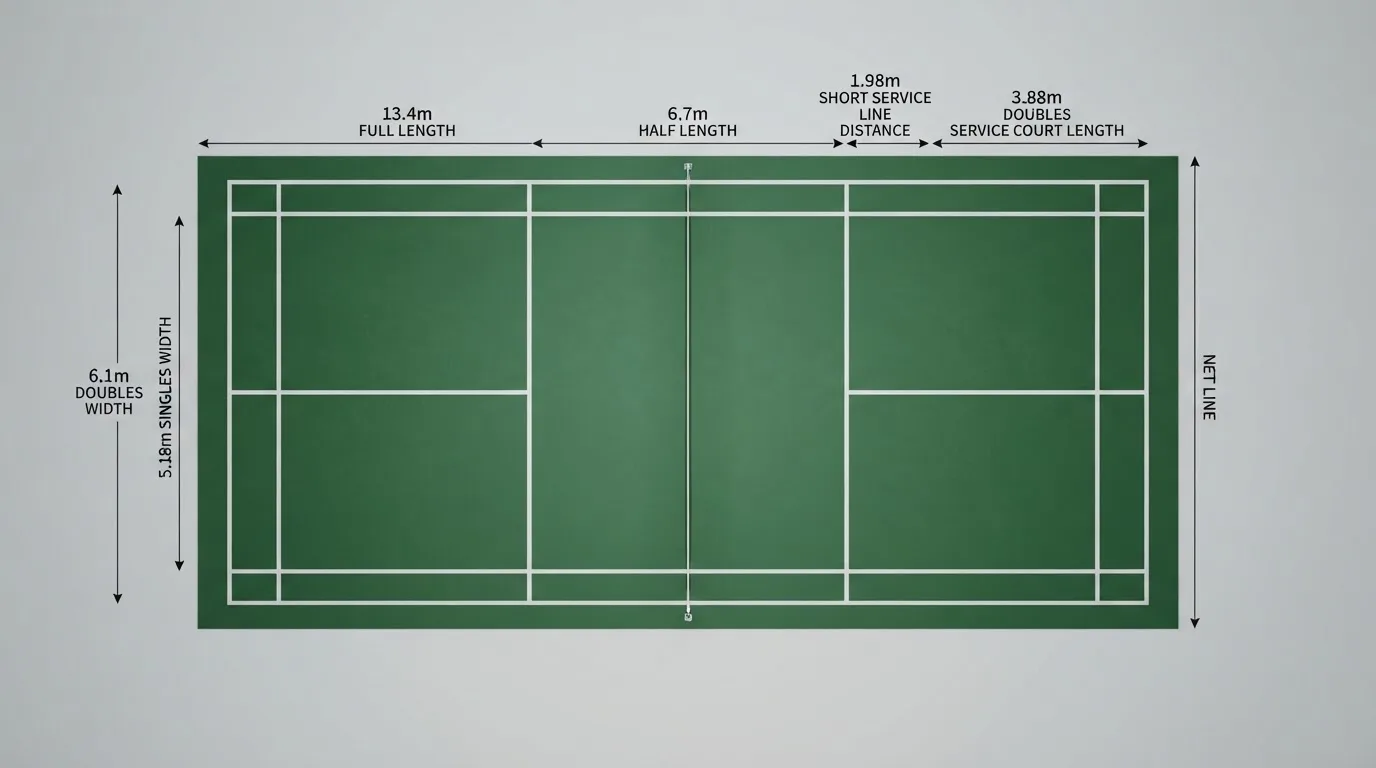
The second is the court. A badminton court is 13.4 metres long, 6.1 metres wide for doubles and 5.18 metres wide for singles, the net is 1.55 metres high at the edges and 1.524 metres at the centre. None of this is variable across the tour. It is the surface effect that the punter is paying for in the bookmaker’s margin: the bookmaker does not have to model the conditions because the conditions do not vary. The bookmaker’s margin on badminton is a margin on probability, not on conditions, and the punter who understands that is reading the odds correctly.
How the ten bookmakers on the British register compare for badminton
The ten operators below are the brands on the Gambling Commission’s public register whose published materials show a real badminton product or a sportsbook of the right scale to plausibly carry one. The list is not a ranking of which brand is “best” — the British register runs to many more licensed brands than ten, and the audited product on badminton is in most cases too thin to support a defensible order. It is a list of the brands a British punter is most likely to meet, ranked here by the depth and breadth of their public materials, with the specific feature that sets each apart.
| Brand | Gambling Commission remote licence number and licence holder | What the operator’s own terms state on the badminton question |
|---|---|---|
| BetVictor | 039576-R-319370-028, BV Gaming Limited | A full sportsbook with Best Odds Guaranteed on UK and Irish horse racing, enhanced live race streaming, BetFinder, Smart Stats; badminton sits inside the standard sports menu |
| Sporting Index | 027343-R-308898-011, Sporting Index Limited | Fixed odds plus spread betting on the same account, in-play across the sportsbook, auto cash-out on football, Multi-Markets; spread betting losses can exceed the deposit |
| Tote | 054779-R-331321-008, TDCO Limited | A pool-betting-led product with fixed-odds sports on the side; badminton coverage is part of the standard sports menu |
| BetMGM | 039198-R-319450-029, LeoVegas Gaming PLC | The four-£10-free-bet welcome with a football-accumulator condition that restricts two of the four free bets to football accas; minimum deposit £10, qualifying bet within seven days, free bets valid seven days |
| Betboro | 044181-R-324363-007, Webmedia Development N.V. | Matched free bet of up to £25 on a first qualifying bet; debit card deposit of at least £10, first bet £5 to £25, three or more selections each at 3/5 (1.60) or higher |
| Betmaster | 065699-R-339929-002, BM Solutions GB Ltd | A sportsbook covering football, cricket, horse racing, NFL and esports (League of Legends, Dota 2); badminton sits within the standard menu |
| Betfred | 039544-R-319290-010, Petfre (Gibraltar) Limited | A long-established sportsbook covering 21 sports plus over 2,000 casino-style games; badminton is part of the standard sports menu |
| William Hill | 039225-R-319373-015, WHG (International) Limited | Best Odds Guaranteed on UK and Irish horse racing from 8 a.m. on race day, on single and multiple bets; does not apply to ante-post, tote or pari-mutuel; badminton is part of the standard sports menu |
| VBet | 044662-R-324273-022, SCGO Limited | A £10 free bet if a new, verified customer stakes £10 or more on a first bet that loses; the cleanest of the welcome offers for a punter who wants to bet on badminton, because the free bet carries no sport or market restriction |
| Sky Bet | 067370-R-341330-005, SBG Sports Limited | Free bets expire 30 days after crediting, single and each-way markets only, multiples excluded, virtuals excluded, non-withdrawable and stake not returned; badminton is part of the standard sports menu |
What the table shows is not a ranking. It shows a pattern. The British bookmakers that carry a real badminton product are, almost without exception, the larger general sportsbooks, and the badminton line is one of a long tail of sports rather than a centrepiece product. The exceptions are the spread-betting-led Sporting Index, whose badminton coverage sits inside a fixed-odds product that the same account also offers, and the pool-betting-led Tote, whose badminton line is part of a fixed-odds sports menu bolted onto a pool product. The punter who wants the deepest outright market on the All England Open is most likely to find it at one of the larger general sportsbooks — Betvictor, Betfred, William Hill — and the punter who wants a clean welcome offer with no market restriction on the free bet is going to find VBet the easiest to read.
What the table also shows is the shape of the welcome offer. Five of the ten brands run a sports welcome offer that is real (BetMGM, Betboro, VBet, Sky Bet, William Hill with a broader promotion suite), and the other five rely on ongoing price boosts, acca insurance and Best Odds Guaranteed on horse racing as the centrepiece of their promotional product. The punter whose main interest is badminton, rather than the welcome offer, is going to spend more time in the second group than the first, because the second group’s ongoing product is the one that touches badminton week-in, week-out. The first group’s welcome offer is a one-time incentive that converts, on average, into a small loss for the punter who uses it on badminton. The cleanest of the ten welcome offers for a badminton punter is VBet’s: a single qualifying bet, a free bet with no market restriction, no accumulator condition, no minimum price beyond the standard floor.
The legality of online badminton betting in Great Britain
Online badminton betting in Great Britain sits inside the same legal frame as every other sport on a British-licensed sportsbook. The Gambling Commission, a non-departmental public body sponsored by the Department for Culture, Media and Sport, licenses the commercial market under the Gambling Act 2005. The Act covers England, Scotland and Wales; Northern Ireland runs its own older law, so a “GB licence” regulates Great Britain and not the United Kingdom as a whole, and the punter who lives in Belfast is in a different legal frame from the punter who lives in Bristol. Since the Gambling (Licensing and Advertising) Act 2014 an operator whose remote facilities are used in Great Britain needs a Commission licence wherever it is based: a Curaçao, Maltese or Gibraltar licence is not a substitute, and the operator’s licence number is the only test of who holds one. The Commission’s public register, searchable by business name, trading name, domain or account number, is the whole answer to whether a brand is licensed, and the punter who is unsure is one register check away from being sure.
There is no state list of permitted sports, events or markets. An operator holds a licence for a category — remote general betting standard (real events), remote general betting standard (virtual events), remote general betting limited, remote pool betting, or remote betting intermediary (the licence for betting exchanges) — and offers markets under its own rules and the Commission’s Licence Conditions and Codes of Practice. Badminton falls inside the standard real-events category, and the British bookmakers that carry a badminton line are licensed to do so under the same licence they use for football, tennis and horse racing. The punter who wants to know whether a brand is licensed to take a badminton bet is asking the same question as the punter who wants to know whether the brand is licensed at all: check the register, read the licence number off the operator’s own terms page, and reconcile the two.
The minimum age is 18. Identity, address and date of birth are verified before the first deposit or bet, and the verification covers a free bet or bonus as well as a cash bet. Credit cards are banned for gambling in Great Britain, including credit-card-funded payments through an e-wallet; debit cards and bank-based payments are not covered. There is no statutory cap on stakes, no state-set deposit ceiling, and no state-set loss limit: the customer sets the limits, the operator must offer the tools to set them, and the customer is the one who decides how much to stake. The customer pays no tax on betting winnings in Great Britain; General Betting Duty is the operator’s tax on gross profits and is not charged to the punter, though from 1 April 2027 a new remote betting rate of 25 per cent applies within the duty, while remote bets on UK horse racing, self-service betting terminal bets, pool betting and in-person betting stay at 15 per cent. The punter who sees odds shorten on a remote badminton market in 2027 can read the duty change as a background pressure on margins, but the duty itself is not the punter’s.
The relevant licence-condition changes for the badminton punter in 2026 are three. The first is the bonus cap: from 19 January 2026 wagering requirements on bonuses are capped at 10x, and mixed-product promotions — offers that ask the punter to bet on badminton to unlock free spins in a casino, for example — are banned. The second is the financial vulnerability check, in force on a £150 rolling 30-day deposit-minus-withdrawal threshold since 28 February 2025: a public-record check (bankruptcy, county court judgments) on the customer, not an income check, not a credit reference check. The third is the deposit limit requirement, with the first phase live since 31 October 2025 and a second phase announced for 30 September 2026: the operator must offer a gross deposit limit on a fixed time frame, and the punter can set one if they want to. None of these is a state-set ceiling: the ceiling is the one the punter sets, the check is the one the operator runs, and the bonus is the one the punter claims.
The financial spread-betting exception is the one the punter should be aware of. Financial spread betting is regulated by the Financial Conduct Authority, not the Gambling Commission, and a spread-betting account can lose more than the deposit. Sporting Index, one of the ten brands in the table above, offers spread betting alongside fixed odds on the same account, and the spread-betting side of that account is FCA-regulated while the fixed-odds side is Commission-regulated. The punter who opens a Sporting Index account and is offered the spread product is being offered a financial product, and the protection regime is the FCA’s, not the Commission’s. The two are not interchangeable, and the punter who wants the Commission’s protection on every market they bet on should restrict themselves to the fixed-odds side of the account.
The offshore frame is the last piece. A brand that is not on the Commission’s register is not licensed to take bets from customers in Great Britain, and the customer who bets with that brand has none of the British protections: no GAMSTOP coverage, no Commission complaints route, no approved dispute-resolution body, no British consumer redress if funds are withheld, no protection under the 10x bonus cap, no vulnerability check. The brand is operating outside the British regulatory perimeter, and the punter is outside the British protection perimeter with it. The honest framing is that an unlicensed brand is not a safer choice by default and not a more dangerous one by default — it is a brand operating under its own house rules, and the punter’s protection is whatever the brand chooses to offer. A GB licence is the test the punter should apply, and the register is the place to apply it.
Safer gambling on badminton: what every British bookmaker has to offer
Three tools sit at the centre of safer gambling on a British-licensed sportsbook, and every one of them is a condition of the operator’s licence rather than a customer-service gesture. The first is GAMSTOP, the national multi-operator online self-exclusion scheme. Since 31 March 2020 it has been a mandatory licence condition for every online operator, and the periods are six months, one year, five years, or five years with auto-renewal. After the minimum period the exclusion stays in place for a further seven years unless the customer asks GAMSTOP to remove it, and the bettor who self-excludes is excluded from every licensed online bookmaker in Great Britain at once. GAMSTOP covers online sites and apps; the betting shops use a separate service. The punter who wants to self-exclude from online badminton betting is asking for a GAMSTOP registration, not a brand-by-brand opt-out.
The second is the financial vulnerability check, the new public-record check on the customer when deposits minus withdrawals cross £150 in a rolling 30 days. It is not an income check, not a credit reference check, and not a check on how much the punter can afford. It is a check on whether the customer is in a financial difficulty that is already on the public record — a bankruptcy, a county court judgment, an individual voluntary arrangement. The threshold is low and the trigger is automatic, and the punter who crosses it on a regular monthly cycle is going to see the check run more than once a year. The check is the operator’s compliance duty, not a sales channel, and the punter is not asked to provide a payslip.
The third is the deposit limit. The operator must offer a gross deposit limit on a fixed time frame, and the punter can set one at any time. The limit is the punter’s, not the operator’s, and the operator’s duty is to make the limit easy to set, easy to keep, and hard to remove without a cooling-off period. The first phase of the deposit-limit regime has been live since 31 October 2025; a second phase was announced for 30 September 2026, and whether it is live in 2026 is not established from the published materials. The punter who wants a deposit limit on a badminton account sets it in the account’s responsible-gambling settings, and the limit applies across the account rather than across the sport.
Beyond these three, every British-licensed operator offers timeouts, the option to take a break, the option to self-exclude for a period, and links to the support services — GamCare and its National Gambling Helpline, GambleAware, the NHS gambling clinics, Gamblers Anonymous. The support services are free, confidential and not part of the operator’s business. The punter who wants to talk about a gambling problem is not asking the bookmaker for help; they are asking one of the support services, and the bookmaker is the one that has to provide the link.
The framing the punter should hold on safer gambling is the framing the British regulator holds. The licensed operator is the operator with the protection regime. The punter who wants the protection chooses the licensed operator, uses the tools the licence requires the operator to offer, and uses them before the punter needs them. The licensed operator is not the “safe” operator by default; it is the operator that is required to be safer, with the tools that are required to be available, and the punter’s protection is the punter’s use of them. The unlicensed operator is the operator with no protection regime at all, and the punter’s choice to use one is a choice to step outside the British frame.
What the badminton price actually costs the punter: a worked margin
A bookmaker’s margin is the share of every pound staked that the bookmaker keeps on average across all outcomes of a market. It is the price the punter pays for the convenience of betting with a bookmaker rather than a betting exchange, and it is the number that makes a market beatable or unbeatable. The formula is the same on badminton as on every other sport: the payout share is the sum of the reciprocals of the prices on each outcome, and the margin is one minus that sum.
Take an illustrative two-way market at decimal odds of 1.90 on each side — the kind of line a bookmaker might run on a closer-ranked BWF World Tour match. The reciprocal of 1.90 is 0.5263, and the sum across both outcomes is 1.0526. The payout share is the reciprocal of that sum, which is 0.9501, or about 95.0 per cent. The margin is 1 minus the payout share, or 5.0 per cent. That is the bookmaker’s edge: for every £100 staked across both sides of the market, the bookmaker expects to keep about £5 in profit, and the punter, on average across both sides, gets back about £95. A market at 1.80 on each side has a payout share of about 90.5 per cent and a margin of about 9.5 per cent. A market at 2.00 on each side has a payout share of exactly 100 per cent and a margin of zero — the kind of line a bookmaker would never run, because it offers no edge. A market at 1.95 on each side has a margin of about 2.6 per cent, and that is the kind of line a sharp bookmaker runs on a heavily-traded event.
The margin is not the same on every market. The match winner market at a major BWF event typically trades at a 5–7 per cent margin, the handicap market at 8–10 per cent, the total games market at 7–9 per cent, the outright tournament winner at 20–30 per cent, and the in-play match winner once the match is in progress at 9–12 per cent or wider. The smaller the event, the wider the margin. The thinner the market, the wider the margin. The punter who understands where the bookmaker is taking a thinner margin is the punter who knows which market to bet on.
The price-to-margin reading is the one that makes a margin visible in a price. A 1.50 favourite on a two-way market is offering the punter 67 pence for every pound staked on that outcome, and the underdog at 3.50 is offering 29 pence. Together the two prices sum to 96 pence, and the bookmaker is keeping 4 pence of every pound. The 4 per cent margin is a thin one for badminton; the same shape on a smaller event would be 7 or 8 per cent. The punter who reads the prices in this way is reading the bookmaker’s edge directly, and the bookmaker’s edge is the price the punter pays.
The honest framing on a margin is that it is a price the punter is paying for liquidity, for the convenience of a settled bet, for the welcome offer, for the live product, for the cash-out, and for the regulatory perimeter. The licensed British bookmaker is offering a product at a known margin; the punter’s choice is whether to pay that margin or to look elsewhere. The punter who wants a sharper price on badminton is going to find it at a betting exchange, where the market is back and lay between customers and the bookmaker is not on the other side of the bet. The punter who wants the British protections, the welcome offer, the in-play product and the cash-out is going to pay the bookmaker’s margin and accept it as the cost of the package. The choice is the punter’s, and the margin is the price tag on the choice.
Frequently asked questions on online badminton betting in Great Britain
How is a bet on badminton actually placed with a British bookmaker?
A British-licensed bookmaker’s badminton product is opened through the sportsbook, the sport is selected from the menu, the specific event is opened, the market is chosen (match winner, handicap, total games, outright), the stake is entered, and the bet is confirmed. The bet is settled when the event is over, with the return credited to the account balance. The bookmaker’s own terms state which markets are available on which events, and the punter who wants a market that is not showing on the page should check the operator’s other sports or the outright menu before assuming the market is missing.
How can it be checked that a bookmaker holds a Gambling Commission licence?
The Gambling Commission’s public register is searchable by business name, trading name, domain or account number, and the entry on the register shows the licence number, the licence holder, the licensed activities, and the status of the licence. The punter who wants to check a brand reads the licence number off the operator’s own terms page — usually in the footer, usually in the responsible-gambling or terms-and-conditions section — and reconciles it against the register. A brand that publishes no licence number, or a brand whose number does not appear on the register, is a brand the punter should not be depositing with.
How is the return on a bet worked out from the stake and the odds?
The return on a winning bet is the stake multiplied by the decimal odds. A £10 stake at 2.50 returns £25, of which £15 is profit and £10 is the original stake. On a combination bet (an accumulator or “acca”) the odds of the legs multiply into one price, and the same formula applies: stake times the combined price gives the total return if every leg wins. A losing bet returns nothing. The bookmaker’s margin sits inside the prices, and the punter pays it on every stake they place.
What is the bookmaker’s margin and how can it be seen in the odds?
The margin is the share of every pound staked that the bookmaker keeps across all outcomes of a market. On a two-way market at 1.90 on each side, the sum of the reciprocals is 1.0526, the payout share is about 95.0 per cent, and the margin is 5.0 per cent. The narrower the prices (closer to evens), the thinner the margin; the wider the prices, the wider the margin. The margin is the bookmaker’s edge, and it is the price the punter pays for the convenience of betting with a bookmaker.
How do fractional odds such as 5/1 convert to decimal odds such as 6.00?
Fractional odds of a/b convert to decimal odds of a divided by b, plus one. 5/1 is 5 divided by 1, plus 1, which is 6.00. 11/4 is 11 divided by 4 (2.75), plus 1, which is 3.75. 4/6 is 4 divided by 6 (0.67), plus 1, which is 1.67. The conversion is mechanical and the two formats express the same price; British bookmakers publish both, and the punter who reads the decimal is reading a single number rather than a fraction in their head.
Which tools for controlling play does a licensed British bookmaker have to offer?
Every British-licensed online bookmaker has to offer GAMSTOP self-exclusion, deposit limits, timeouts, the option to take a break, and links to GamCare, GambleAware and the NHS gambling clinics. A financial vulnerability check runs on the customer when deposits minus withdrawals cross £150 in a rolling 30 days. The punter who wants to use any of these tools does so in the account’s responsible-gambling settings, and the support services listed are free and confidential. The licensed operator is the one required to offer them; the unlicensed operator is not.
Tennis, darts & cue sports – signupbetsguide.com
Content created by the «signupbetsguide.com» team
