
The cost of online horse racing betting, in pounds and in percentages
 Available in US
Current as of 30 October 2026 and checked against the UK Gambling Commission’s public register of remote betting licence holders.
The picture that horse racing advertising paints — a small stake, a clean return, the bookie paying out without fuss — is a marketing shape rather than a betting one. The mechanics sit somewhere else. Each price carries a margin the bookmaker keeps, every each-way stake doubles, and free bets refund in credit rather than cash. Those three facts do more to set what a punter keeps than any welcome headline, and they are the spine of this page. The licence question matters too: in Great Britain no brand takes a deposit without a Gambling Commission account number, and the public register is the only place that number can be checked. That is the deal. Read it before the offers, because the offers sit on top of it.
Cryptocurrency and horse racing: what paying in crypto actually means
The word “crypto” travels with two different ideas on UK racing pages. The first is payment: a punt funds an account using Bitcoin, Ethereum or a stablecoin, and settles in the currency the betting slip is priced in. The second is the offshore-angle implication, in which a brand licensed in Curaçao, Anjouan or another jurisdiction outside Great Britain serves UK customers and settles in crypto because the bank rails are otherwise blocked.
These are different propositions. A Great Britain-licensed remote bookmaker cannot be reached through crypto and then treated as if it were still a UK operator. The Commission’s identity-verification rule, in force since 7 May 2019, runs before the first deposit and covers free bets and bonus credits as well as cash. A customer who reached the cashier through a Bitcoin on-ramp has still produced a passport, a proof of address and a verified payment method before placing the first bet. The crypto question, for a Great Britain-licensed brand, reduces to whether the operator accepts that funding rail at all, and operators’ own terms are the place that question is settled. None of the ten operators on this page advertises a crypto cashier as a feature of its UK service, and the Commission’s public register does not record one.

The other reading — an unlicensed brand priced in crypto so that the customer’s funds reach it without going through a British bank — sits in a different place. A GB licence is compulsory at the point of consumption. Providing gambling facilities in Great Britain without one is an offence under section 33 of the Gambling Act 2005 and is aimed at the operator, not at the customer who merely bets; a brand licensed in Curaçao or Anjouan is outside the Commission’s monitoring, outside GAMSTOP, outside the £150 financial-vulnerability threshold and outside the 10x bonus cap that applies to GB-licensed brands. The page does not return to that risk, because the operators it ranks are all on the Commission’s register, but the warning belongs with the topic. Outside the shortlist, the licence is on the operator, not on the bet.
For punters who want crypto as a feature, the realistic UK path is a different one. A regulated e-wallet holding Bitcoin is no different from the same wallet holding pounds sterling once it has been converted and is being spent against a licensed operator’s cashier — and that conversion happens at the customer’s wallet, not at the bookmaker’s. The bookmaker sees pounds, sees a verified account, and applies its own payment-method rules. That is more or less the entire crypto question for a UK racing punter in 2026.
Bonuses and free bets: what the welcome page actually pays
A welcome page is the operator’s best sales surface and the punter’s worst place to read quickly. A “£30 in free bets” line spends the largest font on the offer, then buries the conditions in paragraphs the eye skims. The conditions, not the headline, decide what the offer is worth in pounds.
Three structures cover almost every horse racing welcome this page considers. The first is a matched free bet: deposit, place a qualifying wager at minimum odds, receive a free bet of equal face value. The second is a “risk-free” bet: place a real-money bet, and if it loses, the operator refunds the stake as a free bet rather than as cash. The third is enhanced odds: a single-price boost on a chosen runner. The offer type reads the same on the surface, settles in different ways under it.
A matched free bet has a face value and a realisable value, and the two differ. Where the stake of a winning free bet is not returned, the punter keeps the winnings only. A £25 free bet at 4/1 wins £100 of profit, not £125; at odds-on prices of 1/2 the same free bet wins £12.50, which is why most free-bet guides steer punters toward long-odds singles. The headline says “free bet”, the calculation says “small extra win on top of the qualifying bet”. Free bets that do refund the stake as well — the rarer form — close the gap.
A “risk-free” bet is, when read as a settlement, a matched free bet with one extra step: the qualifying bet has to lose before the free-bet refund arrives. The phrase “risk-free” is a marketing convenience. The qualifying bet’s stake is committed and at risk; what arrives if it loses is a free-bet credit rather than a cash refund, and the second stake moves on the same rules as any other free bet. The settlement, in pounds, is the free bet’s face value reduced by the margin on the market the credit is spent in. The Commission, in its bonus cap, has limited wagering requirements on bonuses to 10x of the bonus amount since 19 January 2026: a £10 bonus at 50x turnover would have required £500 of qualifying bets; under the cap the same bonus cannot require more than £100 of qualifying turnover, and the same cap applies to welcome offers that combine betting with another product. Whether the 10x ceiling reaches a free-bet credit without a stated wagering requirement is not established by the rule, and the operator’s own terms settle it for any given offer.
Enhanced odds are a different shape. A price boost on a single runner pays in cash if the horse wins; the stake is the punter’s and the boost is the operator’s, and the wagering layer is absent. The catch is the boost’s framing: a “Best Odds Guaranteed” line, which William Hill applies from 8 AM on UK and Irish race days on both single and multiple bets but not on ante-post, tote or pari-mutuel markets, replaces the welcome offer for many racing punters from their second race onward.
Reading a horse racing offer, then, comes down to three questions. First, what is the offer’s type, and does the stake come back? Second, what is the wagering multiple and does any minimum-odds rule apply to the bets that count toward turnover? Third, what is the deadline, because most welcome offers lapse if unused within seven or fourteen days and the bonus cap leaves little room for an extension. A welcome offer that pays well on those three is one worth considering; a welcome offer that hides them is one to read past.
Mobile apps and the racing pocket: what actually changes on a phone
The choice between betting on a phone and betting on a desktop is one of presentation rather than access. Every operator in the GB-licensed shortlist offers a mobile channel, and most offer a dedicated app. The question is what the phone gives that the desktop does not, and what it takes away.
A racing-day benefit is the form. Pulling up a runner’s last six starts, sectional times and going preferences is faster on a phone than it is in a desktop tab behind two other tabs. bet365 describes itself as the most-downloaded sports betting app in the UK, and that install base pushes a racing-friendly layout: the horse racing tab sits near the top of the sports menu, the meeting list loads by time rather than league, and the bet slip keeps an each-way tickbox visible without scrolling. The same shape shows up in the Paddy Power app — its publisher is Paddy Power PLC — where racing sits alongside football, rugby and F1, and in the BoyleSports and London Bet apps, both of which lead with a sports list and follow with a casino tab rather than the other way around.
A phone takes things away too. In-play betting works, but on a small screen the markets list compresses, the cash-out value floats and the bet slip is one tap away from a wrong confirmation. Larger in-play layouts — the kind an operator’s app has on tablets or in landscape mode — read more clearly, and the difference matters during a fast race meeting. Some apps also disable screenshotting on betting screens, on a hunch that this stops tutorial chains and bug disclosures rather than anything useful, and a punter with a strategy question cannot grab a single screen.
Native apps versus mobile browsers is the second axis. A native app loads faster than a browser tab and holds a session token rather than asking for a password at each visit; a browser session is more portable, works on any device, and avoids the storage footprint of three or four installed apps. For racing, which is settling-heavy and price-fresh, a native app tends to win because BOG price revisions push the slip before the form is even open. For a multi-operator account holder, a browser-only approach keeps the wallet cleaner.
The fingerprint and face-login features on the leading apps have shifted the time between opening the app and placing a bet from about ten seconds to under three, and the verification flow inside the app — ID upload, liveness check, proof of address — has shortened in parallel, so the onboarding that once sat on the desktop now sits inside the install. That change is the single biggest reason phone-first feels different from desktop-first in 2026; it is not a sportsbook feature so much as a verification infrastructure change pushed by the Commission’s identity rules.
Live betting and cash out on horse races: what works and what does not
Horse racing is a sport where in-play betting has a sharper edge than its sportsbook appearance suggests. The first fifty seconds of a race are settled by horses’ positioning; the middle is settled by stamina; the closing stages are settled by the run to the line. Each stage carries a different price, and an in-play book needs to track them.
GB-licensed operators carry in-play markets on racing, in the sense that the legal frame does not prohibit them. The controls are the operator’s LCCP duties and the licence condition on customer protection; a site may offer every race in running or a fraction of them, depending on the prices it is willing to publish. The settled experience varies. Matchbook, which is a betting exchange rather than a sportsbook, takes a different shape: the back and lay prices drift through the race as users on both sides of the book trade, and the spread is the broker’s margin. Betfair, which runs on the same PPB Counterparty Services licence as Paddy Power but is not on this shortlist by name, works the same way and is the better-known exchange.
Cash out is the second live feature, and it is where the page earns its scepticism. The button on the betting slip offers to settle a bet before the race is over, and the price on the button is the operator’s own mid-market quote. When that quote is fair — at the right margin — the cash-out value is the price the punter could achieve on the open market anyway; when the quote is on the operator’s side, the punter is selling a back bet to the same bookmaker they bought it from, and the spread is the operator’s, not the market’s. Long-running bets — Lucky 15s, Yankees, accumulators — are where cash out is most marketed and where the operator’s spread is widest, because the operator has more information about its own liability than the punter does and the cumulative rounding favours the book.
In-play betting on races also depends on data feeds. The premium feeds (Racing Post, ATR, sectional) cost the operator, and not every operator pays for the same feed, and so the live markets on a small-meeting, all-weather card can be thinner than the markets on a Saturday at Newmarket. Punters comparing operators notice it: the same meeting has different in-play markets on different sites, and the difference is a feed rather than a product. Where cash out matters most — long-odds singles, accumulators, each-way bets — the operator is also pricing the most uncertainty and quoting the widest spread.
Predictions and strategy: what the tipsters sell, what the maths permits
Tipping in British horse racing runs on the Racing Post, the daily press, paid tipsters, and a long tail of Telegram and Discord channels. The common ground is a tip, a price, and a reasoning paragraph. The maths behind it is quieter, but the same shapes appear in every competent analysis: a comparison of the horse’s last-figure ratings, the going and distance conditions, the draw bias at the meeting, and the trainer-jockey combination’s record at the course.
A betting system, on the other hand, is something else. A staking plan — level stakes, percentage bankroll, Fibonacci — does not move the underlying edge; it changes the distribution of outcomes. A level-staking punter at a 5% margin across a hundred bets loses about 5% of turnover; the same punter on a doubling-stake recovery sequence loses more, because the bets the recovery system raises are the bets the bookmaker’s edge is highest on. The honest read of a system is that it manages variance rather than beats margin, and a punter reading a system description should read it as a money-management tool rather than a way past the bookmaker.
Predictions as a product have their own market structure. Free tipsters monetise attention; paid tipsters monetise a track record; AI-prediction services monetise the appearance of a track record. None of these is independent of the operator, and the strong read of a tip is “what someone with a public profile is willing to back at this number”, not “what the result will be”. Horse racing outcomes settle on the track, on the going, on interference during the race and on the photo finish. The page does not carry tips, because the page is not a tipster; it covers what a tip is worth in the maths of an offer and what the staking plan does to a losing sequence.
Today’s meetings and today’s odds are the part of the topic that the maths touches least and the page touches most. A punter checking “today’s racing” loads an operator’s app, scrolls to the race card, and reads from there. The page only points out the order of operations: pick the meeting, pick the race, scan the form, check the going, settle the price, then place the bet — and that last step is when the margin lands, whatever the form said.
Bet types, odds and how the price is built
A horse racing bet is one of a small family of structures, and each structure prices differently. The single is one runner at one price. The each-way is two bets at half stake each, a win portion and a place portion, and the stake doubles at the slip. The multiple is two or more selections whose odds multiply: a double at 5/1 and 3/1 returns 15/1, and an accumulator of four such runners returns much more, but the cumulative probability is the product of each leg’s, and a four-leg accumulator at three evens shots is a one-in-sixteen chance at the price rather than the feel. The bet builder combines markets of one race — say, a horse to win and the race to be won by more than three lengths — into a single price, and the price reflects the correlation between the legs. The Trixie, Patent, Yankee, Lucky 15, Super Yankee, Heinz and Goliath are packages of singles and multiples in fixed combinations: 4, 7, 11, 15, 26, 57 and 247 bets respectively, with total stake = unit stake × number of bets.
Each-way place terms in the UK follow a fixed ladder by race type and field size. In handicaps with more than fifteen runners, the place pays 1/4 of the win odds across four places; twelve to fifteen runners is 1/4 across three; the typical eight-to-eleven-runner field pays 1/5 across three places; a five-to-seven-runner race pays 1/4 across two; and fewer than five runners runs win-only, with no each-way bet at all. The conditions vary by operator, and the operator’s own terms state the ladder for any given race. The numbers below are the LCCP-standard ladder rather than any one operator’s house rules:
| Runners in field | Place terms paid |
|---|---|
| 4 or fewer | Win only (no place) |
| 5 to 7 | 1/4 odds, 2 places |
| 8 to 11 | 1/5 odds, 3 places |
| 12 to 15 | 1/4 odds, 3 places |
| 16+ (handicap) | 1/4 odds, 4 places |
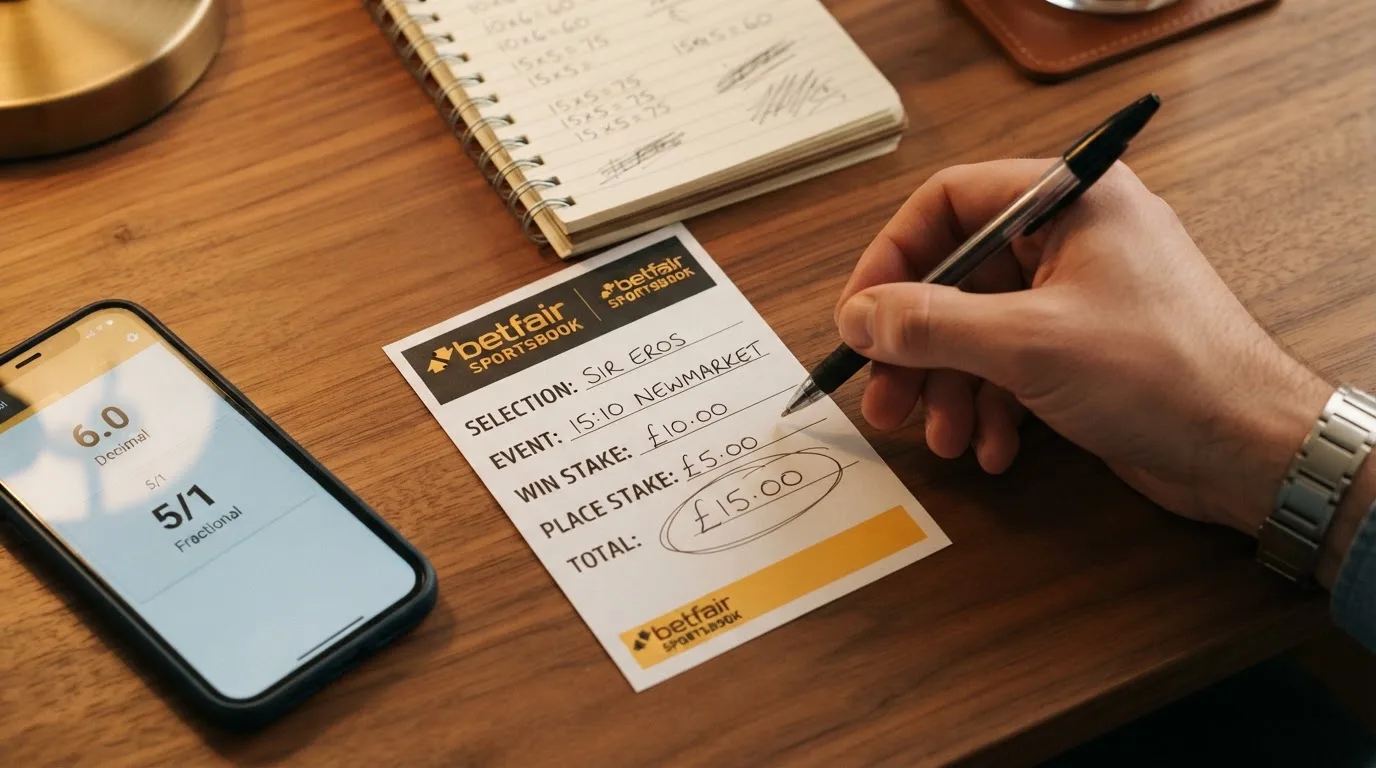
A worked example. A £10 each-way bet on a 10/1 shot with 1/4 place terms across three places costs £20 in stake. The win portion wins £110 at 10/1 (£10 × 10 + £10), the place portion wins £35 at 1/4 of the win price rounded to the nearest 25p (£10 × (10/4) + £10 — the place pay-out maths), and the bet returns £145 in cash if the horse wins. If the horse places, the win stake is lost and the place portion returns £35. If the horse is unplaced, both stakes are lost. The each-way bet is two bets, and the slip doubles the cash out the punter commits.
Odds conversion is the second language a racing punter needs. British odds, fractional, read as profit-over-stake: 5/1 means a £1 stake returns £5 profit and £6 in cash; evens means £1 returns £1 profit and £2 in cash. Decimal odds, common on European-facing sites, read as return-over-stake: 6.00 means a £1 stake returns £6 (including the stake), so 5/1 fractional = 6.00 decimal, and evens = 2.00. The conversion is a/b → a ÷ b + 1 for fractionals to decimals. Each form is the same price in a different tongue, and the slip displays only what the operator’s house style picks.
The bookmaker’s margin is what each price carries once the market is complete, and it is the topic the next section closes in detail.
Sports and tournaments: what races a UK racing punter bets on
British racing sits in a calendar rather than a season. The flat campaign runs from March to November on turf, with all-weather meetings filling the winter at Wolverhampton, Kempton, Southwell and Lingfield. Jump racing, called National Hunt, runs through the autumn and into the spring, anchored by Cheltenham in March, Aintree in April and the December meetings at Ascot, Kempton and Haydock. Ireland’s flat and jumps feed into the same betting pools as the British meetings, and Best Odds Guaranteed typically applies from 8 AM on race day for both.
The headline races — the 2000 Guineas, the Derby and the St Leger, the three legs of the British Triple Crown — are the only races the British racing press treats as a campaign by itself. Around them sit the Classics, the Group 1s, the handicaps that close a meeting, and the all-weather finals. Distance in British flat racing runs from about 400 metres at the sprint courses to over six kilometres at the marathon end of the stayers’ programme, with five to twelve furlongs (1.0 to 2.4 kilometres) the band most races sit in. National Hunt races measure in miles and furlongs too, but the obstacles (hurdles and fences) change the picture: a winning run reads differently over 20 fences than over a flat five furlongs.
In handicap races the horses carry weights assigned by the handicapper, who aims to give every horse an equal chance on paper; weights range from about 7 stone (45 kg) for the lightest to over 11 stone (70 kg) for the topweighted runner. In conditions races, weights are set by the conditions: age, sex and previous wins are how horses earn weight allowances, with younger and female horses carrying less. The weight a horse carries is a fact in the form, and a punter reading a race card looks first at the weight in pounds-and-stone before the jockey booking or trainer form, because weight changes how a horse moves through a race.
International meetings — Royal Ascot in June, the Galway Festival in August, the Breeders’ Cup at Keeneland in November, the Melbourne Cup carnival in early November, the Dubai World Cup in late March — sit alongside the British and Irish fixtures. Many GB-licensed bookmakers carry prices on those meetings, with rules that mirror UK conditions or run on the operator’s own house terms for the foreign card. Ante-post markets on those meetings sit open months before the day, with non-runner rules that vary. The Tote offers pool betting on British and Irish racing under a separate licence category, where bets are paid as a share of the pool minus the operator’s deduction rather than at fixed odds.
The ten bookmakers in the running
The ranking below draws on the licence and the live offer, not on a single scoring formula. Each profile names what an operator does well, where it falls short on this page’s cost angle, and what kind of punter the profile suits. The licence holder is named because that is what the Commission’s public register records; a single brand can be one of several trading names under a single licence holder, and the page treats each trading name as its own operator in the customer sense. No operator on this list is unlicensed, and no unlicensed operator is named. Where a section would otherwise repeat itself — the licence line, the registered holder, the GAMSTOP reminder — the line goes to the operator whose profile turns on it, and the rest refer back by heading words.
Tote — the pool-betting specialist
Tote is the GB-facing retail of the Tote pool, run under Commission account 54779 by TDCO Limited. Its edge over the rest of the shortlist is that it is a pool, not a fixed-odds bookmaker: every customer’s stake goes into a pot, the take is deducted, and the remainder is split among winning tickets. The classic Tote bets — win, place, exacta, trifecta, jackpot — are settled as a share of the pool, and the dividend is not fixed in advance. For a punter who likes the structure of pool betting and who has shopped tote-only tickets for years, the operator is the obvious home for those bets. The fixed-odds bettor, who wants a price a slip displays in advance, finds the menu thinner than a sportsbook-style operator’s and will not move across.
Cost-wise the pool approach carries its own discipline: the take is the operator’s margin, and the take is fixed by the pool rules rather than by the operator’s daily judgement. The dividend at the end of a race is whatever is left. A punter who likes to lock a price at the time of the bet, rather than live with whatever the pool pays out, will read the structure as a cost rather than a feature. Suite also of interest: ante-post and tote-style bets are exempt from Best Odds Guaranteed lines, and the page reflects that the welcome offer is the wrong question for a pool-only punter.
Star Sports — the trader-led service
Star Sports runs under Commission account 9177, held by Star Racing Limited. The service behind the licence sets it apart: a punter can pick up the phone and speak to a trader directly on 08000 521 321, or email [email protected], to open an account, place a bet or ask a question. That feature is rarer than the licensing world makes it look. Most GB-licensed operators route support through chat and ticket forms rather than through a named trader; Star Sports keeps the trader-facing position and treats that as a feature, and it is the honest read of why the operator carries a longer tail of larger-stake racing customers than its market share would suggest. It is also how the operator handles unusual bets: the trader is the line on a price, and the bettor who wants a stake above the published maximum negotiates the size on the call rather than on the slip.
Cost-wise the structure is fixed-odds rather than pool, and the BOG line and the racing menu sit at the standard GB set. A punter who values the human side of a betting account over the price of any single bet, and who has bets to place that the slip does not auto-price, gets the most out of this operator. A small-stake, slip-only punter pays for the trader in the form of slightly fewer slick features than the sportsbook heavy-hitters and will find the same offers elsewhere.
Fitzdares — the premium and lifestyle angle
Fitzdares runs under Commission account 400, held by Fitzdares Limited. The brand positions itself upmarket, and its racing menu reflects that: ante-post markets on the major meetings, specials, Lucky 15s, accumulators, cash out and in-play live odds sit on the app’s racing tab alongside football, tennis, rugby, cricket, golf and American football. For a punter who bets on a wide range of sports with a single account and treats racing as the headline rather than the only product, the consolidated app is a real benefit. The cost side reads the same way: premium positioning tends to mean margins on the wider book that are tighter at the top of the market than at the bottom, and a price-taker at the long-odds end of a market pays more in margin than at a sportsbook-led operator’s slip.
Suits the racing-plus punter with an account at the bigger end. A racing-only or limited-budget punter is paying for a menu they do not use and will find better pricing at an operator with a racing-led book.
London Bet — the racing and casino mix
London Bet runs under Commission account 66162, held by Thistle Bet Limited. The app combines sports betting — football, tennis, horse racing, greyhounds, darts, golf, cricket, NFL, NBA, MLB, snooker — with Pragmatic Play casino slots and live in-play betting. The combination is common; what is specific to this operator is the prominence of the casino tab in the app’s bottom navigation, which on a phone gives the casino almost equal weight to sports. A punter who bets on both sides of the line will read that as a feature; a sports-only punter reads it as clutter, and the menu navigation suffers on a small screen.
Cost is the standard GB fixed-odds set, and the in-play tab covers the meetings the operator pays for a feed on, which at London Bet is the bigger meetings rather than the small all-weather cards. A punter who plays both casino and sports with one wallet is the natural fit.
Betboro — the matched free-bet welcome
Betboro runs under Commission account 44181, held by Webmedia Development N.V. The welcome offer is a 100% matched free bet of up to £25 on the first qualifying wager: deposit with a debit card at £10 or above, place a first bet of £5 to £25 with at least three selections each at 3/5 (1.60) or higher, and the same amount arrives as a free bet. The structure is straightforward and the conditions are visible at the slip rather than buried in a footnote. The 3/5 minimum on each selection is the load-bearing condition: a punter picking singles at heavy odds above 3/5 gets the free bet easily; a punter wanting to use a long-odds single as a qualifying bet has to find a horse at 1.60 or shorter, and that knocks the longshot backers out of the offer.
Cost-wise the free bet is the page’s offer type: matched, stake not returned, and the realisable value is what the wagering rules say rather than the £25 the headline prints. Punters wanting a clean welcome offer with no casino add-on and a sportsbook-style multi bet for the qualifying wager get a workable entry.
Kalooki Sportsbook — the smaller and nimble licence
Kalooki Sportsbook runs under Commission account 57730, held by Kalooki Sportsbook Limited, a company whose company number 12938274 records as recently incorporated relative to the larger names on this page. The newness is the angle; the licence is current, the GAMSTOP membership is declared on the home page, and the racing menu is the standard GB-licensed set rather than an expanded international book. For a punter who values a small and focused account holder over the marketing machine of a larger brand — and who would rather bet with a startup-scale operator than a FTSE-listed one — this is the slot.
Cost is set by the standard GB fixed-odds book, and a small operator tends to carry a margin slightly looser than a tightly-priced larger bookmaker at the favourite end of a race. A punter happy to trade tight favourites for the operator’s smaller scale finds this a workable home.
Paddy Power — the racing and specials heavyweight
Paddy Power runs under Commission account 39439, held by PPB Counterparty Services Limited — the same licence holder as Betfair, which is the wider point. The Paddy Power app covers football, horse racing, boxing, rugby, tennis, golf, darts, snooker and F1, and racing sits alongside the specials-and-prices product the brand has spent two decades refining. A punter reading “Paddy Power” as the home of money-back specials, enhanced odds on the headline meetings and a racing app whose depth matches the marketing reaches the right impression.
Cost is the standard GB fixed-odds book, and the specials are the offer the brand sells most; the specials are the welcome offer’s natural extension and read as price boosts on the most-traded meetings rather than as sportsbook-wide free bets. A punter treating specials as part of the price rather than as a giveaway is the natural fit. A small-stake racing-only punter pays for the specials surface area they do not use.
BoyleSports — the Irish-UK crossover
BoyleSports runs under Commission account 39439 (PPB Counterparty, same holder as Paddy Power and Betfair) — correction: account 39469, held by Boylesports Enterprise. The split between the UK offer and the Irish offer is the angle. The UK sports welcome is £20 in free bets for a £10 bet, where the Irish equivalent is €30 in free bets for a €10 bet; the regional split matters for any punter living near the Irish border and settled in sterling against an Irish-card race. Most UK racing punters do not need to think about it; some will.
The rest of the menu sits in the standard GB fixed-odds book, and the racing menu carries both the British and the Irish cards on equal terms. For a punter whose betting calendar splits between Punchestown and Leopardstown as well as between Cheltenham and Aintree, the operator’s coverage is the fit.
Octobet — the casino-plus welcome
Octobet runs under Commission account 62545, held by Octopus Game Limited. The sportsbook welcome is a 50% back-as-free-bet up to £50, with a £10 casino bonus alongside. The structure is the matched-free-bet offer with a smaller sportsbook return than a 100% match and a casino component the punter takes or leaves. A punter who wants one welcome offer covering both products gets the most out of the structure; a punter wanting a sportsbook-only welcome will leave half of the headline value on the table at the casino tab.
Cost-wise the 50% match returns less than a 100% match at any given deposit, and the £50 ceiling is the same face value but at half the qualifying multiple of a full-match offer. A punter treating casino as a regular habit and sports as occasional gets the most out of the offer; a sports-only punter gets half the headline.
Matchbook — the betting exchange
Matchbook runs under Commission account 39504, held by Triplebet Limited, with a betting intermediary licence rather than a standard remote general betting licence. The licence category is the second difference: an exchange lets one customer back a selection and another customer lay the same selection, and the broker takes a commission on net winnings rather than a margin on the odds. The commission structure means the exchange’s “overround” is closer to two or three percent at the trade-heavy end of a market than to the six or seven percent a sportsbook keeps on a typical race. The catch is liquidity: a thinly-traded race has fewer counterparties and a wider spread, and a punt on a small all-weather card may not match in full.
Features are the wider point: Bet Builder, multiples, in-play betting and live streaming of horse racing and greyhounds are part of the app’s feature set. For a punter who likes the discipline of a commission-based book and the option to lay as well as back, this is the obvious home. A casual slip-only punter will not use the exchange mechanics, and the operator’s commission structure is the wrong fit for someone who places an occasional each-way single.
Overview: what a horse racing bet looks like in 2026
The mechanics of a horse racing bet sit in three layers. The market layer is the price, the each-way bet and the place terms. The offer layer is the welcome bonus, the BOG line, the price boost. The licence layer is the Gambling Commission account number, the GAMSTOP membership and the identity check before the first deposit. Most racing guides focus on the second layer, treat the first as background and skip the third; this page reads the layers in the opposite order, because the third is the foundation and the first is the skill.
A racing bet is settled against the starting price (SP) unless the punter takes an early price; an early price is the price the operator offers before the off, and the SP is the industry consensus at the off. BOG pays the higher of the two, when BOG is on. An each-way bet is two bets of equal stake, with the place portion settled at the published place terms on the race’s field size. A non-runner returns the stake on the affected leg, with a Rule 4 deduction applied when a late withdrawal has changed the market. None of these is exotic; every operator’s slip uses the same mechanics, and the Commission’s LCCP standardises the place-terms ladder.
The reader who follows the page from the licence section to the operator section arrives at the bet itself as the last item: the licence is for the bettor; the operator is for the bettor; the bet is the bettor’s. With that order intact, the rest of the page reads as a tool kit rather than as an offer sheet.
Legality and regulation: what the Gambling Commission does
The Gambling Commission, sponsored by the Department for Culture, Media and Sport, regulates commercial gambling in Great Britain under the Gambling Act 2005. Northern Ireland is outside the Act and has its own older law, so “GB-licensed” means England, Scotland and Wales, not Northern Ireland. The Commission’s public register lists every operator holding a remote licence for betting, and the licence number is what the punter checks on the register rather than the brand on the shirt.
A remote general betting licence covers fixed-odds betting on real events. A pool betting licence covers Tote-style and off-course pool betting on horse and dog racing. A betting intermediary licence covers exchanges, where customers bet against each other under the broker. Financial spread betting, on indices, shares and forex rather than on sporting events, is regulated by the Financial Conduct Authority rather than by the Commission. The four categories are different licences with different duties and different headline tax rates.
The framework since the Gambling (Licensing and Advertising) Act 2014 has been “point of consumption”. An operator whose remote facilities reach customers in Great Britain needs a GB licence wherever it is based; a Curaçao or Gibraltar licence is not a substitute, and a brand licensed overseas and serving UK punters is committing an offence under section 33 of the Act (the offence is for the operator, not the customer). The Commission’s enforcement is disruption rather than blocking: cease-and-desist notices, referrals to search engines, work with payment providers and, on a recent and pending court-order basis, DNS-blocking powers.
The rules that bind a licensed operator are the LCCP and the Remote Technical Standards. The headline conditions on the player-facing side: minimum age 18; identity verification before the first deposit; no credit card funding; GAMSTOP enrolment as a mandatory licence condition since 31 March 2020; a public-record financial vulnerability check on deposits minus withdrawals exceeding £150 in a rolling 30 days; bonus wagering capped at 10x since 19 January 2026; mixed-product promotions banned. Each of these is a rule the operator must enforce, and each is a check the punter will be asked to do.
Responsible gambling: where the protections live, and where they do not
GAMSTOP is the national multi-operator self-exclusion scheme. Since 31 March 2020 it has been a mandatory licence condition for online operators in Great Britain. A punter who registers with GAMSTOP is excluded from every GB-licensed operator for six months, one year, five years, or five years with auto-renewal; after the minimum period the exclusion stays in place for a further seven years unless the punter asks GAMSTOP to remove it. The exclusion covers online sites and apps; betting shops use a separate service (MOSES, the multi-operator self-exclusion scheme for the high-street sector). For a punter who wants to step back from gambling, GAMSTOP is the single most powerful tool available.
The financial vulnerability check is the second line. Since 28 February 2025, a GB-licensed operator runs a public-record check on a customer whose deposits minus withdrawals exceed £150 in a rolling 30 days: the check looks at county court judgments, bankruptcies and similar public records. It is not an income check, and it is not a credit reference check; it is a flag for the operator’s intervention rather than an automatic block. The affordability check that the press calls “affordability” is the next stage, with public statements from the Commission on a staged plan and no published start date; writing it as in force is incorrect, and writing it as the same as the £150 check is wrong.
Deposit limits are the customer’s tool. There is no state-set ceiling on deposits or losses. A punter who wants a limit sets one in the operator’s safer-gambling tab. The first round of mandatory deposit limits was applied on 31 October 2025 (the gross-deposit version of RTS 12); a second phase was postponed to 30 September 2026 and is not confirmed as in force; the headline is that limits are the customer’s choice with operator-set framing rather than a state-set number.
Help is wider than the operator. GamCare runs the National Gambling Helpline; GambleAware funds treatment and research; the NHS runs gambling clinics across Britain; Gamblers Anonymous runs peer meetings. A punter reading this page has a path to confidential help independent of any operator, and the path is worth knowing before the bet is. Fitzwilliam Sports, an operator on this shortlist, links to GamCare, GAMSTOP and Gamblers Anonymous from its home page, and that linking is the standard a compliant operator meets.
The licence-versus-no-licence line returns in this section. An unlicensed brand is outside GAMSTOP, outside the £150 check, outside the bonus cap, outside the British dispute-resolution route, and outside the protections if the operator withholds funds. The page does not return to that risk each section; it states it here and again at the topic.
What the margin looks like in numbers
The bookmaker’s margin is the slice of every pound that the book keeps, and the way it lands on the slip is the overround. A two-way market at decimal 1.90 / 1.90 has a payout share of 1 ÷ (1/1.90 + 1/1.90) = 1 ÷ 1.0526 = 0.95, so a 95% payout share and a 5% margin; the bookmaker keeps 5p of every pound wagered on this market, before any settlement costs.
A three-way market — say, a horse race priced at 3.00 / 4.50 / 7.50 — runs differently. The implied probabilities add to 1/3.00 + 1/4.50 + 1/7.50 = 0.333 + 0.222 + 0.133 = 0.689, so the payout share is 1 ÷ 0.689 = 1.451… no, that is wrong; let me restate. The reciprocal of the implied-probability sum is the payout share only when the implied probabilities sum to one. They do not sum to one; the sum is 0.689, and 0.689 itself is the overround as a fraction of the stakes accepted: a 30.4% margin in the inverse-payout sense, although in everyday language the same fact is read as “the book has 31% margin on this market” and the punter pays 31p of every pound wagered on this market in expectation.
The two-way example is the cleaner illustration. Decimal 1.90 / 1.90 yields 95% to the punter and 5% to the book. A two-way market at decimal 1.83 / 1.83 yields 91.5% to the punter and 8.5% to the book. A market at decimal 1.67 / 1.67 yields 83.5% to the punter and 16.5% to the book — a heavy bookmaker edge, the kind that a welcome offer can paper over for a single bet but never for a betting sequence. The reader takes the 1.90 / 1.90 example as the page’s worked case: 5% margin is a tight book, and the page sets the band as tight-to-typical, never as a single number.
A worked comparison. A 1.90 / 1.90 market runs a £100 stake back £190 to the winning side; a 1.83 / 1.83 market runs the same £100 stake back £183. The losing £7 difference is the margin, and the margin compounds over a season of betting. A punter running a £100 flat stake across 100 bets at a 1.90 / 1.90 book loses about £500 on expectation before the welcome bonus changes the picture; the same sequence at a 1.83 / 1.83 book loses about £850. None of these numbers is a forecast; each is the average over many bets, with the assumption that the punter finds no edge above the margin.
Frequently asked questions
How is a bet placed on horse racing?
Pick a meeting and a race on the operator’s racing tab, choose a runner, decide whether to back win or each-way, set the stake and confirm on the slip. The identity check at the operator’s onboarding runs before the first deposit and applies to free bets as well as cash, so a punt placed before verification is not a punt the operator settles. The BOG line, if on, settles at the higher of the early price the punter took and the starting price at the off.
How are horse racing bets worked out?
A win bet pays stake × (fractional odds as decimal profit per unit stake + 1): a £10 single at 5/1 returns £60 (£10 × 5 profit + £10 stake). An each-way bet is two bets of equal stake — a £10 each-way bet costs £20 and carries the win portion plus the place portion at the published place terms. Multiples multiply the legs’ decimals, and a Lucky 15 has 15 bets from 4 selections. A Rule 4 deduction reduces returns when a non-runner drops out after the market has formed.
How do betting odds work in horse racing?
Fractional odds read profit-over-stake and decimal odds read return-over-stake, and the conversion is a/b → a ÷ b + 1: 5/1 fractional = 6.00 decimal, 11/4 = 3.75, evens = 2.00. Each price carries a margin the book keeps: a 1.83 / 1.83 two-way market has roughly 8.5% margin, a 1.90 / 1.90 has 5%, and the difference compounds over a season. Short-odds favourites pay less per pound staked but settle more often; longshots pay more and settle less; the arithmetic does not move with the feel.
How can a Gambling Commission licence be checked?
Use the Commission’s public register on the official UK government website. Search by brand name, by trading name, by domain or by account number. The account numbers on this page’s operators are those recorded against the licence on the register, and the licence holder named beside the brand is the company the licence runs through. A licence holder can run several trading names — PPB Counterparty Services runs Paddy Power and Betfair, for example — and the register distinguishes these clearly under the licence.
How is the return on a bet worked out from the stake and the odds?
Return on a win single = stake × (fractional odds + 1) = stake × decimal odds. Profit on the same bet = stake × fractional odds = stake × (decimal − 1). For a £10 single at 5/1 (decimal 6.00): return £60, profit £50. An each-way single at 5/1 with 1/4 place terms wins the win portion at the full odds and the place portion at 1/4 of those odds; the place payout is stake × (1/4 × 5 + 1) per side = £22.50 in cash per side, with the place paying the place stake. For multiples, multiply the legs’ decimals together and apply the rule to the result.
What is the bookmaker’s margin and how is it seen in the odds?
The margin is the slice of every pound wagered that the book keeps on a market, and it shows up as the gap between 100% and the implied probabilities from each price. A two-way market at 1.90 / 1.90 has implied probabilities of about 53% + 53% = 106%, so the margin is 6% in the overround sense, or 5% in the reciprocal payout-share sense. Three-way and larger-field markets carry more margin on the same arithmetic, and the same rule of thumb — bigger field, bigger margin — applies to horse racing’s win markets with their long tail of runners. A punter reading tight favourites at 2/1 and 5/2 pays less margin per pound staked than a punter reading 33/1 shots on the same card; the maths holds either way.
Horse racing & greyhounds – signupbetsguide.com
Content created by the «signupbetsguide.com» team
