
What Rugby League Betting Really Costs the Punter in 2026
 Available in US
30 October 2026 · Checked against the Gambling Commission’s public register.

A rugby league season drags on for most of the calendar year, and the betting market stretches with it. Super League runs from February to the Grand Final in October; the NRL’s Australian and New Zealand competition takes over summer; the World Cup is years away from now but still shapes futures prices the moment the draw is out. Between those bookmakers that carry the sport seriously, customers can bet on almost any fixture a ball is thrown into, and almost any event within it — try scorers, handicap lines, margin of victory, race-to-ten markets. The question is what that depth costs. A market crowded with options is also a market where the bookmaker’s overround sits inside every price, where a “risk-free” refund is paid back as a free bet whose stake is not returned, and where a bonus that looks generous in a headline takes £100 of matched stakes for every £10 it gives. This page looks at rugby league betting through that lens: not what the sport is, not who sells bets on it, but what the bettor pays — in margin, in turnover requirements, in dead-money conditions — to play it.
Bonuses & Free Bets: What the Headline Price Leaves Out
A welcome offer is the first thing a comparison turns up, and in rugby league terms it is also the least informative. The headline number — bet £5, get £25 in free bets; 50% back as a free bet up to £50; 100% bonus on deposit — is what marketing is built to put in front of you. The number that matters is the wagering requirement sitting underneath it. Since 19 January 2026, the Gambling Commission’s promotion rules cap wagering requirements on bonuses at 10x: a £10 bonus cannot ask for more than £100 of qualifying bets. The cap has put a ceiling on the worst of it, but the average offer still asks the punter to play through several times the bonus value before any winnings are theirs to withdraw.

The shape of a rugby league welcome offer
Most bookmakers serving GB customers run a welcome package built around a sports free bet. The mechanics are similar across the panel: place a first qualifying bet at minimum odds (often evens, 1/1, decimal 2.00 or greater), meet a stake floor, claim the free bet within a window — usually seven or fourteen days — and use it before it expires. Midnite’s package, for instance, gives £25 in free bets and 50 free spins to a new customer staking £5 or more at odds of EVS (2.0) or above within 14 days of sign-up, with seven days to use the free bets. The £5 stake is qualifying; the £25 return is the offer’s headline; the £5 wagering is the cost of unlocking it, and on a sport with thin liquidity like rugby league, finding a £5 wager on a market priced at 2.0 or longer is rarely the constraint.
What that headline does not state is how much a free bet is actually worth. A free bet whose stake is not paid back with a win has an average value calculated as free bet amount × (odds − 1) ÷ odds × payout share of the market it lands on. A £25 free bet priced at 2.00 — the minimum qualifying odds on most welcome offers — returns an average of £25 × (2 − 1) ÷ 2 × 0.95, the payout share typical of a two-way market, so £11.88 of expected value. The headline shows £25; the realistic return is closer to £12, and that is before any expiry window applies.
Rugby league-specific offers
The sport gets its own promotions during Super League, the NRL, the World Cup and the Challenge Cup final window. The shape of these is more variable than the welcome offer: a price boost on a specific match (Wigan to win at 5/1 instead of 4/1), an acca insurance that returns a stake if one leg lets an accumulator down, an early payout if a team goes two tries up. Each is a small price adjustment dressed up as a gift.
The arithmetic that decides whether to take one is the same as for any boost: compare the boosted price to the unboosted line elsewhere and to the true probability of the outcome. A boost from 5/1 to 6/1 on a 6/1 shot is worth taking only if the margin on the boosted market is lower than the margin on the same selection priced normally. The bookmaker has paid for the boost from its margin, and the customer has to keep enough of the difference for the offer to land in front.
The harder offers to value are the insurance ones. Acca insurance that returns a free bet if one leg loses asks the punter to build an accumulator of a given size (often five folds or more), backs it with the bookmaker’s margin built into every leg, and then offers to refund the stake in free bets if one leg fails. The cost is that the boost is rarely large enough to compensate for the overpaid margin on the rest of the bet.
The wagering requirement and what it takes to clear a bonus
The 10x cap is new, and not all offers sit comfortably within it. A 100% deposit bonus of £100 at the cap asks for £1,000 of qualifying bets before the bonus and any winnings on it become withdrawable. On rugby league, where markets run twenty-four hours a day during the season and the depth is enough to find qualifiers at any hour, that volume is achievable but not free: every qualifying bet pays the bookmaker’s margin, and an offer can cost more in lost edge than it gives back in bonus cash.
The faster-to-clear route is the free bet without a wagering requirement, which is paid back as withdrawable cash rather than as another free bet. The bookmaker gives away less in headline value and keeps more of the margin on the qualifying bet. For a punter with the time to find markets and the discipline to stick to short-odds qualifiers, the no-wagering free bet usually wins.
Live Betting, In-Play and Cash Out on Rugby League
In-play rugby league is the sport’s deepest market during a Super League round or an Origin series, and the thinnest market during an international friendly in mid-season. The sport fits in-play well: matches run for eighty minutes, scoring happens in clusters of four or six points rather than the constant drip of football, and a six-tackle set means the ball changes hands regularly. Each phase offers a price update.
How in-play pricing works on rugby league
A bookmaker’s in-play system pulls live data from a feed, recomputes a probability for each outcome after every scoring event, and offers a new price within seconds. The price the customer sees has the same margin as the pre-match market, plus a small in-play premium that reflects uncertainty in the feed and the speed at which the bookmaker has to commit to a number. The premium rarely rises above two percentage points on a major match with a reliable feed; on a lower-tier fixture it can be higher.
The decision for the bettor is the same as for any in-play market: compare the new price to what the price was before the event that drove it. A Wigan try on the twelfth minute moves the Wigan price from 1.91 to about 1.50; a Wigan try on the seventy-second minute with fifteen minutes to go moves it the same distance on a shorter clock. The first is closer to a value opportunity; the second is closer to the bookmaker rebuilding its margin at a less informative point.
Cash Out, partial cash out and the cost of taking the offer
Cash Out lets the punter close a bet before the match ends, at a price the bookmaker sets. The price the bookmaker pays out is built from the current live prices adjusted for the bookmaker’s margin plus a cash-out premium, usually between two and five percentage points on top of the spread. The premium is the cost of certainty.
For an accumulator, the cash-out price is a function of every leg still standing, recomputed live, with the same premium layered on. A five-fold with four winning legs at the seventy-fifth minute of the fifth looks generous; the cash-out price the bookmaker offers usually is, after the premium, less generous than the bet’s expected value if the customer lets it ride.
Partial cash out is the same mechanism at half the stake, and exists because full cash out at a fair price is unappealing to the operator. The punter who is unwilling to let a winning bet ride should ask which cash-out premium the bookmaker charges. The number is in the small print, and small print is where offers that look generous are usually settled.
Live streaming of rugby league fixtures
The bigger sportsbooks hold rights to live streams of selected Super League, NRL and international fixtures. Streamed matches are usually the ones on which the bookmaker has built the most complete in-play market, and the tie is not incidental: a streamed event pulls bettors into the in-play markets, and the bookmaker’s feed and its pricing system are both paid for out of the margin those bettors leave on each click.
Smaller books that do not stream rugby league charge the same margin on the sport’s in-play markets but offer fewer promotions and less depth. The premium they avoid in licensing costs is the same premium that lets them undercut the bigger books on welcome offers — a trade-off that takes a different shape depending on which bookmaker the customer wants to keep on a phone.
Predictions, Tips and the Cost of a Forecast
A rugby league tip is a forecast dressed up as analysis, and the market it sits inside charges the same margin regardless. A tipster who picks Wigan to beat Leeds at 4/5 is not giving anything away: the price the bookmaker offers on that outcome is the price, and the tipster’s role is to call it. The cost is the margin inside it.
What a tip can and cannot do
A tip can frame a price the punter had not thought about, surface a fixture the punter had not seen on the coupon, and identify a market the punter had not opened. It cannot move a bookmaker’s price: the price is the price across every bookmaker serving the same market, and the only edge any single customer has is the line shopping between them.
The honest framing of a tip is that it converts time spent watching the sport into probability estimates, and the bettor pays margin on those estimates the same way they would on anyone else’s. The dishonest framing — that a tip is “inside information”, or that a tipster has a “model” that beats the closing line — is the framing the marketing pages use, and it carries nothing the bookmaker’s margin does not already take off.
The bankroll discipline that turns a forecast into a position
A forecast is only as good as the staking plan behind it. A tip that returns 1.85 with a 60% true probability is worth 0.6 × 1.85 − 1 = 0.11 per unit staked; staking the entire bankroll on it costs 1 − 0.6 = 0.4 units on the loss. The shape of the staking plan is the difference between a tip that compounds and a tip that wipes a bank.
The standard approach is to stake between 1% and 5% of the bank on any single selection, depending on confidence, and to keep the average around 2%. The discipline makes the cost of bad luck finite and the cost of bad picks visible — neither of which a flat stake does.
Multi-leg accumulators and the rugby league variant
A rugby league multi is a bet on several matches that pays only if all of them win, and the price multiplies with each leg. A five-fold at 1.5, 1.5, 1.5, 1.5, 1.5 prices at 7.59, and the implied probability of each leg is 1 ÷ 1.5 = 0.667; the bookmaker’s average margin across the five legs is the difference between 0.667 × 5 and 1.
The bookmaker’s overround rises with each leg. A single at 1.91 carries about 5% margin; a five-fold built from five 1.91 singles carries about 27% margin in total. The acca is the most efficient conversion of margin into a long-shot price, and the only reason it pays out at all is that punters prefer long-shot bets to singles.
Today’s odds and how the price moves between morning and kick-off
A rugby league price moves between the morning line and the kick-off line as money comes in. Early money on a popular team shortens the price; weight of money in the opposite direction lengthens it. The bettor who backs the morning line catches more favourable prices on selections the market eventually agrees with; the bettor who backs the kick-off line catches the bookmaker’s last margin adjustment.
The closing line is the most informative price, and disciplined punters keep a record of theirs. A punter whose picks beat the closing line over a hundred bets is paying less margin than one whose picks average level with it.
Bet Types, Markets and How the Odds Are Built
The standard rugby league market looks like football’s: Match Betting (1X2), Handicap, Total Points, Anytime Tryscorer, First Tryscorer, Half-Time / Full-Time, Winning Margin. Each carries a margin, and the margin sits inside every price the bookmaker publishes.
Match Betting and Handicap
Match Betting on a Super League fixture offers Home, Draw and Away. Rugby league does draw as often as football — ten to fifteen times a season — so the draw is a real market. The bookmaker prices 1, X and 2 such that 1 ÷ home odds + 1 ÷ draw odds + 1 ÷ away odds is less than 1, with the difference being the margin.
Handicap betting runs the same fixture with a points handicap applied to one side. A Wigan −6.5 line asks Wigan to win by seven or more points for the bet to win; a Leeds +6.5 line asks Leeds to lose by six or fewer points, or to win. Whole-number handicaps — Wigan −7 — settle differently: if Wigan wins by exactly seven, the bet is refunded. The refund on a whole-number line is unusual in betting and worth knowing before staking on a point spread.
Anytime Tryscorer, First Tryscorer and player markets
Tryscorer markets are the most popular rugby league player market. An anytime tryscorer bet pays out if the named player scores a try at any point in the match. First tryscorer pays out only if the player scores the match’s first try. The pricing of each is a function of each player’s average tries per game and the bookmaker’s margin; the difference between them is the difference between the chance of scoring at all and the chance of scoring first.
Player markets widen into total metres, tackle count, and goal kicks in NRL pricing. They narrow into outright scorer markets for the Super League season outright, where each bookmaker offers its own ante-post list months before the end of the season.
The settlement rules the bookmaker applies
A rugby league fixture has the complication of a settlement question that football does not: does the bet settle on 80 minutes, or on the official result including extra time and any golden-point period? The honest answer is to check the bookmaker’s rules, but the convention is that Match Betting and Handicap Betting settle on 80 minutes of play, while outright markets and most player markets settle on the official result including extra time. A Super League Grand Final that goes to extra time therefore settles differently depending on which market the bet was placed on — a small detail that does not matter until the bet depends on it.
A few other rules are worth knowing. Bets on a postponed match stand for 48 hours from the original kick-off and then become void; a team that forfeits before kick-off makes most markets void; a player who doesn’t start a match voids that player’s player markets but not the match markets. Each of these is in the bookmaker’s terms, in the small print, in language written by lawyers and read by bettors only when a bet is at stake.
Settlement and the margin built into every price
The margin is what the bookmaker keeps out of every unit staked, and it is built into the odds the customer takes. A two-way market priced at 1.90 and 1.90 has a payout share of 1 ÷ (1 ÷ 1.90 + 1 ÷ 1.90) = 0.95, and a margin of 1 − 0.95 = 0.05, or 5%. A three-way market at 1.91, 3.50 and 4.50 has a different payout share, calculated across all three outcomes, and a higher margin — typically between 6% and 8% on a major fixture.
The bettor pays 5% on every unit staked on the two-way market, before any individual bet’s outcome is decided. Over a thousand bets, that is the gap between a punter who breaks even on their picks and a punter who is 5% behind the closing line — the difference between a hobby and a loss.
Sports and Tournaments the Betting Markets Wrap Around
The sport’s calendar is the spine of its betting market, and the calendar has three ribs: the northern European club season, the southern hemisphere competition running in parallel, and the international windows bookending each.
Super League
Super League is the top club competition in Europe. Twelve teams play each other home and away between February and September, plus a knockout play-off series that ends in the Grand Final in early October. A bookmaker’s Super League market runs weekly during the season, with depth that increases between Round 8 and the play-offs and decreases during the international windows. Pre-season futures are live from November onwards, with outright winner, top-four finish, top-eight finish and to-make-the-play-offs markets available for ten months before the eventual winner is decided.
The Grand Final is the heaviest-fixtured match of the year for the sport, with everything from Winning Margin to MVP-priced markets. The Challenge Cup Final, traditionally at Wembley in August, sits in a similar position.
The NRL
The NRL is the Australian and New Zealand competition. It runs almost back-to-back with the Super League: a fixture is being played in one hemisphere or the other on most weekends between March and October. The NRL has more teams (seventeen from 2026) and a wider variety of player markets than Super League, including total metres and tackle counts. State of Origin, the three-match New South Wales versus Queensland series played in mid-season, is the NRL’s biggest betting event, and bookmakers price Origin match markets more like a Test than a regular-season NRL fixture.
The NRL market is a useful diversifier for a Super League punter: the two sports have different rhythms, different dominant teams, and different bookmaker attention. A bookmaker that closes a Super League match betting market for a low-stakes fixture is more likely to have kept its NRL one open.
International and World Cup
International rugby league is rarer than club football and rarer than club cricket; the international windows are six months apart, and the major tournament — the Rugby League World Cup — runs every four years. The next World Cup is in 2026 with the draw already scheduled; ante-post markets for tournament winner, group winner and top try-scorer will be live from mid-year.
Test matches between established nations are priced at a similar margin to top-flight club fixtures, but the depth of player markets is shallower. The bookmakers that price NRL player markets at full depth may offer only First Tryscorer on a Test.
The 10 Licensed Bookmakers Taking Rugby League Bets in Great Britain
| Brand | Gambling Commission Licence | Key Terms |
|---|---|---|
| Swifty Sports | 058957 (Swifty Global (UK) Ltd) | BOG on racing; Cash Out; Bet Builder coming soon |
| Ladbrokes | 054743 (LC International Limited) | Multi-sport depth; Super League focus |
| Smarkets | 039173 (Smarkets (Malta) Limited) | Betting exchange; lay betting; instant payments |
| Midnite | 101839 (Midnite Limited) | £25 free bet + 50 spins offer; acca builder |
| Copybet | 053774 (Copybet UK Limited) | BOG all day; copy-trading layer |
| Betfred | 039544 (Petfre (Gibraltar) Limited) | Broad sports coverage; 21 sports |
| Fafabet | 057385 (Taichi Tech Limited) | BOG from 9am on horse racing |
| Fitzwilliam Sports | 048760 (SBKI Limited) | High Stakes Welcome; instant payments |
| Bar One Racing | 056516 (Bar-One Racing Limited) | Irish racing focus; major event focus |
| BetTom | 064959 (Bet Tom Limited) | 50% back as free bet/slots funds (£50 cap) |
The set below lists ten GB-licensed bookmakers. Each holds a Gambling Commission remote licence for Great Britain; each takes part in GAMSTOP; each was running as of the snapshot date. The list is not a ranking: a place in this comparison is not a recommendation, and what is worth taking from the sport depends on which bookmaker gives the punter what they bet to find. Where a detail such as a cash-out premium, a minimum price on an offer, or a margin on a specific market is not confirmed, it is described qualitatively or omitted, and the punter is best served by reading the brand’s own terms before staking.
1. Swifty Sports — best odds guaranteed and a builder on the way
Swifty Sports carries Best Odds Guaranteed on horse racing plus a Cash Out that already covers football and racing markets, with daily price boosts and a live streaming offer already shipped. The Bet Builder product is on the roadmap and listed as coming soon; rugby league markets are in the in-play offer. The brand is licensed under Gambling Commission account 58957 through Swifty Global (UK) Ltd.
For a rugby league punter, Swifty’s strongest feature is the in-play build — it is one of the smaller books in the panel with the same menu of price boosts the bigger books run. The rugby league margin is not listed here; the punter should check it on the bet slip before staking.
2. Ladbrokes — the long-established GB bookmaker
Ladbrokes is published by Entain Operations Limited and rated 4.66 in the GB App Store from a large ratings base. The platform runs as part of a multi-brand GB group along with Coral, though the two products are kept separate. Ladbrokes’s depth on top-flight English football is its headline sport; rugby league sits in the second tier of depth, with full match markets on Super League and the Challenge Cup, narrower coverage on Championship and League One, and limited coverage of mid-tier NRL fixtures.
3. Smarkets — the betting exchange
Smarkets runs as a betting exchange rather than a traditional bookmaker. Its UK deposits by open bank transfer are instant from £10 to £10,000, withdrawals are processed within 6 hours from £10 to £100,000, and UK debit card deposits are instant from £10 to £15,000. The exchange’s commission structure is the bettor’s alternative to margin: instead of paying an overround inside every price, the exchange charges a commission on net winnings.
For rugby league, an exchange gives the punter access to lay prices — the option to bet against an outcome as well as on it — which is unavailable on a traditional bookmaker. The exchange’s depth on Super League match markets is sufficient to build a strategy around; the depth on NRL, particularly on Friday morning UK time, is thinner.
4. Midnite — welcome offer built around a £5 qualifier
Midnite offers new customers a £25 free bet bundle plus 50 free spins in return for a £5+ pre-match wager at minimum odds of EVS (2.0) within 14 days of sign-up, valid for 7 days. The platform carries an acca builder, popular accas, and price boosts with stated maximum-stake limits. The sportsbook is licensed under Gambling Commission account 101839, and the brand runs in-play markets that include the Super League and selected NRL fixtures.
The welcome offer is a price war on the headline figure (£25 for £5) rather than a structural advantage on long-run value. A punter whose rugby league betting will be ongoing needs to check the sport’s depth on Midnite’s in-play board before making it a primary account.
5. Copybet — best odds guaranteed all day, every day
Copybet offers Best Odds Guaranteed all day, every day on UK and Irish racing, and pays first past the post on horse racing where a disqualification might otherwise change the result. The platform’s sportsbook depth sits inside a wider product that includes a copy-trading layer, where customers can follow other bettors’ positions in something closer to a tipping exchange.
For rugby league, Copybet’s value is the BOG equivalent pricing structure on the racing markets the punter already uses; the sport itself sits within a multi-sport menu whose depth matches the larger app stores rather than the niche specialty books.
6. Betfred — a GB bookmaker with a deep sports book
Betfred is published by Done Brothers (Cash Betting) Ltd and covers 21 sports alongside over 2,000 casino-style games in its combined product. The platform’s breadth of sports coverage makes Betfred one of the more useful options for a punter who wants one account for several sports; the rugby league coverage runs the standard match and player markets with a typical mid-range margin.
For a rugby league punter, Betfred’s value is operational. The depth is what one expects from a major GB bookmaker, but the welcome offer is less competitive than smaller books running under market-entry pressure.
7. Fafabet — best odds guaranteed from 9am
Fafabet pays Best Odds Guaranteed on UK and Irish horse racing win and each-way bets from 9am on race days: if the starting price is bigger than the original price, the bigger odds are paid. The platform is licensed under Gambling Commission account 57385 through Taichi Tech Limited. Its sportsbook covers rugby league within a broader product that sits between the major GB books and the small ones.
For rugby league, Fafabet carries a standard menu. The BOG pricing on horse racing is a useful detail for a punter who bets on both codes; the sport’s depth is not yet the platform’s differentiator.
8. Fitzwilliam Sports — a Dublin bookmaker with capped membership
Fitzwilliam Sports describes itself as a Dublin bookmaker with capped membership and a High Stakes Welcome subject to compliance criteria. The platform offers instant deposits, fast withdrawals, timeouts and deposit limits, and links to safer-gambling bodies including GambleAware, GAMSTOP and Gamblers Anonymous. The platform is licensed in Great Britain under account 48760 through SBKI Limited.
For a rugby league punter, Fitzwilliam is a specialty product. The High Stakes positioning suggests its offer is built around bigger account balances and thicker stakes rather than mass-market Super League match markets — a model that suits some bettors more than others.
9. Bar One Racing — an Irish bookmaker with a GB licence
Bar One Racing has rebranded to BAR 1 Betting and operates an Irish independent bookmaker with shops across Ireland plus horse racing sponsorships at Dundalk, Fairyhouse, Navan, The Curragh, Curraheen Park and Cork. The platform is licensed in Great Britain under account 56516 through Bar-One Racing Limited, even though most of its physical presence is on the Irish side. GB customers access it online.
For rugby league, BAR 1’s depth sits within a sportsbook product whose main focus is Irish racing. The rugby league market is built around major events rather than the weekly round.
10. BetTom — 50% back as a free bet up to £50
BetTom’s sports welcome offer is 50% back as a free bet up to £50, with a matching 50% back as free slot funds for casino play. The platform is licensed in Great Britain under account 64959 through Bet Tom Limited. The sportsbook is narrower in product range than the major GB books and within the smaller end of the panel.
For rugby league, BetTom fits the model of a smaller bookmaker using a heavy welcome offer to onboard customers. The £50 cap on the free bet is competitive in headline terms; the assessment is the same one applied to every welcome offer in the panel — value depends on the margin on the qualifying bet and on the average value of the free bet once returned.
Rugby League Betting in One Page
The fundamentals of the sport
A rugby league team has 13 players and a match lasts 80 minutes, in two 40-minute halves. The attacking team gets a maximum of six tackles before possession changes; a seventh tackle in modern rugby league means handing the ball over without playing it. Try 4 points, conversion 2, penalty goal 2, drop goal 1, with the latter scoring 2 if kicked from beyond the 40-metre line. International Rugby League governs the sport at the international level; Super League is the main European club competition and the NRL the Australian and New Zealand one.
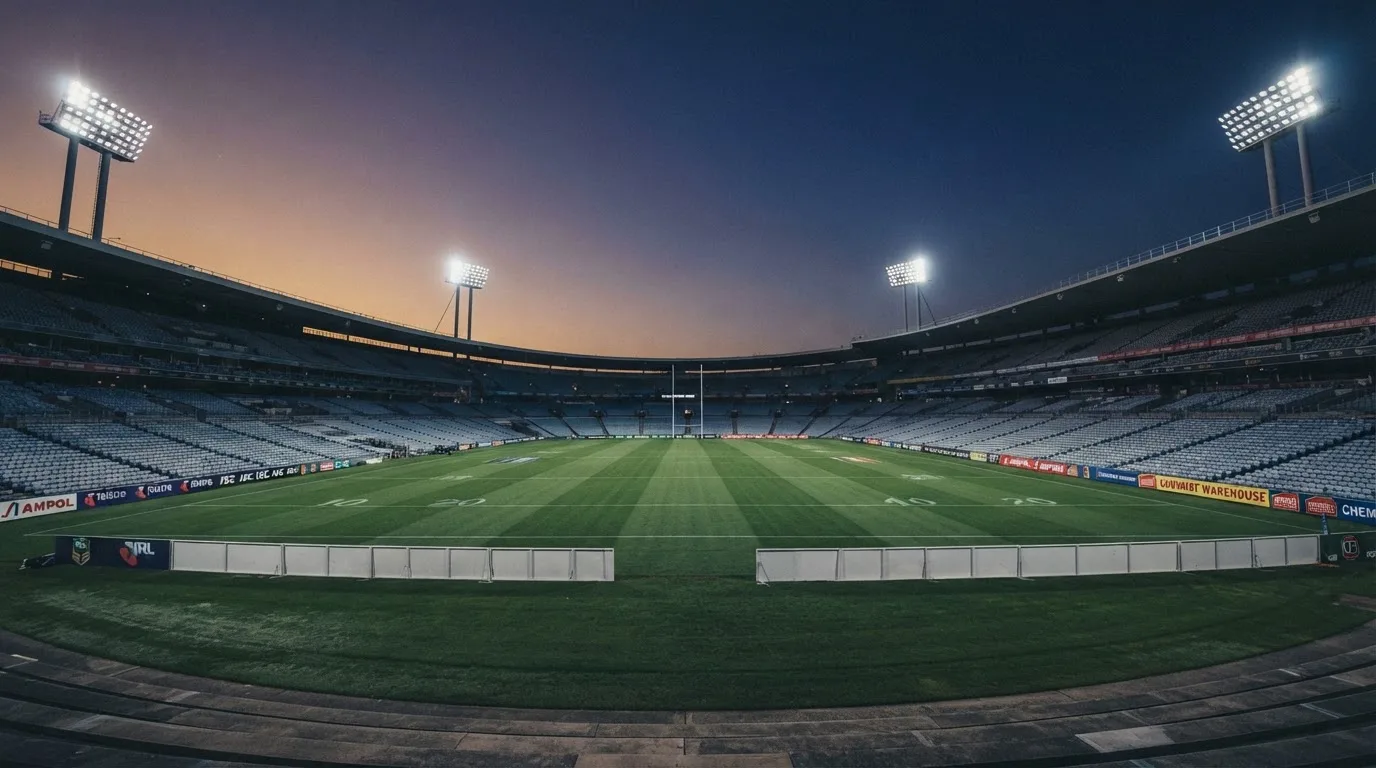
The sport’s scoring shape — clusters of four and six rather than single goals — makes it an easier sport to handicap than football. A lead is rarely safe in the same way a one-goal lead in football is rarely safe; a two-try lead is closer to a football three-goal lead than to a one-goal lead.
What a rugby league margin looks like in numbers
A two-way market priced at 1.90 and 1.90 has a payout share of 1 ÷ (1 ÷ 1.90 + 1 ÷ 1.90) = 0.95, and a margin of 1 − 0.95 = 0.05, or 5%. Three-way markets — Match Betting on a Super League fixture where a draw is possible — carry a higher margin, between 6% and 8% on a well-priced fixture and higher during the early rounds of the season. Rugby league’s three-way shape is the single biggest reason its margins differ from a typical football match: a three-way market always pays the overround more than a two-way one in any sport.
The bettor pays the margin on every unit staked. The bookmaker pays out the payout share on every unit won. The difference is the bookmaker’s expected return on the market — and the bettor’s expected cost of playing it.
Where the pricing lives
A serious rugby league punter keeps at least two accounts open. A Betfair Exchange or Smarkets account is the pricing reference; a major bookmaker — Bet365, Betfred, Ladbrokes — is the staking account; a smaller bookmaker is the welcome-offer rotation account. The reason is simple: bookmakers’ prices move together, but they do not move identically, and a 0.05 difference on a 1.91 shot is worth more over a season than the headline saving on a welcome offer.
Legality, Regulation and What a Gambling Commission Licence Buys
Great Britain’s commercial betting market runs under a single regime. The Gambling Commission, a non-departmental public body sponsored by the Department for Culture, Media and Sport, licenses operators under the Gambling Act 2005. The Act covers Great Britain — England, Scotland and Wales; Northern Ireland is outside the Act. Since the Gambling (Licensing and Advertising) Act 2014, an operator whose remote facilities are used in Great Britain needs a Commission licence wherever it is based, and a Curaçao, Maltese or Gibraltar licence is not a substitute.
What the licence covers
The Commission issues a small set of licence categories for remote betting. The relevant ones for rugby league punters are remote general betting standard (real events), remote general betting limited, remote pool betting, and remote betting intermediary for exchanges. The Commission’s public register lists every operator; the register is the whole test of who holds a licence. The minimum age is 18, and licensed operators verify name, address and date of birth before a customer can deposit or gamble, including with a free bet or bonus — so anonymous play is not on the table at a GB-licensed site.
Player protection under the licence
Every GB-licensed online operator takes part in GAMSTOP, the national multi-operator self-exclusion scheme, and has done so as a licence condition since 31 March 2020. Periods are six months, one year, five years, or five years with auto-renewal; after the minimum period the exclusion stays in place for a further seven years unless the customer asks GAMSTOP to remove it. GAMSTOP covers online sites and apps; betting shops use a separate self-exclusion service.
A financial vulnerability check (LCCP condition 3.4.4, in force since 30 August 2024) applies to licensed remote betting when a customer’s deposits minus withdrawals exceed £150 in a rolling 30 days (since 28 February 2025): it is a public-record check (for example bankruptcy or county court judgments), not an income check and not a credit reference check. Financial risk assessments — the “affordability checks” of the press — have been announced in a staged plan (Commission article of 7 July 2026) with no start date.
Deposit limits under RTS 12 require operators to offer a gross deposit limit on a fixed time frame; the first changes have applied since 31 October 2025, a second phase was postponed to 30 September 2026, and whether it is in force is not established. There is no state-set deposit or loss ceiling for betting: limits are the customer’s choice.
Payments, advertising and tax
Credit cards are banned for gambling in Great Britain (since 14 April 2020, LCCP condition 6.1.2), including credit-card-funded payments through an e-wallet; debit cards and bank-based payments are not covered by that ban. Identity verification before the first deposit means no anonymous play at a licensed site, and source-of-funds questions at higher spend are normal under the money-laundering rules.
Marketing runs through the ASA under the CAP Code (non-broadcast) and BCAP Code (broadcast). CAP Code section 16 requires marketing to be socially responsible, not of strong appeal to under-18s, and no one who is or seems to be under 25 may be featured gambling or play a significant role. Promotion rules in force since 19 January 2026 cap wagering requirements on bonuses at 10x and ban mixed-product promotions. The Premier League clubs’ withdrawal of gambling sponsorship from the front of matchday shirts (from 2026/27; sleeves and hoardings remain) is voluntary, not law. Operators are responsible for marketing by their affiliates.
The player pays no tax on betting winnings in Great Britain — general information, not tax advice; a professional gambler should ask HMRC or an adviser. General Betting Duty is the operator’s tax on gross profits, currently 15%; from 1 April 2027 a new remote betting rate of 25% applies within it, while remote bets on UK horse racing, bets on self-service betting terminals, pool betting and in-person betting stay at 15%. Until 1 April 2027 the remote rate stays at 15%. The Commission’s statutory levy is a separate charge, not a tax.
Offshore and the cost of an unlicensed account
A GB licence is compulsory at the point of consumption. Providing gambling facilities in Great Britain without the licence the Act requires is an offence under section 33 of the Gambling Act 2005 — aimed at the operator. No offence aimed at a customer who merely bets on an unlicensed site was found, and the honest framing for a customer is the loss of protection rather than a criminal offence: no GAMSTOP coverage, no Commission complaints route, no approved dispute-resolution body, no British consumer redress if funds are withheld, and not bound by the 10x bonus cap or the £150 vulnerability check. Enforcement is disruption — cease-and-desist notices, search-engine referrals, work with registrars, hosts and payment providers — rather than ISP blocking.
Safer Gambling, Limits and the Tools Every Licensed Site Carries
A licensed bookmaker offers a set of safer-gambling tools as a condition of its licence. Every brand on the panel — and every other GB-licensed operator — carries the same minimum menu; what differs is how visible and how useful the tools are in practice.
The minimum tools: deposit limits, timeouts and self-exclusion
The minimum menu starts with deposit limits, which operators must offer on a fixed time frame under RTS 12; the first phase of the technical standard has applied since 31 October 2025, and a second phase has been postponed to 30 September 2026. The customer sets the limit; the operator enforces it. Timeouts let the customer close the account for a shorter window — twenty-four hours, one week, one month — and reopen it at the end of the period. Self-exclusion sends the customer’s details to GAMSTOP, where they apply across every licensed operator. The minimum period is six months; a five-year exclusion with auto-renewal goes deeper and lasts longer if the customer does not actively ask GAMSTOP to remove it.
Reality checks and session timers
Most licensed sites show reality-check pop-ups at intervals the operator chooses: a reminder that the customer has been logged in for ninety minutes, two hours, four hours. The interval, the language and the option to take a break at the reminder are all within the operator’s product design.
The financial vulnerability check
A vulnerability check at £150 of net deposits in a rolling 30 days is a public-record check — bankruptcy, county court judgments, similar markers — not an income check and not a credit reference check. A customer whose deposits stay below the threshold does not trigger one; a customer whose deposits cross it does, and a customer whose deposits cross it heavily triggers a fuller source-of-funds request under the money-laundering rules.
Help outside the operator
GamCare runs the National Gambling Helpline. GambleAware funds treatment and prevention. NHS gambling clinics run a small number of in-person services across England. Gamblers Anonymous runs mutual-help meetings. Each of these is reachable independent of the bookmaker.
Frequently Asked Questions
How do I bet on rugby league?
Pick a licensed GB bookmaker from the panel above, complete the identity verification at sign-up (the operator must do this before you can deposit), deposit using a debit card or bank transfer, open the rugby league tab and select a market — Match Betting, Handicap, Anytime Tryscorer or one of the deeper options. Place your stake; confirm the bet slip. Winnings are paid back to the same payment method you deposited with, and withdrawals above a small floor usually take less than twenty-four hours at a major bookmaker.
How can I check whether a bookmaker holds a Gambling Commission licence?
The Commission’s public register lists every operator against business name, trading name, domain and account number. Searching the brand’s own name brings up the licence entry. If the brand is not on the register for a remote general betting standard (real events) or remote betting intermediary licence, it is not licensed to take bets from customers in Great Britain.
How is the return on a bet worked out from the stake and the odds?
Return equals stake × odds. Net profit on a winning bet equals stake × (odds − 1). A £10 stake at 2.50 returns £25; the £15 above the stake is profit. For an accumulator, the legs’ odds multiply: a £10 stake on a four-fold at 2.00, 2.50, 3.00 and 4.00 returns 10 × 2.00 × 2.50 × 3.00 × 4.00 = £600.
What is the bookmaker’s margin and how can it be seen in the odds?
The margin is the share of every unit staked that the bookmaker expects to keep. It is visible in the odds as the difference between the implied probability sum and 100%. A two-way market priced at 1.90 / 1.90 implies 1 ÷ 1.90 + 1 ÷ 1.90 = 1.053, or a margin of about 5%. The actual margin on a market is the underround above 100% across all outcomes of one market.
How do fractional odds such as 5/1 convert to decimal odds such as 6.00?
The conversion is decimal = a ÷ b + 1. So 5/1 = 5 ÷ 1 + 1 = 6.00; 11/4 = 11 ÷ 4 + 1 = 3.75; 9/10 (fractional odds-on) = 9 ÷ 10 + 1 = 1.90. Evens (1/1) is 2.00. The fractional form is the British betting convention; the decimal form is the one a price calculator and most betting apps display.
Which tools for controlling play does a licensed bookmaker have to offer?
The minimum menu is deposit limits on a fixed time frame, timeouts from twenty-four hours to a month, GAMSTOP self-exclusion from six months onwards with a five-year option, reality checks and the financial vulnerability check at £150 of net deposits in a rolling 30 days. A licensed operator must offer all of these; a customer who cannot find them on the site should ask customer services before staking.
Rugby, cricket & Gaelic – signupbetsguide.com
Content created by the «signupbetsguide.com» team
