
Where snooker betting actually costs you — UK bookmakers, markets and the maths behind them
 Available in US
Snooker is a quiet sport in the betting market until it isn’t. A World Championship final, a Masters run from a young wildcard, an unexpected 6-0 session in a best-of-25 and the betting screens fill up. What stays constant is the structure of the prices and the conditions around them: a bookmaker’s margin baked into every market, a bonus that converts into turnover before it converts into money, a settlement rule that decides whether your bet stands when a player withdraws. This page looks at that structure, end to end, for bettors in Great Britain.

Data current as of 30 October 2026 and checked against the Gambling Commission’s public register.
Crypto snooker betting: what an “anonymous” account actually means
A handful of offshore sites tell snooker bettors they can deposit in Bitcoin or Ethereum, settle in the same coin, and skip the name-and-address step that a UK bookmaker has to run before the first bet. The pitch is privacy; the trade is regulatory protection. The licence the operator holds — typically Curaçao or Anjouan — does not require the source-of-funds or age checks a Gambling Commission licence does, and it does not bind the operator to any British bonus cap, deposit-limit regime or dispute-resolution route. A deposit in crypto settles fast, but a complaint that is not resolved by the site’s support desk has no formal UK backstop.
The pitch also reaches further than the technology. A crypto deposit is pseudonymous on the ledger, not anonymous at the cashier: the exchange the coin was bought from collects the same identity the bank would have collected, and exchanges report to their own authorities. The site you fund records wallet addresses and IP addresses. “Anonymous betting” is a marketing line that stops where the deposit leaves a traceable chain.
For a UK bettor the practical consequences land in three places. There is no GAMSTOP coverage if the bettor asks to be excluded — GAMSTOP applies to GB-licensed sites only. There is no Commission route if a withdrawal is delayed or refused beyond the operator’s own terms; courts remain available, but they are a private dispute, not a regulator’s intervention. And the operator is not bound by the 10x wagering cap on bonuses in force from 19 January 2026, the credit-card ban, the £150 financial vulnerability check, or any deposit-limit framework. A snooker bettor who values the protection those rules offer — affordability screening, complaints to a regulator, dispute resolution through an ADR — finds none of it at a crypto-only site.
The case for using one is real but narrow. A bettor outside Great Britain, or one placing a single small bet who has weighed the loss of recourse and accepted it, can transact without the verification delay every GB site runs. For the typical UK snooker bettor the offer is privacy in exchange for every consumer safety the licensed market has spent a decade building.
Snooker bonuses and free bets: reading the offer past the headline
Snooker bonuses are framed as free money. The frame is honest about as often as a bookmaker’s margin is hidden inside a price. Three cost lines travel with every snooker welcome offer and free-bet promo, and they decide whether the offer is a sweetener or a grind.
The first is the wagering requirement. From 19 January 2026 a Gambling Commission rule capped wagering on bonuses at 10x for licensed operators — a £10 bonus at 50x, the kind of headline that used to be routine, is no longer lawful at a GB-licensed site. Even inside that ceiling, “10x the bonus” means £100 of qualifying bets per £10 of bonus, settled at minimum odds that often sit between 1.50 (1/2) and 2.00 (evens); acca insurance, where one leg lets you down and the stake is refunded as a free bet, does not change the requirement, only the size of the losing run before it triggers.
The second is the free bet itself. A free bet whose stake is not returned with a winning selection is the standard form on a UK snooker bookmaker, and the value of such a free bet to the bettor is its face value multiplied by (odds − 1) divided by odds, then multiplied by the payout share of the market it is used on. A £10 free bet at 4.00 (3/1) on a two-way market with a 5% margin converts to roughly £10 × 3 ÷ 4 × 0.95, or about £7.13 of expected value — not £10, and not the £40 the ticket would print at settlement if it won. A free bet whose stake is paid back with a win is a different offer and rarer.
The third is the market the offer is spent on. A bonus cleared at minimum odds 1.50 on a snooker match-winner market with a 9% margin costs roughly £100 × 0.09, or £9, in expected loss — close to the bonus’s face value. The same bonus cleared at minimum odds 2.00 on a tighter market with a 5% margin costs about £5, well inside the bonus. The same offer can be a fair gift or a quiet charge depending on where it is cleared. A promotion that bundles a snooker free bet with free spins on slots is a different category under the rules of 19 January 2026: a mixed-product promo tying betting to casino play is no longer permitted at GB-licensed sites.
The marketing word that travels with all of these is “free”. Read it as “comes with a wagering multiple, a minimum price, a deadline and a market”. None of those are punitive by design, but each one shifts the cost of the offer from the bookmaker to the bettor; the arithmetic works the same on offer after offer. A £500 accumulator insurance refund on snooker world championship free bets still requires the qualifying bets to be placed and lost before the refund pays out.
In-play snooker betting and cash out: how live prices are built
In-play snooker is a slow-burn sport played on a fast clock. Frames run twenty minutes or longer, sessions stretch across hours, and between the balls potting the market is frozen — literally, on most licensed bookmakers, who suspend frame-winner and next-break prices between shots and reissue them once a red is off the table or a safety exchange has settled. That pause is not the absence of a market; it is the market’s own honesty about what it knows.
The live prices track what the snooker literature calls “momentum”: a player two frames up at 4-1 with the table running their way is shorter than the same scoreline after they’ve missed three pots in a row, even though the scoreline has not changed. Live markets do not eliminate the margin — a 5% margin at the off stays roughly a 5% margin at the interval — but they re-weight outcomes fast enough that a punt-in-the-pub point of view is no match for the bookmaker’s model.
Cash out rides on top of in-play. A cash-out button appears when the bookmaker’s current price is better than the price at which the bet was struck, and the offered cash-out value is the current price times the stake, less the bookmaker’s own haircut. Two snooker-specific points are worth holding onto. First, cash out is not a guarantee: the bookmaker can suspend it mid-frame, on a re-spot, or when a critical ball is on its spot, and the bettor’s only option at that moment is to wait or let the bet ride. Second, when cash out is suspended, the offer does not vanish — it returns when the frame state is unambiguous again, and a bettor who took the early cash out has locked in a smaller return than the same bet left running would have produced.
For snooker specifically, the live markets on most GB-licensed sites are thinner than for football or tennis: frame winner, session winner, next century, and a handful of handicap lines on outright tournament markets. Match-aggregate lines (total frames, total centuries) are rarer in-play than pre-match. Where the in-play screen is wide, the margin is generally tighter — fewer customers, more competition on price. Where the screen is narrow (one outright tournament market, no player props) the margin widens and the cash-out range is loose.
Snooker betting predictions and strategy: what “tips” can and cannot do
Tipping sites and model-builders publish snooker picks the morning of every ranking event. The picks tell a bettor who the tipster thinks wins — they do not tell a bettor anything about the price. A 4.00 (3/1) tip on a player whose true winning chance is one in four is a fair price at the margin; the same tip at 2.50 (6/4) is a loss whatever the outcome. Strategy work that ignores the price of the bet is decoration.
What the data does support, and what survives a hard look, is narrower. Form over the last six to twelve months correlates with results more reliably than head-to-head records, which in snooker are heavily dependent on venue and frame length — a player two-from-ten in head-to-heads may dominate the same opponent across the season at neutral frames. Tournament schedule matters: late-season events ahead of the World Championship have historically produced upsets at the cost of top seeds running out of the season. Frame length and best-of format matter too: best-of-25 sessions favour the deeper cue, best-of-7 short formats over-reward hot hands.
The honest reading of “snooker betting tips” is that they cluster general information — form, recent results, head-to-heads, schedule — and the price of the bet is the variable the tip rarely carries. A bettor who treats form tables as one input among several and refuses to back a tip at a price that does not match the chance has a structural edge over one who follows tips into whatever the screen offers.
The other lesson snooker teaches is the cost of in-running decisions. A pre-match price on a World Championship quarter-final is set the morning of the match with full information. An in-running price on the same match, after four frames have been played, is set against an unsettled table state with two-thirds of the match still to play; the bookmaker’s edge on the in-running price is wider, and the bettor’s information edge is narrower. Pre-match, model-driven betting beats impulse adjustments in-play more often than not.
Snooker bet types, odds and how they settle
Snooker markets are unusual in two ways. First, the most popular market, the match-winner, is a two-way market with a one-frame shot-clock; most snooker is best-of-7, best-of-9 or best-of-11 in ranking events, escalating to best-of-25 at the World Championship final. Two-way markets settle cleanly: the player who wins the match wins the bet, dead heats at the half-frame are vanishingly rare, and there is no draw. Second, the outright market dominates turnover: a single tournament winner bet at the start of the World Championship, the UK Championship, the Masters or the Champion of Champions captures a bettor’s view of three weeks of play for one stake.
Frame-by-frame betting works the same way as match-winner: settle on the result of one frame, dead heat rules are rare, and an unfinished frame due to a re-spot or a session halt voids the bet for that frame (most licensed operators void frame-specific markets when the frame does not complete). Break betting — a player to make a 50, a 75, a century, a maximum — settles on the official scorecard; a 147 is its own market where it is offered.
Each-way betting, common in horse racing, applies to outright tournament markets on most licensed snooker sites: half the stake at the win price, half at a place price the operator sets, usually a quarter of the field at one-third of the win odds. An each-way bet on a 33/1 outsider is two bets of equal stake, one of which pays on the win, the other on the place; the stake doubles. A non-runner voids the bet and refunds the relevant portion of the stake; an in-tournament withdrawal usually voids outright bets placed before the event started.
Handicaps and totals — frame handicaps, session winner handicaps, total frames — work like the equivalent football markets: the operator sets a line, the bettor buys a side, and the result is decided on the official score after the relevant scope ends. Margin on these lines is generally wider than on the match-winner two-way market because the trade is thinner, and a bettor who compares markets on price is comparing across liquidity, not across products.
Settlement rules matter more than the markets themselves in some respects. A match that does not start within a window (most operators: 24 or 48 hours of the scheduled start) voids outright bets and frame-by-frame bets. A match reduced in frames from best-of-25 to best-of-19 mid-tournament voids outright markets unless the operator rules otherwise, and refunds stakes for in-play bets. A player who concedes mid-match voids frame markets for the frame they conceded and settles match-winner on the official result.
Snooker tournaments and the betting calendar
The professional snooker calendar runs almost year-round, but four tournaments carry the bulk of outright betting: the World Snooker Championship at the Crucible Theatre in Sheffield, the UK Championship at York, the Masters at Alexandra Palace in London, and the Champion of Champions. Each is a multi-session, multi-day event with best-of frames that escalate into the weekend. The World Championship is the longest and the most heavily priced: it has been held at the Crucible since 1977, ranges from best of 19 in the first round to best of 35 in the final, and runs from mid-April into early May.
The 2026 World Snooker Championship ran from 18 April to 4 May 2026 at the Crucible Theatre, with Wu Yize beating Shaun Murphy 18-17 in the final, taking the top prize of £500,000 from a £2,395,000 total prize fund. That event sits at the centre of any bookmaker’s snooker outright market for the year: futures settle then, season-end reviews reference it, and form tables reset against it.
The other side of the calendar is made up of ranking events that feed the season list — home nations events at York, Belfast, Cardiff and Edinburgh, the World Open at Yushan, the English Open, the Scottish Open — and invitational events (the Masters, the Champion of Champions) whose fields are the top of the season standings. Match formats cluster around best-of-7 in the first round of ranking events, best-of-9 in later rounds, best-of-11 in semi-finals, best-of-19 at the World Championship first round, best of 25 in the second round and quarters, and best of 33 and 35 in the semis and final respectively.
Outright markets carry a margin wider than the match-winner market, often 30-40% across the field, because each player carries a long price and the bookmaker’s overround is spread across 64, 128 or more runners. Match-winner margins on a high-profile fixture sit closer to 5-9% over the two outcomes, handi-cap and session markets sit higher, frame-by-frame markets sit in the same band. The widest margin on a snooker book is the player-prop market — “player A to make a 147”, “player B to win a frame in one visit” — because the trade is thinner and the bookmaker’s edge larger.
The holding bodies matter for the rules under which the matches are played. The World Professional Billiards and Snooker Association (WPBSA) governs professional snooker and owns the official rules; the International Billiards and Snooker Federation (IBSF) governs amateur competition. Most GB-licensed bookmakers offer both professional events and IBSF-ranked amateur events, but the trade and the margin are concentrated at the professional end, and outright markets on amateur ranking events are frequent small-stake offers rather than the headline titles.
Ranking the best snooker betting sites in the UK
A “best” snooker betting site is a function of three questions, none of them answered by a single number. The first is whether the bookmaker offers the snooker markets you actually bet on: outright tournament winner, match winner, frame winner, session winner, total frames, century and 147 markets. The second is what those markets pay after the bookmaker’s margin. The third is what the operator does to the price between the off and settlement — best odds guaranteed on the day of the event, cash out during the session, price boosts that hold across a multi-frame market.
The ranking below is a comparison of ten GB-licensed bookmakers against those questions, with the Gambling Commission licence number on each so the reader can verify the licence directly with the Commission’s public register. The comparison is not a recommendation; a brand’s position is not a verdict, and any reader who disagrees on a price can place the bet somewhere else. The price a reader sees is the price that operator is showing; nothing below is a guarantee.
| Brand | Gambling Commission remote licence number and licence holder | Snooker offer and price terms |
|---|---|---|
| DAZN Bet | 048756-R-327274-019 (Commission account 48756) — DZBT Limited | Minimum deposit £5 by debit card, Apple Pay, Paysafecard, Trustly and Skrill; £20 by PayPal; no processing fees |
| Swifty Sports | 058957-R-334734-006 (Commission account 58957) — Swifty Global (UK) Ltd | Best Odds Guaranteed, daily price boosts, live streaming, in-play betting; Bet Builder listed as coming soon |
| Ladbrokes | 054743-R-330863-014 (Commission account 54743) — LC International Limited | Sports betting app rated 4.66 from 101,255 GB App Store ratings |
| QuinnBet | 061011-R-335683-004 (Commission account 61011) — QuinnBet (Gibraltar) Limited | Best Odds Guaranteed on UK and Irish horse racing from 10:00am, singles, multiples and system bets; benefit capped at £150 per customer per race |
| DragonBet | 064908-R-339041-003 (Commission account 64908) — DragonBet Ltd | Markets including Welsh football and rugby, racing, American football, in-play and bet builder |
| Copybet | 053774-R-330743-010 (Commission account 53774) — Copybet UK Limited | Best Odds Guaranteed all day every day on UK and Irish racing; pays first past the post on horse racing even on later disqualification |
| Bet600 | 044731-R-323941-016 (Commission account 44731) — Tyche Tech Limited | Best Odds Guaranteed on horse racing: starting price overrides the early or show price taken |
| Sporting Index | 027343-R-308898-011 (Commission account 27343) — Sporting Index Limited | Switch between fixed odds and spread betting, in-play betting, Bet Builder for football, auto cash-out, Multi-Markets |
| William Hill | 039225-R-319373-015 (Commission account 39225) — WHG (International) Limited | Best Odds Guaranteed on UK and Irish horse racing from 8am on race day, singles and multiples; no ante-post, tote or pari-mutuel |
| LiveScore Bet | 056859-R-332720-005 (Commission account 56859) — LiveScore Betting and Gaming (Gibraltar) Limited | Bet Builder up to 10 selections, match result, both teams to score, corners, total goals, player scoring, card markets |
DAZN Bet
DAZN Bet is the sportsbook of the streaming operation, run by DZBT Limited under a GB remote licence. The starting point is the deposit menu — £5 minimums across debit card, Apple Pay, Paysafecard, Trustly and Skrill, £20 by PayPal — and the absence of any processing fee the reader has to budget for. Sports coverage is broad; snooker is offered but the in-play depth varies session to session. If you already use the DAZN platform, the sportsbook offers a convenient, integrated experience. A dedicated snooker bettor, however, might prefer the market depth found at longer-established operators.
Swifty Sports
Swifty Sports is a newer British app whose snooker screens run Best Odds Guaranteed on selected markets, daily price boosts, live streaming and in-play betting — a feature set that competes directly with the long-established names. A Bet Builder is listed as coming soon, so the frame-by-frame bet-builder experience is not yet on the app. Worth it for the snooker bettor who values live streams and price boosts over the more rounded app an older operator offers, provided the bettor accepts that some features are still in build.
Ladbrokes
Ladbrokes runs under LC International Limited, the same Entain plc subsidiary that runs Coral and a stable of other UK-facing sportsbooks — a useful fact when the reader sees similar terms across those brands. The mobile app is one of the most-rated on the GB App Store, with 101,255 ratings averaged out at 4.66, a level of trust earned over years of trading. Snooker coverage is broad: outright tournament winner, match winner, frame markets, session markets, specials. Ladbrokes stands as a strong option for those seeking depth in long-shot outright markets within an all-in-one app that covers football, horse racing, in-play and casino. Those who prioritize cutting-edge live snooker features might find the interface less modern by comparison.
QuinnBet
QuinnBet’s Best Odds Guaranteed is well-defined: from 10:00am daily, singles, multiples and system bets on UK and Irish horse racing, with the benefit capped at £150 per customer per race. That cap is a real cost to a high-staking racing book — a customer at the cap has the offer reduced to a single-race saving regardless of how many horses they back. The snooker offering sits on top of that racing core. Worth it for the recreational racing and snooker bettor at modest stakes; the cap disqualifies it for a high-staking racing customer.
DragonBet
DragonBet is the Welsh-focused bookmaker whose app is published by DragonBet Ltd. Markets include Welsh football and rugby — a niche the larger operators pay lip service to — alongside racing, American football, in-play and bet builder. The snooker offering is a side of the racing and football core, not the centrepiece, and a Welsh or a Welsh-football-focused bettor is the natural customer. Worth it for that customer; less so for a snooker-only bettor.
Copybet
Copybet’s headline is Best Odds Guaranteed all day, every day on all UK and Irish racing — and a rule that pays first past the post on horse racing even when the winner is later disqualified, sparing the bettor some of the post-result sting. The sportsbook is wide rather than snooker-specific. Worth it for a racing-led reader; the snooker offering is not its reason for being.
Bet600
Bet600 is a smaller brand whose Best Odds Guaranteed rule is built around horse racing: if the starting price is bigger than the early or show price taken, the bet is paid at the SP. The starting-price override is the rule most other “BOG” sites run, with the same effect. The sportsbook covers the main UK sports plus a snooker selection. Worth it for a reader who likes the brand’s interface and cares less about snooker depth than about a clean racing experience.
Sporting Index
Sporting Index runs both fixed-odds betting and spread betting, which is where it differs from every other brand in this set. A spread bet on snooker works differently from a fixed-odds match bet: a customer’s stake is the size of the bet per unit, the settle depends on how right they are on a stated spread, and a more right outcome pays more linearly without a fixed ceiling. The same FCA-style risk that runs through financial spread betting applies — losses can exceed the deposit on the spread side, even on snooker — and the firm’s Gambling Commission licence covers the fixed-odds side. Worth it for the reader who already understands spread betting and wants to use it on a snooker session; not for a reader who only wants two-way fixed-odds match betting.
William Hill
William Hill is the longest-trading name on the comparison, with the snooker markets you’d expect — outright, match winner, frame markets — and the racing infrastructure of a long-established British bookmaker. The Best Odds Guaranteed rule is the standard 8am-on-race-day model. Worth it for the reader who values an old name, a wide sportsbook and a brand whose mobile offering is broadly reliable; less so for a reader whose snooker betting is heavy in-play, where newer entrants have built faster streams.
LiveScore Bet
LiveScore Bet’s Bet Builder covers up to 10 selections across match result, both teams to score, corners, total goals, player scoring and cards — most of those lines are football-shaped, and the snooker betting mirrors that structure for frame and session markets. The brand sits on the LiveScore scores feed, so a reader using the app has the live snooker scores alongside the betting. Worth it for a reader who wants scores and bets in one app and frame-level flexibility; less so for a reader whose snooker betting is the tournament outright market.
What online snooker betting actually is
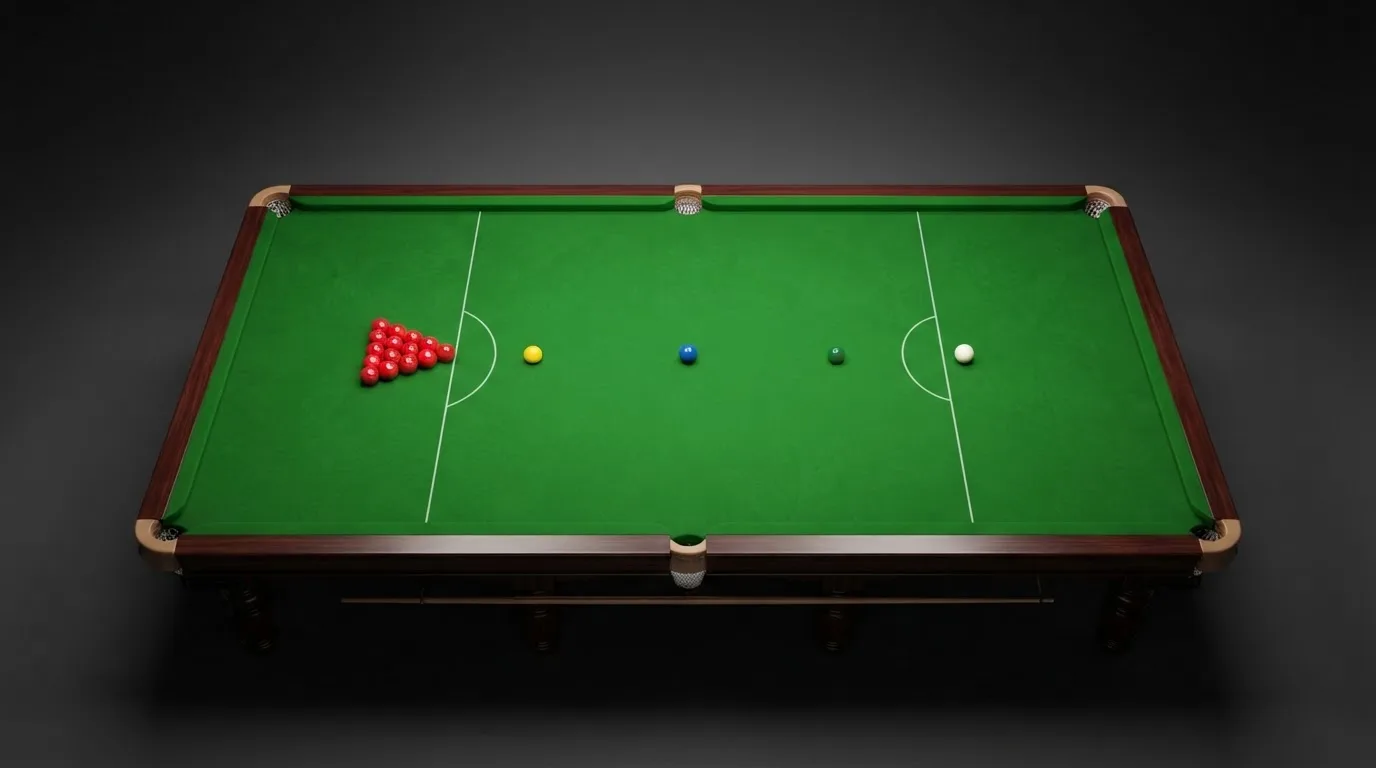
Snooker is a cue sport played on a 12 ft by 6 ft table with six pockets, a white cue ball, 15 reds and six colours worth yellow 2, green 3, brown 4, blue 5, pink 6 and black 7. A maximum break is 147, made by potting all 15 reds with blacks and then all six colours in order. Most professional matches are best of 7, 9 or 11 frames; ranking events escalate to best-of-25 by the quarters, best-of-33 in the semi and best-of-35 in the World Championship final.
Online snooker betting is the wagering on those matches through a remote bookmaker: pre-match outright tournament winner, match winner, frame winner, session winner, total frames, century markets, 147 markets, and handicaps. The structure of the prices and the cost of the offers is what a page like this one writes about, because the sport side of the offering is the same on every licensed site, and the differences are in the markets, the prices and the bonuses.
The phrase “snooker betting apps” travels through search as the practical question: which app holds the snooker screens a reader wants to use, on which the cash out behaves, on which the best odds guaranteed stands up on the day of the event. The reviewed app set above is one form of that answer; the size of the live snooker screens on each app is the variable that decides day-to-day comfort.
The legal frame for online snooker betting in the UK
There is no statutory list of permitted sports or markets in Great Britain. The Gambling Act 2005 licenses bookmakers; the Commission issues remote licences that authorise categories of betting (remote general betting standard for real events is the typical one for a sportsbook, with separate categories for virtual events and pool betting); each operator decides which sports and markets to offer within the licence it holds. Snooker, football, horse racing, esports, politics, TV shows and novelty markets are all available under the general betting licence, and the absence of a prohibition is what makes them legal.
Since the Gambling (Licensing and Advertising) Act 2014 a remote bookmaker whose facilities are used in Great Britain needs a Gambling Commission licence wherever it is based. The licence is the test, not the company’s trading address: a Gibraltar- or Malta-licensed operator serving UK customers without a Commission licence is offering facilities in Great Britain without the required authorisation, and section 33 of the Gambling Act 2005 sets out the offence. A GB-licensed bookmaker can be based anywhere and run a .com site; a Curaçao-licensed bookmaker offering into Great Britain without the Commission’s authority is offering without one.
The minimum age for any betting on a GB-licensed site is 18, and identity verification is now part of the first deposit, not the first withdrawal. Name, address and date of birth are checked before a customer can deposit or gamble — including with a free bet or bonus. “Anonymous betting” at a GB site is not a product feature.
The single test of whether a brand holds a GB licence is the Commission’s public register. The register can be searched by business name, trading name, account number or web address, and it is updated as licences are granted, varied and revoked. Searching the register for the brand’s name — or, more reliably, for the company name behind the brand, which is sometimes different — gives a definitive answer. Quoting a licence number does not replace the check; the check is the test.
A related test on the same page is whether the operation is licensed to offer spread betting on the financial side. Financial spread betting in the UK is regulated by the Financial Conduct Authority, not the Gambling Commission, and an operator offering both fixed-odds sports betting and financial spread betting holds two licences. For a snooker bettor the practical difference is the FCA disclosure regime around the spread side — including a warning that losses can exceed deposits on a spread position.
Spread betting on snooker, where it is offered, is a financial spread position, not a fixed-odds match outcome. The same warning that losses can exceed the deposit applies whether the underlying asset is a city index or a snooker session. Sporting Index, the only brand in the comparison set that offers spread betting on sports, holds both an FCA registration for that side and a Commission licence for fixed-odds, and the FCA’s warning sits on the spread-side of the offering, not the fixed-odds side.
Where a GB licence stops and where the offshore market begins
The clean framing is two pictures, side by side. A GB-licensed operator runs age and identity verification before the first bet, takes part in GAMSTOP, caps bonus wagering at 10x, applies the £150 financial vulnerability check from 28 February 2025 for customers whose deposits net of withdrawals exceed that level in a rolling 30 days, and offers a deposit-limit framework. A bettor with a complaint has the Commission as a regulator and an ADR as the dispute-resolution body. The bettor also lives with verification friction, withdrawal reviews, source-of-funds questions at higher spend, and the slow end of the deposit process.
An offshore operator (Curaçao, Anjouan, the like) skips the verification step, accepts crypto deposits at speed, and runs bonuses and limits under its own licence terms. A complaint that the operator does not resolve sits in private litigation; no Commission intervention, no GAMSTOP coverage, no ADR. The bettor has speed, ease of deposit, often a bigger bonus, in exchange for every consumer protection the licensed market has built. The bet that is illegal to offer in Great Britain carries no risk to the bettor who places it on a foreign site (no offence aimed at the customer was found in the framework), but the loss of recourse is the trade.
Enforcement is at the operator, not the customer. The Commission has used cease-and-desist notices, search-engine referrals, registrar work and payment-provider pressure; the Commission’s DNS-blocking powers via court order are recent, on a case-by-case basis, not blanket. Banking blockades, where payment processors decline transactions to certain merchant categories, run alongside and are not Commission-led.
The framing worth holding: licensed = checks, limits, GAMSTOP, the 10x bonus cap, complaints to a regulator, but also the verification friction, the withdrawal reviews, the slower deposit. Unlicensed = none of the protections and the same risks every cross-border bettor takes on a site whose regulator sits a thousand miles and a different law away. Neither is “the safe choice” by default; each is a different trade.
Responsible gambling around snooker betting
Snooker is a long-format sport: a best-of-35 final can run nine hours across two sessions, with markets priced on every frame. That structure rewards both kinds of bettor — the long-considered outright bettor and the impulse in-running bettor — and punishes both kinds the same way when the gambling is unmanageable. The GB framework treats both under the same set of safeguards, and a snooker bettor using any of the comparison brands has the same backstops.
GAMSTOP is the national self-exclusion scheme, free to register, with periods of six months, one year, five years, or five years with auto-renewal. After the minimum period the exclusion stays in place for a further seven years unless the customer asks GAMSTOP to remove it. GAMSTOP covers online betting sites and apps; betting shops use a separate service. A bettor who registers is excluded across every GB-licensed site at once. The scheme is mandatory for every GB-licensed online operator; the offshore sites do not participate.
The financial vulnerability check (LCCP condition 3.4.4, in force since 30 August 2024) is a public-record check applied to licensed remote betting when a customer’s deposits minus withdrawals exceed £150 in a rolling 30 days. It looks at publicly available markers — bankruptcy, county court judgments, the equivalent — and is not an income check, not a credit reference check, not an affordability interview. The follow-on “affordability checks” were announced in the Commission’s plan of 7 July 2026 as a staged programme with no start date; treat any operator-advertised affordability interview as the operator’s own policy, not a statutory requirement yet.
Deposit limits remain the customer’s choice on the operator side, with an RTS 12 obligation on operators to offer a gross deposit limit on a fixed time frame. The first changes have applied since 31 October 2025, a second phase was postponed to 30 September 2026. There is no state-set ceiling; the ceiling is whatever the customer puts on themselves.
Outside the operator’s own stack, the help lines sit free and confidential. GamCare runs the National Gambling Helpline; GambleAware funds treatment and education; the NHS runs gambling clinics; Gamblers Anonymous runs peer-support meetings across the country. A bettor whose snooker betting has stopped fitting the budget has the tools in place to stop, and the regulator’s view is that the tools should be used early, before they are needed urgently.
What a snooker bet pays: working out a winning return
A snooker bet pays the stake plus a profit. The arithmetic is the same on every market and every bookmaker, in two lines. A £10 single on a snooker match winner at decimal odds 3.00 (2/1 fractional) returns £30 — the £10 stake and £20 of profit. The decimal odds are the total returned per unit stake, so 3.00 × £10 = £30. A £10 single at 1.50 (1/2) returns £15 — £5 of profit on £10 of stake.
A combination bet multiplies the odds. A £10 double on two legs at 3.00 and 4.00 (a stake of £10 covering both legs, total stake £10) returns the £10 stake plus profit of £10 × (3 × 4 − 1) = £10 × 11 = £110, total return £120. The stake is £10, not £20 — a double costs the unit stake, not the stake per leg. A treble at 3.00, 4.00 and 5.00 on £10 returns the £10 stake plus £10 × (3 × 4 × 5 − 1) = £10 × 59 = £590 of profit, total £600. Every leg has to win; one leg down voids the bet in the standard form.
An each-way bet is two equal bets, doubling the stake. On a 33/1 outright win with one-quarter odds for a place, a £10 each-way bet is £10 on the win at 33/1 and £10 on the place at 33/4 = 9.25 decimal. A win returns £10 × (33 + 1) = £340 on the win leg, plus £10 × (9.25 − 1) = £82.50 on the place leg — the place leg pays even when the win loses, so a place finish alone returns the place leg’s profit without the win leg’s stake. The bettor’s stake on an each-way is genuinely twice the unit stake, not a same-stake double.
A free bet is different. A free bet whose stake is not returned with the win pays only the profit at the bet’s odds. A £10 free bet at 4.00 returns £10 × (4 − 1) = £30 of profit, not £40; the £10 is the operator’s stake, not the bettor’s. A free bet whose stake is paid back with the win is a different and rarer offer, where the return is the £10 stake plus the £30 of profit — that is the “free bet + stake” form, and the value gap to the bettor is the difference.
Reading the margin in a snooker price
The bookmaker’s margin is the share of every unit staked on a market that the bookmaker keeps on average. It is the gap between the price the bettor receives and a “fair” price — one whose implied probabilities sum to exactly 100%. On a two-way match-winner market the gap is the simpler to read.
Take a snooker match between two players priced at 1.90 and 1.90 (9/10 fractional on each side — a near-even contest). The implied probabilities are 1 ÷ 1.90 = 0.5263, or 52.63%, on each side. Added, the bookmaker’s book totals 105.26% — an overround of 5.26% and a margin of 5.0% (a 95% payout share). The fair book, with no margin, would sum to 100%.
The calculation scales with the market. A two-way frame-winner market at 1.85 and 1.85 carries an implied probability of 0.5405 on each side, summing to 108.1% — that market sits at an 8.1% margin. A three-way soccer market (home / draw / away) carries more outcomes and typically a higher overround for a similar balance. A snooker outright market with 64 runners carries an overround that is the sum of all 64 implied probabilities, less the fair 100% — typically 115-130% on a major tournament, which translates to a margin in the 15-25% band, and which is why long-shot outrights at major snooker events are a higher-cost bet than match-winner markets on the same tournament.
The margin of one market is not the margin of another. A snooker match-winner margin of 5% is not a frame-winner margin, not a session-winner margin, not a century margin, and not a margin on football markets run by the same brand. Comparing margins means comparing same-scope markets on the same sport, and the only honest band to publish is for the exact market and snapshot the figure was taken from. A price or a margin stated without a snapshot date is a description, not a quote.
There are three places the margin shows up for a snooker bettor. In the long-run, on a market priced at a 5% margin, the average punter loses 5p on every £1 staked before any bonus cost. In the bettor’s edge calculation, a model’s fair price minus the bookmaker’s price is positive only when the model beats the margin. In the cash-out valuation, the offered cash-out value already includes a bookmaker haircut that sits on top of the underlying margin — cash-out is one of the more expensive ways to settle a winning position.
Worked margin illustration: a 1.90 / 1.90 snooker match
Take a hypothetical snooker match between two roughly even players — a frame-by-frame contest on a best-of-11, both in form, neither carrying an obvious edge. A bookmaker lists the frame winner at 1.90 on each side.
The arithmetic runs in three lines. Each side’s implied probability is 1 ÷ 1.90 = 0.5263, or 52.63%. The two sides together sum to 1.0526, or 105.26%. The bookmaker’s margin, expressed as the overround, is 5.26%; expressed as the payout share, it is 1 ÷ 1.0526 = 0.9500, or 95%.
That margin is the cost on average of every £1 the bettor puts on the frame, before any bonus or cash-out. On a 5% margin market, an expected loss of roughly 5p per £1 is the baseline. The same market at 1.85 / 1.85 carries an 8.1% margin; at 2.00 / 2.00 a 0% margin in theory, the marketing claim of an “evens” line, even though in practice line movement keeps the real line at least 2-3% from break-even.
The 1.90 / 1.90 illustration is a band, not a quote. Real snooker match-winner margins on a major event usually sit between 4% and 8% on the two-way line, depending on the operator and the event; prop markets (century, session total, 147) sit wider; outright futures sit widest of all. The point of the calculation is to show how the prices carry the margin — not to publish a price the operator is not actually showing.
The check is reversible: a snooker bettor who lays a stake at 1.90 and sees a return of £19 on a £10 stake has paid £10 for a chance to receive £9 of profit, with the £10 fully at risk — and the cumulative expectation, on a margin of roughly 5%, is that £10 becomes £9.50 on average, before cash-out and before any free bet gymnastics that might in principle shift the figure.
Conversions between fractional and decimal odds
British snooker betting still speaks in fractional odds on the printed page and the betting shop, even as decimal odds have become the comparison norm and the form on every licensed online site. The conversion is a one-line calculation in either direction, and worth keeping in mind for any price the reader sees in one form and needs in the other.
Decimal to fractional: subtract 1, convert to a fraction. Decimal 6.00 minus 1 is 5; 5 as a fraction is 5/1. Decimal 3.75 minus 1 is 2.75; 2.75 as a fraction is 11/4 (since 11 ÷ 4 = 2.75). Decimal 1.50 minus 1 is 0.50; 0.50 as a fraction is 1/2. Decimal 2.00 minus 1 is 1.00; 1/1 is evens, the line at which stake and profit are equal. Decimal odds shorter than 2.00 are odds-on in the British idiom — 4/6, 1/2, 4/7.
Fractional to decimal: divide, add 1. 5/1 → 5 ÷ 1 + 1 = 6.00. 11/4 → 11 ÷ 4 + 1 = 2.75 + 1 = 3.75. 1/2 → 1 ÷ 2 + 1 = 0.5 + 1 = 1.50. Evens (1/1) → 1 + 1 = 2.00. A fractional price with a non-trivial third column (e.g. 7/2) rounds naturally: 7 ÷ 2 + 1 = 3.5 + 1 = 4.50.
The conversions agree only on round numbers in both forms. Decimal 3.33 is 7/3 if you let the rounding go (since 7/3 + 1 = 3.33 recurring); the more rigorous fraction is 7/3, but most bookmakers round the decimal to 3.33 and call it 7/3 in the fractional column. A reader comparing prices across two sites is comparing decimals and should not rely on the fractional columns matching across them.
For a snooker bettor the practical use is the comparison itself. A match-winner at 4/6 (1.67 decimal) and the same match at 5/7 (1.71) sit close but not equal; the 5/7 line is the longer price, and on a market with a similar margin across both operators, 5/7 is the better bet on average by a small margin per pound staked. The conversion is a small step; the comparison is the use of it.
How to verify a Gambling Commission licence
The Gambling Commission’s public register is a single searchable page on the regulator’s own site, queryable by business name, trading name, web address or account number. A bettor searching for a brand’s licence sees the licence types the company holds (remote general betting standard; remote betting intermediary for an exchange; remote general betting limited for the smaller operator), the licence holder’s legal name (which may differ from the trading name), the status of the licence (active, varied, suspended, revoked), the date the licence was issued, and the operational address.
Three search strategies work, in order of reliability. The first is the brand’s company name — the legal entity behind the trading name. Ladbrokes, for example, runs under LC International Limited; Copybet runs under Copybet UK Limited. The Commission register lists the licence holder, not the trading brand. The second is the account number, which bookmakers usually print on the regulated-disclosure line at the bottom of their home page or in the licence terms; the Commission register accepts it directly. The third is the domain, which is useful when the brand has not published an account number; the register returns the licence holder for a given web address.
What the register does not show is the quality of the bookmaker’s terms, the price of a frame-winner market, or whether a withdrawal is fast. The licence is the test of regulatory standing and dispute resolution; it is not a recommendation to bet.
A licence that is ‘unverified’ or ‘needs checking’ is, on this page, what it says: a licence number that has not been confirmed against the Commission’s register at the search date. The reader should run the same query before staking; the procedure takes seconds, the answer is definitive.
Frequently asked questions about online snooker betting in the UK
How do you actually bet on snooker?
Pick a match from the bookmaker’s snooker section, choose a market (match winner, frame winner, total frames, outright tournament winner, century, 147), tap the price to add the selection to the bet slip, enter the stake, and place the bet. Pre-match markets settle at the match’s completion; in-play markets settle at the relevant frame or session end; outright markets settle when the tournament’s final is decided. The bet’s return is the stake multiplied by the decimal odds, with the stake returned and the rest as profit.
Is snooker betting legal in Great Britain?
Yes, on a Gambling Commission-licensed site. There is no statutory list of permitted sports or markets — snooker sits inside the general betting licence the operator holds. The minimum age is 18 and identity is verified before the first deposit. A bettor on an unlicensed offshore site is placing the bet on an unregulated market; the bet is not unlawful for the bettor (no customer offence was found), but no regulator’s intervention follows if the operator does not pay out.
How do I check whether a bookmaker holds a Gambling Commission licence?
Search the Commission’s public register by trading name, company name, account number or web address. The register returns the licence holder, the licence type (remote general betting standard for a sportsbook), the licence status (active, varied, suspended, revoked) and the issue date. A “yes” result is the test; an unsearchable result, or a licence held by a company the brand has not named, is a reason to ask the operator before staking.
How is the return on a snooker bet worked out from the stake and the odds?
Return = stake × decimal odds, with the stake returned as part of that figure. A £10 single at decimal odds 4.00 returns £40 — £10 stake, £30 profit. A double at 3.00 and 4.00 on a £10 stake returns £10 × 3 × 4 = £120, of which £10 is stake and £110 is profit. A treble at 3.00, 4.00 and 5.00 on £10 returns £10 × 60 = £600. Each leg has to win; one losing leg voids the bet at most licensed bookmakers.
What is a bookmaker’s margin, and where does it sit in the odds?
A bookmaker’s margin is the average share of every £1 staked on a market that the bookmaker keeps. It is the gap between the implied probabilities of the prices listed and 100%. On a two-way snooker match winner at 1.90 and 1.90 the implied probabilities are 52.63% on each side, summing to 105.26% — an overround of 5.26% and a margin of 5.0% (a 95% payout share). Margin widens on long-shot outrights and tighter, more liquid markets run on a smaller overround.
How do I convert fractional odds such as 5/1 to decimal odds such as 6.00?
Fractional to decimal is divide, add 1. 5/1 = 5 ÷ 1 + 1 = 6.00. 11/4 = 11 ÷ 4 + 1 = 3.75. 1/2 = 1 ÷ 2 + 1 = 1.50. Decimal to fractional is subtract 1, write as a fraction. 6.00 = 5, or 5/1. 3.75 = 2.75, or 11/4. 2.00 = 1, or evens in British idiom. Fractional odds shorter than evens (4/6, 1/2) are odds-on; the bet pays less than double the stake.
Tennis, darts & cue sports – signupbetsguide.com
Content created by the «signupbetsguide.com» team
